{"title":"Colloidal Nanoclusters of MgO Coated with Alkali Metal Nitrates/Nitrites for Rapid, High Capacity CO2 Capture at Moderate Temperature","authors":"Takuya Harada, T. Alan Hatton*","doi":"10.1021/acs.chemmater.5b03904","DOIUrl":null,"url":null,"abstract":"<p >Colloidal nanoclusters of metal oxides constitute a promising new class of building blocks for a range of advanced functional materials. Herein, we report on the development of colloidal nanoclusters of MgO for CO<sub>2</sub> capture prepared by a novel nonhydrolytic sol–gel reaction followed by the deposition of alkali metal salts by methanol evaporation-induced surface precipitation. The CO<sub>2</sub> uptake exceeded 11.7 mmol g<sup>–1</sup> (514.8 mg CO<sub>2</sub> per 1 g of adsorbent) in 30 min in the presence of 100% dry CO<sub>2</sub> under ambient pressure (1 bar) at 340 °C and reached 15.7 mmol g<sup>–1</sup> (690.8 mg CO<sub>2</sub> per 1 g of adsorbent) in 4 h. Colloidal nanoclusters possessing multiple inner grain boundaries and rough surfaces allowed for a dramatic increase in active surface area of MgO coated with thin layers of alkali metal salts and enabled the rapid conversion of MgO to MgCO<sub>3</sub> with high conversion ratio. It was also discovered that the CO<sub>2</sub> uptake loading and the regenerability of the sorbents can be enhanced on introduction of nitrite salts to the coating layer through the formation of magnesium nitro or nitrate species, which increased the critical thickness of product layers and mitigated the degradation of nanoclusters over the repeated sorption/desorption cycles.</p>","PeriodicalId":33,"journal":{"name":"Chemistry of Materials","volume":"27 23","pages":"8153–8161"},"PeriodicalIF":7.0000,"publicationDate":"2015-11-09","publicationTypes":"Journal Article","fieldsOfStudy":null,"isOpenAccess":false,"openAccessPdf":"https://sci-hub-pdf.com/10.1021/acs.chemmater.5b03904","citationCount":"84","resultStr":null,"platform":"Semanticscholar","paperid":null,"PeriodicalName":"Chemistry of Materials","FirstCategoryId":"88","ListUrlMain":"https://pubs.acs.org/doi/10.1021/acs.chemmater.5b03904","RegionNum":2,"RegionCategory":"材料科学","ArticlePicture":[],"TitleCN":null,"AbstractTextCN":null,"PMCID":null,"EPubDate":"","PubModel":"","JCR":"Q2","JCRName":"CHEMISTRY, PHYSICAL","Score":null,"Total":0}
引用次数: 84
Abstract
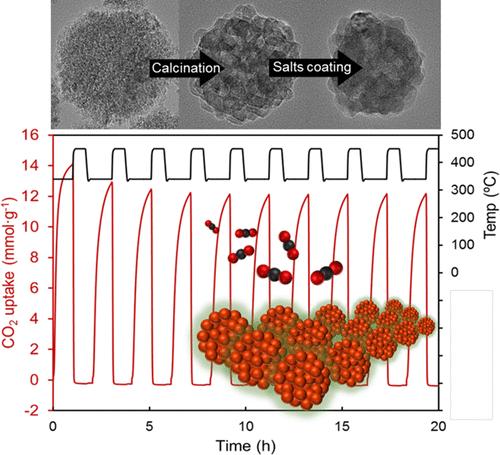
Colloidal nanoclusters of metal oxides constitute a promising new class of building blocks for a range of advanced functional materials. Herein, we report on the development of colloidal nanoclusters of MgO for CO2 capture prepared by a novel nonhydrolytic sol–gel reaction followed by the deposition of alkali metal salts by methanol evaporation-induced surface precipitation. The CO2 uptake exceeded 11.7 mmol g–1 (514.8 mg CO2 per 1 g of adsorbent) in 30 min in the presence of 100% dry CO2 under ambient pressure (1 bar) at 340 °C and reached 15.7 mmol g–1 (690.8 mg CO2 per 1 g of adsorbent) in 4 h. Colloidal nanoclusters possessing multiple inner grain boundaries and rough surfaces allowed for a dramatic increase in active surface area of MgO coated with thin layers of alkali metal salts and enabled the rapid conversion of MgO to MgCO3 with high conversion ratio. It was also discovered that the CO2 uptake loading and the regenerability of the sorbents can be enhanced on introduction of nitrite salts to the coating layer through the formation of magnesium nitro or nitrate species, which increased the critical thickness of product layers and mitigated the degradation of nanoclusters over the repeated sorption/desorption cycles.
期刊介绍:
The journal Chemistry of Materials focuses on publishing original research at the intersection of materials science and chemistry. The studies published in the journal involve chemistry as a prominent component and explore topics such as the design, synthesis, characterization, processing, understanding, and application of functional or potentially functional materials. The journal covers various areas of interest, including inorganic and organic solid-state chemistry, nanomaterials, biomaterials, thin films and polymers, and composite/hybrid materials. The journal particularly seeks papers that highlight the creation or development of innovative materials with novel optical, electrical, magnetic, catalytic, or mechanical properties. It is essential that manuscripts on these topics have a primary focus on the chemistry of materials and represent a significant advancement compared to prior research. Before external reviews are sought, submitted manuscripts undergo a review process by a minimum of two editors to ensure their appropriateness for the journal and the presence of sufficient evidence of a significant advance that will be of broad interest to the materials chemistry community.



 京公网安备 11010802042870号
京ICP备2023020795号-1
京公网安备 11010802042870号
京ICP备2023020795号-1

 分享
分享
 求助内容:
求助内容: 应助结果提醒方式:
 扫码关注我们
