Regulation of ester contents enabled tunable thermal and mechanical properties of poly(ester amide)
Yihuan Liu, Guoqing Zuo, Han Gao, Zhao Wu, Wei Huang, Canliang Ma, Jie Yin, Xin Hu, Ning Zhu, Kai Guo
求助PDF
{"title":"Regulation of ester contents enabled tunable thermal and mechanical properties of poly(ester amide)","authors":"Yihuan Liu, Guoqing Zuo, Han Gao, Zhao Wu, Wei Huang, Canliang Ma, Jie Yin, Xin Hu, Ning Zhu, Kai Guo","doi":"10.1002/pi.6585","DOIUrl":null,"url":null,"abstract":"<p>Poly(<i>ε</i>-caprolactone-<i>co</i>-<i>ε</i>-caprolactam) was synthesized through ring-opening copolymerization of <i>ε</i>-caprolactone (CLO) and <i>ε</i>-caprolactam catalyzed by ethylmagnesium bromide (EtMgBr) or sodium <i>ε</i>-caprolactam. Varied ester contents were achieved from 0 to 100 mol%. EtMgBr enabled the copolymerization with high yield of over 95%. Thermal properties vary with different ester contents. With increasing CLO content, the onset decomposition temperature (273.36 to 240.97 °C) and glass transition temperature (52.1 to −56.3 °C) gradually decreased. The results of melting behavior of resultant poly(ester amide)s through differential scanning calorimetry and theoretical calculation indicated a eutectic temperature of 46.6 °C. The mechanical properties of obtained copolymers were systematically investigated. The enhancement of CLO incorporation led to a decrease in tensile strength (70.99 to 9.88 MPa) and Young's modulus (690.03 to 19.18 MPa). Copolymer with CLO incorporation of 70 mol% exhibited a eutectic temperature of 46.6 °C, and enabled a high elongation at break (658%) and enhanced impact strength (138.5 kJ m<sup>−2</sup>). © 2023 Society of Chemical Industry.</p>","PeriodicalId":20404,"journal":{"name":"Polymer International","volume":"73 3","pages":"223-229"},"PeriodicalIF":3.6000,"publicationDate":"2023-10-26","publicationTypes":"Journal Article","fieldsOfStudy":null,"isOpenAccess":false,"openAccessPdf":"","citationCount":"0","resultStr":null,"platform":"Semanticscholar","paperid":null,"PeriodicalName":"Polymer International","FirstCategoryId":"92","ListUrlMain":"https://scijournals.onlinelibrary.wiley.com/doi/10.1002/pi.6585","RegionNum":4,"RegionCategory":"化学","ArticlePicture":[],"TitleCN":null,"AbstractTextCN":null,"PMCID":null,"EPubDate":"","PubModel":"","JCR":"Q2","JCRName":"POLYMER SCIENCE","Score":null,"Total":0}
引用次数: 0
引用
批量引用
Abstract
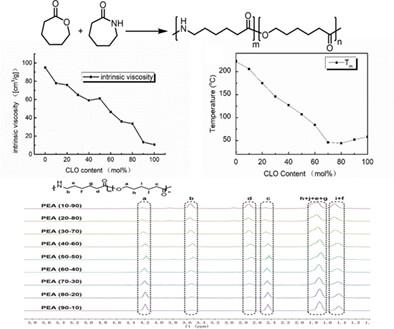
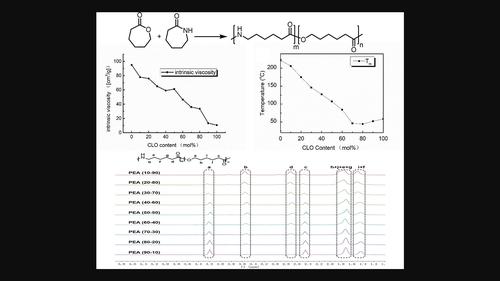
Poly(ε -caprolactone-co -ε -caprolactam) was synthesized through ring-opening copolymerization of ε -caprolactone (CLO) and ε -caprolactam catalyzed by ethylmagnesium bromide (EtMgBr) or sodium ε -caprolactam. Varied ester contents were achieved from 0 to 100 mol%. EtMgBr enabled the copolymerization with high yield of over 95%. Thermal properties vary with different ester contents. With increasing CLO content, the onset decomposition temperature (273.36 to 240.97 °C) and glass transition temperature (52.1 to −56.3 °C) gradually decreased. The results of melting behavior of resultant poly(ester amide)s through differential scanning calorimetry and theoretical calculation indicated a eutectic temperature of 46.6 °C. The mechanical properties of obtained copolymers were systematically investigated. The enhancement of CLO incorporation led to a decrease in tensile strength (70.99 to 9.88 MPa) and Young's modulus (690.03 to 19.18 MPa). Copolymer with CLO incorporation of 70 mol% exhibited a eutectic temperature of 46.6 °C, and enabled a high elongation at break (658%) and enhanced impact strength (138.5 kJ m−2 ). © 2023 Society of Chemical Industry.
调节酯含量,实现聚酯酰胺的可调热性能和机械性能
在溴化乙锭(EtMgBr)或ε-己内酰胺钠催化下,通过ε-己内酰胺(CLO)和ε-己内酰胺的开环共聚合成了聚(ε-己内酰胺-co-ε-己内酰胺)。酯含量从 0 摩尔%到 100 摩尔%不等。EtMgBr 使共聚产率高达 95% 以上。热性能随酯含量的不同而变化。随着 CLO 含量的增加,开始分解温度(273.36 至 240.97 °C)和玻璃化转变温度(52.1 至 -56.3 °C)逐渐降低。通过差示扫描量热法和理论计算得出的聚酯酰胺的熔化行为结果表明,共晶温度为 46.6 ℃。对所获得共聚物的机械性能进行了系统研究。CLO 添加量的增加导致拉伸强度(70.99 至 9.88 兆帕)和杨氏模量(690.03 至 19.18 兆帕)下降。CLO 含量为 70 mol% 的共聚物的共晶温度为 46.6 °C,断裂伸长率高(658%),冲击强度高(138.5 kJ m-2)。© 2023 化学工业协会。
本文章由计算机程序翻译,如有差异,请以英文原文为准。




 京公网安备 11010802042870号
京ICP备2023020795号-1
京公网安备 11010802042870号
京ICP备2023020795号-1

 分享
分享
 求助内容:
求助内容: 应助结果提醒方式:
 扫码关注我们
