{"title":"Is dirt cheap? The economic costs of failing to meet soil health requirements on smallholder farms","authors":"Sydney Gourlay, Talip Kilic","doi":"10.1111/agec.12796","DOIUrl":null,"url":null,"abstract":"<p>Agricultural productivity is hindered in smallholder farming systems due to several factors, including farmers’ inability to meet crop-specific soil requirements. This article focuses on soil suitability for maize production and creates multidimensional soil suitability profiles of smallholder maize plots in Uganda while quantifying forgone production due to cultivation on less-than-suitable land and identifying groups of farmers that are disproportionately impacted. The analysis leverages the unique socioeconomic data from a subnational survey conducted in Eastern Uganda, inclusive of plot-level, objective measures of maize yields and soil attributes. Stochastic frontier models of maize yields are estimated within each soil suitability class to understand differences in returns to inputs, technical efficiency, and potential yield. Farmers cultivating highly suitable soil have the potential to increase their observed yields by as much as 86%, while those at the opposite end of the suitability distribution (i.e., with marginally suitable land) operate closer to the production frontier and can only increase yields by up to 59%, given the current technology set. There is heterogeneity in potential gains across the wealth distribution, with poorer households facing more heavily constrained potential.</p>","PeriodicalId":72134,"journal":{"name":"","volume":"54 6","pages":"793-818"},"PeriodicalIF":0.0,"publicationDate":"2023-10-08","publicationTypes":"Journal Article","fieldsOfStudy":null,"isOpenAccess":false,"openAccessPdf":"https://onlinelibrary.wiley.com/doi/epdf/10.1111/agec.12796","citationCount":"0","resultStr":null,"platform":"Semanticscholar","paperid":null,"PeriodicalName":"","FirstCategoryId":"96","ListUrlMain":"https://onlinelibrary.wiley.com/doi/10.1111/agec.12796","RegionNum":0,"RegionCategory":null,"ArticlePicture":[],"TitleCN":null,"AbstractTextCN":null,"PMCID":null,"EPubDate":"","PubModel":"","JCR":"","JCRName":"","Score":null,"Total":0}
引用次数: 0
Abstract
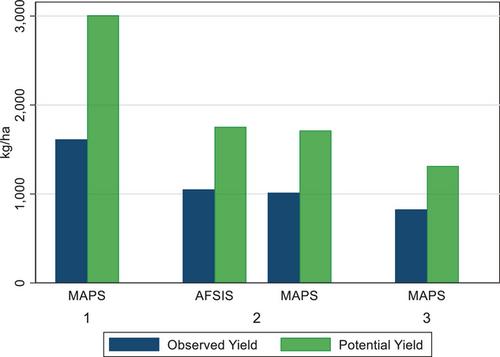
Agricultural productivity is hindered in smallholder farming systems due to several factors, including farmers’ inability to meet crop-specific soil requirements. This article focuses on soil suitability for maize production and creates multidimensional soil suitability profiles of smallholder maize plots in Uganda while quantifying forgone production due to cultivation on less-than-suitable land and identifying groups of farmers that are disproportionately impacted. The analysis leverages the unique socioeconomic data from a subnational survey conducted in Eastern Uganda, inclusive of plot-level, objective measures of maize yields and soil attributes. Stochastic frontier models of maize yields are estimated within each soil suitability class to understand differences in returns to inputs, technical efficiency, and potential yield. Farmers cultivating highly suitable soil have the potential to increase their observed yields by as much as 86%, while those at the opposite end of the suitability distribution (i.e., with marginally suitable land) operate closer to the production frontier and can only increase yields by up to 59%, given the current technology set. There is heterogeneity in potential gains across the wealth distribution, with poorer households facing more heavily constrained potential.




 京公网安备 11010802042870号
京ICP备2023020795号-1
京公网安备 11010802042870号
京ICP备2023020795号-1

 分享
分享
 求助内容:
求助内容: 应助结果提醒方式:
 扫码关注我们
