{"title":"Preparation of 2D V2O3@Pourous Carbon Nanosheets Derived from V2CFx MXene for Capacitive Desalination","authors":"Zehao Zhang , Zheng Wang , Haibo Li","doi":"10.3866/PKU.WHXB202308020","DOIUrl":null,"url":null,"abstract":"<div><h3>Abstract</h3><div>Capacitive deionization (CDI) has been considered one of the most promising desalination technologies in the past decade. However, it faces challenges related to low salt removal efficiency in high salinity water. To address this issue, ion intercalation materials have been developed as anodes for CDI due to their abundant electroactive sites capable of accommodating large salty ions. V<sub>2</sub>O<sub>3</sub>, a typical intercalation host, has garnered significant attention in the field of metal-ion batteries and appears to be a suitable candidate for CDI. Nevertheless, structural instability and slow ion diffusion, resulting from large volume expansion and low intrinsic electron/ion conductivity, present obstacles to its commercial application. Given their high specific surface area, abundant ion diffusion channels, and excellent conductivity, derivatives of metal-organic frameworks (MOFs) have become highly attractive in the electrochemical research community. In this study, 2D V<sub>2</sub>O<sub>3</sub>@porous carbon (V<sub>2</sub>O<sub>3</sub>@PC) nanosheets were prepared using homologous metal V<sub>2</sub>CF<sub><em>x</em></sub> MXene as a precursor for CDI anodes, aiming to enhance salt removal capacity. The structure, crystallinity, wettability, graphitization degree, and electrochemical behavior of V<sub>2</sub>O<sub>3</sub>@PC were investigated by adjusting carbonization temperatures. The findings reveal that V<sub>2</sub>O<sub>3</sub>@PC exhibits a typical 2D nanosheet structure, with highly crystalline V<sub>2</sub>O<sub>3</sub> nanoparticles securely enveloped by graphitized PC. The electronic coupling between PC and V<sub>2</sub>O<sub>3</sub> ensures high electron conductivity. This unique structure demonstrates excellent interfacial wettability and high conductivity, facilitating electrolyte penetration, accelerating interfacial charge transfer, and enhancing salt ion diffusion. Additionally, the PC effectively restricts the volume expansion of V<sub>2</sub>O<sub>3</sub>. Moreover, reversible electrochemical conversion between V<sup>3+</sup>/V<sup>4+</sup> contributes to Na<sup>+</sup> storage, aiding the desalination/regeneration process. Notably, X-ray diffraction (XRD) analysis revealed the preferential growth of V<sub>2</sub>O<sub>3</sub> crystal planes at different carbonization temperatures. Consequently, the optimized V<sub>2</sub>O<sub>3</sub>@PC-850 electrode exhibits remarkable desalination performance, including a desalination capacity of 2.20 mmol·g<sup>−1</sup>, desalination rate of 0.13 mmol·g<sup>−1</sup>·min<sup>−1</sup>, water recovery rate of 62%, and energy consumption of 24.0 Wh·m<sup>−3</sup> at 1.2 V in 1000 μS·cm<sup>−1</sup> NaCl solutions. Compared to V<sub>2</sub>O<sub>3</sub>@PC-750 and V<sub>2</sub>O<sub>3</sub>@PC-950, the superior performance of V<sub>2</sub>O<sub>3</sub>@PC-850 can be attributed to its enhanced interfacial wettability, which promotes charge transfer and improves salt ion diffusion kinetics. Additionally, the preferential growth of the (110) crystal plane in V<sub>2</sub>O<sub>3</sub>@PC-850 enhances ion storage capacity, contributing to its superior desalination performance. This study offers new insights into the synergistic enhancement of electrochemical ion removal characteristics through the utilization of metal oxide and carbon nanomaterials.</div></div>","PeriodicalId":6964,"journal":{"name":"物理化学学报","volume":"40 8","pages":"Article 2308020"},"PeriodicalIF":13.5000,"publicationDate":"2024-08-01","publicationTypes":"Journal Article","fieldsOfStudy":null,"isOpenAccess":false,"openAccessPdf":"","citationCount":"0","resultStr":null,"platform":"Semanticscholar","paperid":null,"PeriodicalName":"物理化学学报","FirstCategoryId":"92","ListUrlMain":"https://www.sciencedirect.com/science/article/pii/S1000681824001140","RegionNum":2,"RegionCategory":"化学","ArticlePicture":[],"TitleCN":null,"AbstractTextCN":null,"PMCID":null,"EPubDate":"2023/9/18 0:00:00","PubModel":"Epub","JCR":"Q1","JCRName":"CHEMISTRY, PHYSICAL","Score":null,"Total":0}
引用次数: 0
Abstract
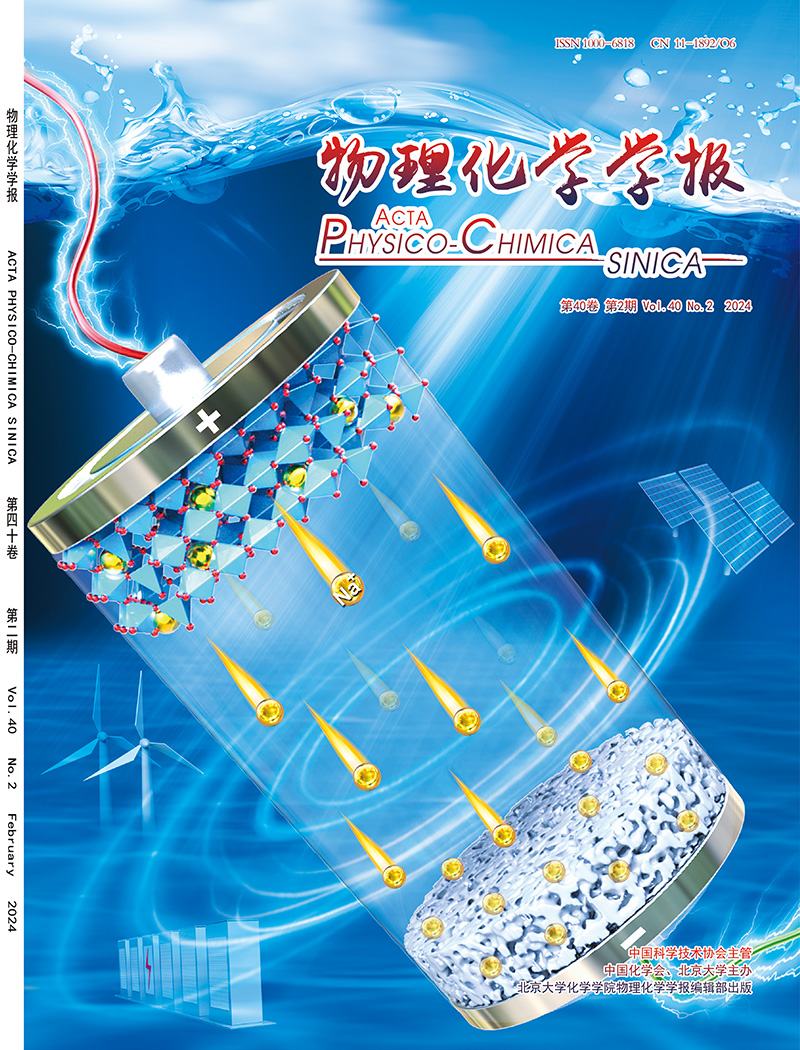
Capacitive deionization (CDI) has been considered one of the most promising desalination technologies in the past decade. However, it faces challenges related to low salt removal efficiency in high salinity water. To address this issue, ion intercalation materials have been developed as anodes for CDI due to their abundant electroactive sites capable of accommodating large salty ions. V2O3, a typical intercalation host, has garnered significant attention in the field of metal-ion batteries and appears to be a suitable candidate for CDI. Nevertheless, structural instability and slow ion diffusion, resulting from large volume expansion and low intrinsic electron/ion conductivity, present obstacles to its commercial application. Given their high specific surface area, abundant ion diffusion channels, and excellent conductivity, derivatives of metal-organic frameworks (MOFs) have become highly attractive in the electrochemical research community. In this study, 2D V2O3@porous carbon (V2O3@PC) nanosheets were prepared using homologous metal V2CFx MXene as a precursor for CDI anodes, aiming to enhance salt removal capacity. The structure, crystallinity, wettability, graphitization degree, and electrochemical behavior of V2O3@PC were investigated by adjusting carbonization temperatures. The findings reveal that V2O3@PC exhibits a typical 2D nanosheet structure, with highly crystalline V2O3 nanoparticles securely enveloped by graphitized PC. The electronic coupling between PC and V2O3 ensures high electron conductivity. This unique structure demonstrates excellent interfacial wettability and high conductivity, facilitating electrolyte penetration, accelerating interfacial charge transfer, and enhancing salt ion diffusion. Additionally, the PC effectively restricts the volume expansion of V2O3. Moreover, reversible electrochemical conversion between V3+/V4+ contributes to Na+ storage, aiding the desalination/regeneration process. Notably, X-ray diffraction (XRD) analysis revealed the preferential growth of V2O3 crystal planes at different carbonization temperatures. Consequently, the optimized V2O3@PC-850 electrode exhibits remarkable desalination performance, including a desalination capacity of 2.20 mmol·g−1, desalination rate of 0.13 mmol·g−1·min−1, water recovery rate of 62%, and energy consumption of 24.0 Wh·m−3 at 1.2 V in 1000 μS·cm−1 NaCl solutions. Compared to V2O3@PC-750 and V2O3@PC-950, the superior performance of V2O3@PC-850 can be attributed to its enhanced interfacial wettability, which promotes charge transfer and improves salt ion diffusion kinetics. Additionally, the preferential growth of the (110) crystal plane in V2O3@PC-850 enhances ion storage capacity, contributing to its superior desalination performance. This study offers new insights into the synergistic enhancement of electrochemical ion removal characteristics through the utilization of metal oxide and carbon nanomaterials.




 京公网安备 11010802042870号
京ICP备2023020795号-1
京公网安备 11010802042870号
京ICP备2023020795号-1

 分享
分享
 求助内容:
求助内容: 应助结果提醒方式:
 扫码关注我们
