{"title":"Nickel effects on carbon dioxide and methane adsorptions on porous glass: experimental and monte carlo simulation studies","authors":"Pakamas Kohmuean, Supawan Inthawong, Atichat Wongkoblap","doi":"10.1007/s10450-023-00421-y","DOIUrl":null,"url":null,"abstract":"<div><p>A Grand Canonical Monte Carlo simulation (GCMC) method is used to study the adsorption of methane and carbon dioxide on porous silica glass in the presence and absence of nickel. Nickel atoms are randomly allocated on pore walls, accounting for approximately 1–5% by weight. Experimental data is collected for various nickel concentrations ranging from 0 to 10%. The preparation of porous glass in the presence of Ni is done both with and without calcination in the furnace. The simulation investigates the adsorption of methane and carbon dioxide at temperatures of 273 K and 298 K for different pore widths. The adsorption of methane increases with higher nickel concentration due to the stronger interaction between methane and nickel. However, the opposite behavior is observed in the case of carbon dioxide. Physical adsorption reveals that fluid adsorption on porous glass surfaces decreases as temperature increases. The adsorption of methane begins at the nickel molecule and then progresses further inside the pore. However, in the experimental work, a similar behavior is found for nickel concentrations less than 5% with calcination, after which the adsorption decreases with increasing Ni concentration. This may be attributed to the blocking of Ni molecules at the pore entrance, resulting in difficulty for methane diffusion through the pore. Regarding the effect of Ni allocation on glass surfaces, it is observed that the isotherm obtained for randomly placed nickels is greater than that for nickels placed at the pore edge. This can also be attributed to the pore-blocking effect. The allocation of Ni does not significantly affect the adsorption of carbon dioxide. The finding of this study are supported by similarity to the results reported by others, for example in the study of methane adsorption on activated carbon in the presence of Ni. It can be concluded that nickel on solid surfaces can enhance the adsorption of methane for energy storage.</p></div>","PeriodicalId":458,"journal":{"name":"Adsorption","volume":"30 :","pages":"313 - 327"},"PeriodicalIF":3.1000,"publicationDate":"2023-11-06","publicationTypes":"Journal Article","fieldsOfStudy":null,"isOpenAccess":false,"openAccessPdf":"","citationCount":"0","resultStr":null,"platform":"Semanticscholar","paperid":null,"PeriodicalName":"Adsorption","FirstCategoryId":"5","ListUrlMain":"https://link.springer.com/article/10.1007/s10450-023-00421-y","RegionNum":4,"RegionCategory":"工程技术","ArticlePicture":[],"TitleCN":null,"AbstractTextCN":null,"PMCID":null,"EPubDate":"","PubModel":"","JCR":"Q3","JCRName":"CHEMISTRY, PHYSICAL","Score":null,"Total":0}
引用次数: 0
Abstract
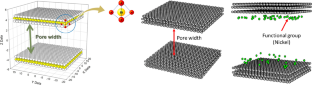
A Grand Canonical Monte Carlo simulation (GCMC) method is used to study the adsorption of methane and carbon dioxide on porous silica glass in the presence and absence of nickel. Nickel atoms are randomly allocated on pore walls, accounting for approximately 1–5% by weight. Experimental data is collected for various nickel concentrations ranging from 0 to 10%. The preparation of porous glass in the presence of Ni is done both with and without calcination in the furnace. The simulation investigates the adsorption of methane and carbon dioxide at temperatures of 273 K and 298 K for different pore widths. The adsorption of methane increases with higher nickel concentration due to the stronger interaction between methane and nickel. However, the opposite behavior is observed in the case of carbon dioxide. Physical adsorption reveals that fluid adsorption on porous glass surfaces decreases as temperature increases. The adsorption of methane begins at the nickel molecule and then progresses further inside the pore. However, in the experimental work, a similar behavior is found for nickel concentrations less than 5% with calcination, after which the adsorption decreases with increasing Ni concentration. This may be attributed to the blocking of Ni molecules at the pore entrance, resulting in difficulty for methane diffusion through the pore. Regarding the effect of Ni allocation on glass surfaces, it is observed that the isotherm obtained for randomly placed nickels is greater than that for nickels placed at the pore edge. This can also be attributed to the pore-blocking effect. The allocation of Ni does not significantly affect the adsorption of carbon dioxide. The finding of this study are supported by similarity to the results reported by others, for example in the study of methane adsorption on activated carbon in the presence of Ni. It can be concluded that nickel on solid surfaces can enhance the adsorption of methane for energy storage.
期刊介绍:
The journal Adsorption provides authoritative information on adsorption and allied fields to scientists, engineers, and technologists throughout the world. The information takes the form of peer-reviewed articles, R&D notes, topical review papers, tutorial papers, book reviews, meeting announcements, and news.
Coverage includes fundamental and practical aspects of adsorption: mathematics, thermodynamics, chemistry, and physics, as well as processes, applications, models engineering, and equipment design.
Among the topics are Adsorbents: new materials, new synthesis techniques, characterization of structure and properties, and applications; Equilibria: novel theories or semi-empirical models, experimental data, and new measurement methods; Kinetics: new models, experimental data, and measurement methods. Processes: chemical, biochemical, environmental, and other applications, purification or bulk separation, fixed bed or moving bed systems, simulations, experiments, and design procedures.




 京公网安备 11010802042870号
京ICP备2023020795号-1
京公网安备 11010802042870号
京ICP备2023020795号-1

 分享
分享
 求助内容:
求助内容: 应助结果提醒方式:
 扫码关注我们
