Site-Directed Spin Label EPR Studies of the Structure and Membrane Interactions of the Bacterial Phospholipase ExoU

IF 1.1 4区 物理与天体物理 Q4 PHYSICS, ATOMIC, MOLECULAR & CHEMICAL Applied Magnetic Resonance Pub Date : 2023-10-04 DOI:10.1007/s00723-023-01620-0
Samantha L. Gies, Maxx H. Tessmer, Dara W. Frank, Jimmy B. Feix
{"title":"Site-Directed Spin Label EPR Studies of the Structure and Membrane Interactions of the Bacterial Phospholipase ExoU","authors":"Samantha L. Gies,&nbsp;Maxx H. Tessmer,&nbsp;Dara W. Frank,&nbsp;Jimmy B. Feix","doi":"10.1007/s00723-023-01620-0","DOIUrl":null,"url":null,"abstract":"<div><p>Site-directed spin labeling (SDSL) has been invaluable in the analysis of protein structure and dynamics and has been particularly useful in the study of membrane proteins. ExoU, an important virulence factor in <i>Pseudomonas aeruginosa</i> infections, is a bacterial phospholipase A2 that functions at the membrane—aqueous interface. Using the SDSL methodology developed in the Hubbell lab, we find that the region surrounding the catalytic site of ExoU is buried within the tertiary structure of the protein in the soluble, apoenzyme state, but shows a significant increase in dynamics upon membrane binding and activation by ubiquitin. Continuous wave (CW) power saturation EPR studies show that the conserved serine hydrolase motif of ExoU localizes to the membrane surface in the active, holoenzyme state. SDSL studies on the C-terminal four-helix bundle (4HB) domain of ExoU similarly show a co-operative effect of ubiquitin binding and membrane association. CW power saturation studies of the 4HB domain indicate that two interhelical loops intercalate into the lipid bilayer upon formation of the holoenzyme state, anchoring ExoU at the membrane surface. Together these studies establish the orientation and localization of ExoU at the membrane surface and illustrate the power of SDSL as applied to peripheral membrane proteins.</p></div>","PeriodicalId":469,"journal":{"name":"Applied Magnetic Resonance","volume":"55 1-3","pages":"279 - 295"},"PeriodicalIF":1.1000,"publicationDate":"2023-10-04","publicationTypes":"Journal Article","fieldsOfStudy":null,"isOpenAccess":false,"openAccessPdf":"","citationCount":"0","resultStr":null,"platform":"Semanticscholar","paperid":null,"PeriodicalName":"Applied Magnetic Resonance","FirstCategoryId":"101","ListUrlMain":"https://link.springer.com/article/10.1007/s00723-023-01620-0","RegionNum":4,"RegionCategory":"物理与天体物理","ArticlePicture":[],"TitleCN":null,"AbstractTextCN":null,"PMCID":null,"EPubDate":"","PubModel":"","JCR":"Q4","JCRName":"PHYSICS, ATOMIC, MOLECULAR & CHEMICAL","Score":null,"Total":0}
引用次数: 0

Abstract

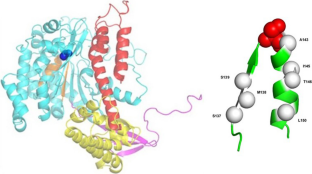
Site-directed spin labeling (SDSL) has been invaluable in the analysis of protein structure and dynamics and has been particularly useful in the study of membrane proteins. ExoU, an important virulence factor in Pseudomonas aeruginosa infections, is a bacterial phospholipase A2 that functions at the membrane—aqueous interface. Using the SDSL methodology developed in the Hubbell lab, we find that the region surrounding the catalytic site of ExoU is buried within the tertiary structure of the protein in the soluble, apoenzyme state, but shows a significant increase in dynamics upon membrane binding and activation by ubiquitin. Continuous wave (CW) power saturation EPR studies show that the conserved serine hydrolase motif of ExoU localizes to the membrane surface in the active, holoenzyme state. SDSL studies on the C-terminal four-helix bundle (4HB) domain of ExoU similarly show a co-operative effect of ubiquitin binding and membrane association. CW power saturation studies of the 4HB domain indicate that two interhelical loops intercalate into the lipid bilayer upon formation of the holoenzyme state, anchoring ExoU at the membrane surface. Together these studies establish the orientation and localization of ExoU at the membrane surface and illustrate the power of SDSL as applied to peripheral membrane proteins.

Abstract Image

查看原文
分享 分享
微信好友 朋友圈 QQ好友 复制链接
本刊更多论文
对细菌磷脂酶 ExoU 的结构和膜相互作用的定点自旋标签 EPR 研究
位点定向自旋标记(SDSL)在蛋白质结构和动力学分析方面具有重要价值,在膜蛋白研究中尤其有用。ExoU 是铜绿假单胞菌感染中的一个重要毒力因子,是一种在膜-水界面起作用的细菌磷脂酶 A2。利用 Hubbell 实验室开发的 SDSL 方法,我们发现 ExoU 催化位点周围的区域在可溶、同工酶状态下被埋藏在蛋白质的三级结构中,但在与膜结合并被泛素激活后,其动态会显著增加。连续波(CW)功率饱和 EPR 研究表明,在活性全酶状态下,ExoU 的保守丝氨酸水解酶基团定位在膜表面。对 ExoU 的 C 端四螺旋束(4HB)结构域进行的 SDSL 研究同样显示了泛素结合与膜结合的协同作用。对 4HB 结构域的 CW 功率饱和研究表明,在全酶状态形成时,两个螺旋间环会插入脂质双分子层,从而将 ExoU 固定在膜表面。这些研究共同确定了 ExoU 在膜表面的定向和定位,并说明了 SDSL 应用于外周膜蛋白的能力。
本文章由计算机程序翻译,如有差异,请以英文原文为准。
求助全文
约1分钟内获得全文 去求助
来源期刊
Applied Magnetic Resonance
Applied Magnetic Resonance 物理-光谱学
CiteScore
1.90
自引率
10.00%
发文量
59
审稿时长
2.3 months
期刊介绍: Applied Magnetic Resonance provides an international forum for the application of magnetic resonance in physics, chemistry, biology, medicine, geochemistry, ecology, engineering, and related fields. The contents include articles with a strong emphasis on new applications, and on new experimental methods. Additional features include book reviews and Letters to the Editor.
期刊最新文献
Ruthenium nanoparticles loaded Gd-DTPA with self-purification capacity for acute kidney injury Motion Artifact Correction in MRI with a Gibbs Sampling Residual Diffusion Model Ionic Mobility in the N-Octyl-N,N-diethylammonium Tetra-fluoroborate ([N228][BF4]) Protic Ionic Liquid in Solid and Liquid States Probed by Solid-State 2H NMR Comparative Spectroscopic Investigation of Amyloid Beta Peptides Spin-Labeled with MTSL and PROF Correction: Magnetic-Field Dependence of LC-Photo-CIDNP in the Presence of Target Molecules Carrying a Quasi-Isolated Spin Pair
×
引用
GB/T 7714-2015
复制
MLA
复制
APA
复制
导出至
BibTeX EndNote RefMan NoteFirst NoteExpress
×
×
提示
您的信息不完整,为了账户安全,请先补充。
现在去补充
×
提示
您因"违规操作"
具体请查看互助需知
我知道了
×
提示
现在去查看 取消
×
提示
确定
0
微信
客服QQ
Book学术公众号 扫码关注我们
反馈
×
意见反馈
请填写您的意见或建议
请填写您的手机或邮箱
已复制链接
已复制链接
快去分享给好友吧!
我知道了
×
扫码分享
扫码分享
Book学术官方微信
Book学术文献互助
Book学术文献互助群
群 号:604180095
Book学术
文献互助 智能选刊 最新文献 互助须知 联系我们:info@booksci.cn
Book学术提供免费学术资源搜索服务,方便国内外学者检索中英文文献。致力于提供最便捷和优质的服务体验。
Copyright © 2023 Book学术 All rights reserved.
ghs 京公网安备 11010802042870号 京ICP备2023020795号-1





