{"title":"Flame Spread Behavior Over a Filter Paper Near Extinction Limit Under Microgravity on the ISS/Kibo","authors":"Shuhei Takahashi, Hiroyuki Torikai, Yoshinari Kobayashi, Masao Kikuchi, Osamu Fujita","doi":"10.1007/s10694-023-01507-3","DOIUrl":null,"url":null,"abstract":"<div><p>The flame spread behavior over a filter paper in opposed flow was investigated on the ISS/Kibo, and the results were compared with the flammability map predicted in advance by scale analysis for a two-dimensional flame. The on-orbit experiments were conducted in the solid combustion experimental module (SCEM) as the first combustion test of the FLARE project by JAXA. A filter paper with a length of 130 mm, a width of 40 mm or 20 mm, and a thickness of 0.12 mm was used as the specimen. The opposed flow velocity and the oxygen concentration were varied from 0 cm/s to 25 cm/s, and from 13.5% to 34%, respectively. The ambient pressure is 101.3 kPa. The predicted limiting curve reasonably agreed with the minimum limiting oxygen concentration observed. On the other hand, in extremely slow flows, very robust flames were observed beyond the limiting curve. When the condition reached the limit of two-dimensional flame, the flame front changed from a linear shape to a spherical shape (flamelet) to shorten the preheat zone length, reducing the radiative heat loss to survive. In these cases, the flamelet was sustained for a long time (> 100 s), and a large amount of decomposed gas was released at the periphery of the pyrolysis zone generating a combustible vapor cloud around the spherical flame font. The presence of a long-life robust flamelet and the accumulation of such combustible mist can be fire hazards in microgravity.</p></div>","PeriodicalId":558,"journal":{"name":"Fire Technology","volume":"60 1","pages":"313 - 334"},"PeriodicalIF":2.4000,"publicationDate":"2023-11-04","publicationTypes":"Journal Article","fieldsOfStudy":null,"isOpenAccess":false,"openAccessPdf":"","citationCount":"0","resultStr":null,"platform":"Semanticscholar","paperid":null,"PeriodicalName":"Fire Technology","FirstCategoryId":"5","ListUrlMain":"https://link.springer.com/article/10.1007/s10694-023-01507-3","RegionNum":3,"RegionCategory":"工程技术","ArticlePicture":[],"TitleCN":null,"AbstractTextCN":null,"PMCID":null,"EPubDate":"","PubModel":"","JCR":"Q2","JCRName":"ENGINEERING, MULTIDISCIPLINARY","Score":null,"Total":0}
引用次数: 0
Abstract
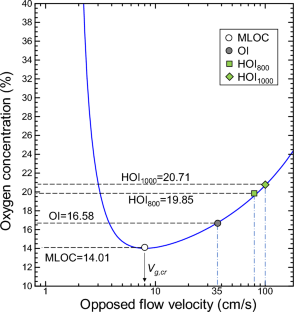
The flame spread behavior over a filter paper in opposed flow was investigated on the ISS/Kibo, and the results were compared with the flammability map predicted in advance by scale analysis for a two-dimensional flame. The on-orbit experiments were conducted in the solid combustion experimental module (SCEM) as the first combustion test of the FLARE project by JAXA. A filter paper with a length of 130 mm, a width of 40 mm or 20 mm, and a thickness of 0.12 mm was used as the specimen. The opposed flow velocity and the oxygen concentration were varied from 0 cm/s to 25 cm/s, and from 13.5% to 34%, respectively. The ambient pressure is 101.3 kPa. The predicted limiting curve reasonably agreed with the minimum limiting oxygen concentration observed. On the other hand, in extremely slow flows, very robust flames were observed beyond the limiting curve. When the condition reached the limit of two-dimensional flame, the flame front changed from a linear shape to a spherical shape (flamelet) to shorten the preheat zone length, reducing the radiative heat loss to survive. In these cases, the flamelet was sustained for a long time (> 100 s), and a large amount of decomposed gas was released at the periphery of the pyrolysis zone generating a combustible vapor cloud around the spherical flame font. The presence of a long-life robust flamelet and the accumulation of such combustible mist can be fire hazards in microgravity.
期刊介绍:
Fire Technology publishes original contributions, both theoretical and empirical, that contribute to the solution of problems in fire safety science and engineering. It is the leading journal in the field, publishing applied research dealing with the full range of actual and potential fire hazards facing humans and the environment. It covers the entire domain of fire safety science and engineering problems relevant in industrial, operational, cultural, and environmental applications, including modeling, testing, detection, suppression, human behavior, wildfires, structures, and risk analysis.
The aim of Fire Technology is to push forward the frontiers of knowledge and technology by encouraging interdisciplinary communication of significant technical developments in fire protection and subjects of scientific interest to the fire protection community at large.
It is published in conjunction with the National Fire Protection Association (NFPA) and the Society of Fire Protection Engineers (SFPE). The mission of NFPA is to help save lives and reduce loss with information, knowledge, and passion. The mission of SFPE is advancing the science and practice of fire protection engineering internationally.





 京公网安备 11010802042870号
京ICP备2023020795号-1
京公网安备 11010802042870号
京ICP备2023020795号-1

 分享
分享
 求助内容:
求助内容: 应助结果提醒方式:
 扫码关注我们
