{"title":"Bending fatigue performance of L-shaped stapled one-side two-gusset-plate upholstered furniture joints in oriented strandboard","authors":"Samet Demirel, Jilei Zhang, Yan Wang","doi":"10.1007/s00107-023-02006-6","DOIUrl":null,"url":null,"abstract":"<div><p>The stapled, one-side, two-gusset-plate system is a standard method for joining two structural members such as front stump and front rail in upholstery furniture frame constructions. The fatigue performances of L-shaped, stapled, one-side, two-gusset-plate joints (TGPJs) in three different oriented strandboard materials were experimentally investigated. All TGPJs were subjected to one-sided cyclic stepped bending moment regimen that is commonly used to evaluate the durability performance of upholstered furniture frames. The purpose was to determine the ratio of TGPJs’ static bending moment capacity to their corresponding passed fatigue bending moment level. It was found that the ratio averaged 2.32. Joint failure modes suggested that the resistance capacity to fatigue bending moments of TGPJs that had their final cumulative cycles to failure less than 125,000 was governed by staples’ lateral withdrawal resistance capacity in OSB materials. In contrast, staple legs' resistance to lateral cyclic load governed the resistance capacity to fatigue bending moments of TGPJs that had their final cumulative cycles to failure greater than 125,000. It is believed that this information can assist furniture engineers carrying out rational strength design of upholstered furniture frames to meet desired durability requirements.</p></div>","PeriodicalId":550,"journal":{"name":"European Journal of Wood and Wood Products","volume":"82 2","pages":"493 - 502"},"PeriodicalIF":2.5000,"publicationDate":"2023-11-04","publicationTypes":"Journal Article","fieldsOfStudy":null,"isOpenAccess":false,"openAccessPdf":"https://link.springer.com/content/pdf/10.1007/s00107-023-02006-6.pdf","citationCount":"0","resultStr":null,"platform":"Semanticscholar","paperid":null,"PeriodicalName":"European Journal of Wood and Wood Products","FirstCategoryId":"88","ListUrlMain":"https://link.springer.com/article/10.1007/s00107-023-02006-6","RegionNum":3,"RegionCategory":"农林科学","ArticlePicture":[],"TitleCN":null,"AbstractTextCN":null,"PMCID":null,"EPubDate":"","PubModel":"","JCR":"Q1","JCRName":"FORESTRY","Score":null,"Total":0}
引用次数: 0
Abstract
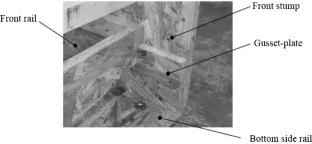
The stapled, one-side, two-gusset-plate system is a standard method for joining two structural members such as front stump and front rail in upholstery furniture frame constructions. The fatigue performances of L-shaped, stapled, one-side, two-gusset-plate joints (TGPJs) in three different oriented strandboard materials were experimentally investigated. All TGPJs were subjected to one-sided cyclic stepped bending moment regimen that is commonly used to evaluate the durability performance of upholstered furniture frames. The purpose was to determine the ratio of TGPJs’ static bending moment capacity to their corresponding passed fatigue bending moment level. It was found that the ratio averaged 2.32. Joint failure modes suggested that the resistance capacity to fatigue bending moments of TGPJs that had their final cumulative cycles to failure less than 125,000 was governed by staples’ lateral withdrawal resistance capacity in OSB materials. In contrast, staple legs' resistance to lateral cyclic load governed the resistance capacity to fatigue bending moments of TGPJs that had their final cumulative cycles to failure greater than 125,000. It is believed that this information can assist furniture engineers carrying out rational strength design of upholstered furniture frames to meet desired durability requirements.
期刊介绍:
European Journal of Wood and Wood Products reports on original research and new developments in the field of wood and wood products and their biological, chemical, physical as well as mechanical and technological properties, processes and uses. Subjects range from roundwood to wood based products, composite materials and structural applications, with related jointing techniques. Moreover, it deals with wood as a chemical raw material, source of energy as well as with inter-disciplinary aspects of environmental assessment and international markets.
European Journal of Wood and Wood Products aims at promoting international scientific communication and transfer of new technologies from research into practice.



 京公网安备 11010802042870号
京ICP备2023020795号-1
京公网安备 11010802042870号
京ICP备2023020795号-1

 分享
分享
 求助内容:
求助内容: 应助结果提醒方式:
 扫码关注我们
