Elaboration, spectroscopic characterization, and study of the thermal decomposition process of energetic composites based on ammonium perchlorate and dual-biopolymers
Nawel Matmat, Amir Abdelaziz, Djalal Trache, Ahmed Fouzi Tarchoun, Hani Boukeciat, Aziz Rahal
{"title":"Elaboration, spectroscopic characterization, and study of the thermal decomposition process of energetic composites based on ammonium perchlorate and dual-biopolymers","authors":"Nawel Matmat, Amir Abdelaziz, Djalal Trache, Ahmed Fouzi Tarchoun, Hani Boukeciat, Aziz Rahal","doi":"10.1016/j.fpc.2023.10.003","DOIUrl":null,"url":null,"abstract":"<div><p>The current study presents a successful elaboration and characterization of an innovative energetic composite based on nitrocellulose and nitrostarch (NC<img>NPS) dual-biopolymers, and ammonium perchlorate (AP). A pre-establishment of the optimal formulation of the AP@NC<img>NPS composite has been determined through a theoretical estimation of the ballistic performance via CEA-NASA software. The obtained composites were then fully characterized by FTIR, DSC, and TGA analyses. The IR-spectroscopy depicted the presence of all the characteristic groups of ester nitrates, revealing that the incorporation of AP did not alter the chemical structure of the dual-biopolymers. The thermal analysis demonstrated a mutual catalytic effect between AP and NC<img>NPS biopolymeric matrix supported by the decrease of the maximum degradation temperatures observed for all the decomposition stages of AP@NC<img>NPS composite after the incorporation of the oxidizer. The thermo-kinetic investigation, carried out using linear and non-linear isoconversional approaches (TAS, VYA/CE) demonstrated a considerable reduction in the activation energy values, highlighting, once again the role of AP in the improvement of the thermolysis process of the prepared AP@NC<img>NPS energetic composite.</p></div>","PeriodicalId":100531,"journal":{"name":"FirePhysChem","volume":"4 2","pages":"Pages 166-176"},"PeriodicalIF":3.6000,"publicationDate":"2024-06-01","publicationTypes":"Journal Article","fieldsOfStudy":null,"isOpenAccess":false,"openAccessPdf":"https://www.sciencedirect.com/science/article/pii/S2667134423000536/pdfft?md5=420d862cc33f8a00e83eb6d65339e940&pid=1-s2.0-S2667134423000536-main.pdf","citationCount":"0","resultStr":null,"platform":"Semanticscholar","paperid":null,"PeriodicalName":"FirePhysChem","FirstCategoryId":"1085","ListUrlMain":"https://www.sciencedirect.com/science/article/pii/S2667134423000536","RegionNum":0,"RegionCategory":null,"ArticlePicture":[],"TitleCN":null,"AbstractTextCN":null,"PMCID":null,"EPubDate":"2023/10/17 0:00:00","PubModel":"Epub","JCR":"","JCRName":"","Score":null,"Total":0}
引用次数: 0
Abstract
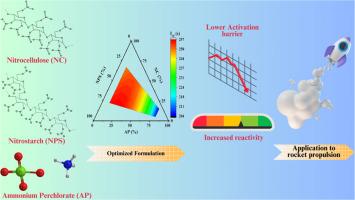
The current study presents a successful elaboration and characterization of an innovative energetic composite based on nitrocellulose and nitrostarch (NCNPS) dual-biopolymers, and ammonium perchlorate (AP). A pre-establishment of the optimal formulation of the AP@NCNPS composite has been determined through a theoretical estimation of the ballistic performance via CEA-NASA software. The obtained composites were then fully characterized by FTIR, DSC, and TGA analyses. The IR-spectroscopy depicted the presence of all the characteristic groups of ester nitrates, revealing that the incorporation of AP did not alter the chemical structure of the dual-biopolymers. The thermal analysis demonstrated a mutual catalytic effect between AP and NCNPS biopolymeric matrix supported by the decrease of the maximum degradation temperatures observed for all the decomposition stages of AP@NCNPS composite after the incorporation of the oxidizer. The thermo-kinetic investigation, carried out using linear and non-linear isoconversional approaches (TAS, VYA/CE) demonstrated a considerable reduction in the activation energy values, highlighting, once again the role of AP in the improvement of the thermolysis process of the prepared AP@NCNPS energetic composite.



 京公网安备 11010802042870号
京ICP备2023020795号-1
京公网安备 11010802042870号
京ICP备2023020795号-1

 分享
分享

 求助内容:
求助内容: 应助结果提醒方式:
 扫码关注我们
