Georgios Giamagas, Francesco Zonta, Alessio Roccon, Alfredo Soldati
{"title":"Turbulence and Interface Waves in Stratified Oil–Water Channel Flow at Large Viscosity Ratio","authors":"Georgios Giamagas, Francesco Zonta, Alessio Roccon, Alfredo Soldati","doi":"10.1007/s10494-023-00478-3","DOIUrl":null,"url":null,"abstract":"<div><p>We investigate the dynamics of turbulence and interfacial waves in an oil–water channel flow. We consider a stratified configuration, in which a thin layer of oil flows on top of a thick layer of water. The oil–water interface that separates the two layers mutually interacts with the surrounding flow field, and is characterized by the formation and propagation of interfacial waves. We perform direct numerical simulation of the Navier-Stokes equations coupled with a phase field method to describe the interface dynamics. For a given shear Reynolds number, <span>\\(Re_\\tau =300\\)</span>, and Weber number, <span>\\(We=0.5\\)</span>, we consider three different types of oils, characterized by different viscosities, and thus different oil-to-water viscosity ratios <span>\\(\\mu _r=\\mu _o/\\mu _w\\)</span> (being <span>\\(\\mu _o\\)</span> and <span>\\(\\mu _w\\)</span> oil and water viscosities). Starting from a matched viscosity case, <span>\\(\\mu _r=1\\)</span>, we increase the oil-to-water viscosity ratio up to <span>\\(\\mu _r=100\\)</span>. By increasing <span>\\(\\mu _r\\)</span>, we observe significant changes both in turbulence and in the dynamics of the oil–water interface. In particular, the large viscosity of oil controls the flow regime in the thin oil layer, as well as the turbulence activity in the thick water layer, with direct consequences on the overall channel flow rate, which decreases when the oil viscosity is increased. Correspondingly, we observe remarkable changes in the dynamics of waves that propagate at the oil–water interface. In particular, increasing the viscosity ratio from <span>\\(\\mu _r=1\\)</span> to <span>\\(\\mu _r=100\\)</span>, waves change from a two-dimensional, nearly-isotropic pattern, to an almost monochromatic one.</p></div>","PeriodicalId":559,"journal":{"name":"Flow, Turbulence and Combustion","volume":"112 1","pages":"15 - 31"},"PeriodicalIF":2.4000,"publicationDate":"2023-09-12","publicationTypes":"Journal Article","fieldsOfStudy":null,"isOpenAccess":false,"openAccessPdf":"https://link.springer.com/content/pdf/10.1007/s10494-023-00478-3.pdf","citationCount":"0","resultStr":null,"platform":"Semanticscholar","paperid":null,"PeriodicalName":"Flow, Turbulence and Combustion","FirstCategoryId":"5","ListUrlMain":"https://link.springer.com/article/10.1007/s10494-023-00478-3","RegionNum":3,"RegionCategory":"工程技术","ArticlePicture":[],"TitleCN":null,"AbstractTextCN":null,"PMCID":null,"EPubDate":"","PubModel":"","JCR":"Q3","JCRName":"MECHANICS","Score":null,"Total":0}
引用次数: 0
Abstract
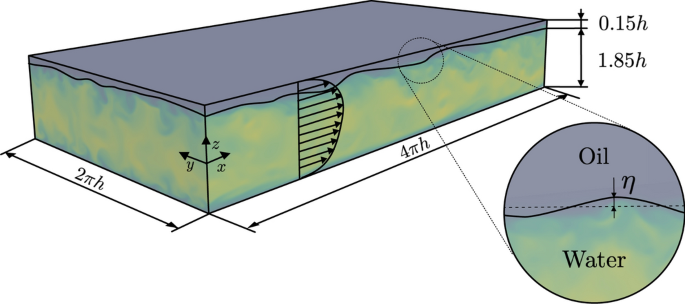
We investigate the dynamics of turbulence and interfacial waves in an oil–water channel flow. We consider a stratified configuration, in which a thin layer of oil flows on top of a thick layer of water. The oil–water interface that separates the two layers mutually interacts with the surrounding flow field, and is characterized by the formation and propagation of interfacial waves. We perform direct numerical simulation of the Navier-Stokes equations coupled with a phase field method to describe the interface dynamics. For a given shear Reynolds number, \(Re_\tau =300\), and Weber number, \(We=0.5\), we consider three different types of oils, characterized by different viscosities, and thus different oil-to-water viscosity ratios \(\mu _r=\mu _o/\mu _w\) (being \(\mu _o\) and \(\mu _w\) oil and water viscosities). Starting from a matched viscosity case, \(\mu _r=1\), we increase the oil-to-water viscosity ratio up to \(\mu _r=100\). By increasing \(\mu _r\), we observe significant changes both in turbulence and in the dynamics of the oil–water interface. In particular, the large viscosity of oil controls the flow regime in the thin oil layer, as well as the turbulence activity in the thick water layer, with direct consequences on the overall channel flow rate, which decreases when the oil viscosity is increased. Correspondingly, we observe remarkable changes in the dynamics of waves that propagate at the oil–water interface. In particular, increasing the viscosity ratio from \(\mu _r=1\) to \(\mu _r=100\), waves change from a two-dimensional, nearly-isotropic pattern, to an almost monochromatic one.
期刊介绍:
Flow, Turbulence and Combustion provides a global forum for the publication of original and innovative research results that contribute to the solution of fundamental and applied problems encountered in single-phase, multi-phase and reacting flows, in both idealized and real systems. The scope of coverage encompasses topics in fluid dynamics, scalar transport, multi-physics interactions and flow control. From time to time the journal publishes Special or Theme Issues featuring invited articles.
Contributions may report research that falls within the broad spectrum of analytical, computational and experimental methods. This includes research conducted in academia, industry and a variety of environmental and geophysical sectors. Turbulence, transition and associated phenomena are expected to play a significant role in the majority of studies reported, although non-turbulent flows, typical of those in micro-devices, would be regarded as falling within the scope covered. The emphasis is on originality, timeliness, quality and thematic fit, as exemplified by the title of the journal and the qualifications described above. Relevance to real-world problems and industrial applications are regarded as strengths.



 京公网安备 11010802042870号
京ICP备2023020795号-1
京公网安备 11010802042870号
京ICP备2023020795号-1

 分享
分享
 求助内容:
求助内容: 应助结果提醒方式:
 扫码关注我们
