{"title":"Comparative Study on Upward Flame Spread Over Single and Twin Polyethylene-Insulated Copper Core Wires at Different Inclination Angles","authors":"Yunji Gao, Yueyang Luo, Peiyao Zhang, Zhengyuan Yang, Feng Guo","doi":"10.1007/s10694-023-01501-9","DOIUrl":null,"url":null,"abstract":"<div><p>In this paper, a series of comparative experiments were performed to study the upward flame spread over single and adjacent twin polyethylene-insulated copper wires from horizontal (0°) to vertical (90°). The flame morphology and flame spreading rate of single and twin wires were compared at different inclination angles, which show a larger flame size, but a lower overall flame spread rate over twin wires. As the inclination angle increases, the flame characteristic length, and flame spread rate increase with the inclination angle for both wire arrangements. The flame spreads steadily to the end of the sample without molten dripping or sliding for single-wire conditions. However, molten dripping or sliding behaviors were found during flame spreading for twin-wire conditions, and the averaged dripping or sliding frequency increases with the inclination angle. Correspondingly, the periodical variation of flame characteristic length, flame height, and flame spread rate for twin-wire conditions have been investigated in detail compared with single-wire conditions. Finally, a simplified heat transfer analysis is carried out to quantitatively study the flame spread rate for both wire arrangements, and the effects of molten dripping/sliding and overlapped area on the heat transfer and flame spread rate are qualitatively discussed.</p></div>","PeriodicalId":558,"journal":{"name":"Fire Technology","volume":"60 1","pages":"213 - 237"},"PeriodicalIF":2.4000,"publicationDate":"2023-10-31","publicationTypes":"Journal Article","fieldsOfStudy":null,"isOpenAccess":false,"openAccessPdf":"","citationCount":"0","resultStr":null,"platform":"Semanticscholar","paperid":null,"PeriodicalName":"Fire Technology","FirstCategoryId":"5","ListUrlMain":"https://link.springer.com/article/10.1007/s10694-023-01501-9","RegionNum":3,"RegionCategory":"工程技术","ArticlePicture":[],"TitleCN":null,"AbstractTextCN":null,"PMCID":null,"EPubDate":"","PubModel":"","JCR":"Q2","JCRName":"ENGINEERING, MULTIDISCIPLINARY","Score":null,"Total":0}
引用次数: 0
Abstract
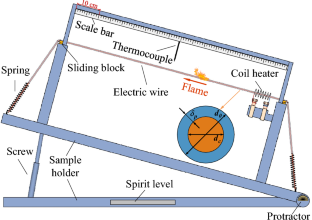
In this paper, a series of comparative experiments were performed to study the upward flame spread over single and adjacent twin polyethylene-insulated copper wires from horizontal (0°) to vertical (90°). The flame morphology and flame spreading rate of single and twin wires were compared at different inclination angles, which show a larger flame size, but a lower overall flame spread rate over twin wires. As the inclination angle increases, the flame characteristic length, and flame spread rate increase with the inclination angle for both wire arrangements. The flame spreads steadily to the end of the sample without molten dripping or sliding for single-wire conditions. However, molten dripping or sliding behaviors were found during flame spreading for twin-wire conditions, and the averaged dripping or sliding frequency increases with the inclination angle. Correspondingly, the periodical variation of flame characteristic length, flame height, and flame spread rate for twin-wire conditions have been investigated in detail compared with single-wire conditions. Finally, a simplified heat transfer analysis is carried out to quantitatively study the flame spread rate for both wire arrangements, and the effects of molten dripping/sliding and overlapped area on the heat transfer and flame spread rate are qualitatively discussed.
期刊介绍:
Fire Technology publishes original contributions, both theoretical and empirical, that contribute to the solution of problems in fire safety science and engineering. It is the leading journal in the field, publishing applied research dealing with the full range of actual and potential fire hazards facing humans and the environment. It covers the entire domain of fire safety science and engineering problems relevant in industrial, operational, cultural, and environmental applications, including modeling, testing, detection, suppression, human behavior, wildfires, structures, and risk analysis.
The aim of Fire Technology is to push forward the frontiers of knowledge and technology by encouraging interdisciplinary communication of significant technical developments in fire protection and subjects of scientific interest to the fire protection community at large.
It is published in conjunction with the National Fire Protection Association (NFPA) and the Society of Fire Protection Engineers (SFPE). The mission of NFPA is to help save lives and reduce loss with information, knowledge, and passion. The mission of SFPE is advancing the science and practice of fire protection engineering internationally.



 京公网安备 11010802042870号
京ICP备2023020795号-1
京公网安备 11010802042870号
京ICP备2023020795号-1

 分享
分享
 求助内容:
求助内容: 应助结果提醒方式:
 扫码关注我们
