Wei Shen, Lebin Yuan, Fei Cheng, Zhao Wu, Xiaodong Li
{"title":"SRSF7 is a promising prognostic biomarker in hepatocellular carcinoma and is associated with immune infiltration.","authors":"Wei Shen, Lebin Yuan, Fei Cheng, Zhao Wu, Xiaodong Li","doi":"10.1007/s13258-023-01463-w","DOIUrl":null,"url":null,"abstract":"<p><strong>Background: </strong>Previous studies indicate that the splicing process, regulated by the cellular machinery of tumors (spliceosome), undergoes alterations, leading to oncogenic splicing events associated with the progression of tumors towards aggressiveness. However, the role of serine/arginine-rich splicing factor 7 (SRSF7) in hepatocellular carcinoma (HCC) and the tumor microenvironment (TME) remains unclear.</p><p><strong>Methods: </strong>This study was aimed to explore the role and clinical significance of SRSF7 in HCC. By conducting functional analysis and gene set enrichment analysis, it was discovered that SRSF7 contributes to multiple pathways associated with immune response and tumor advancement. Further experiments verified that silencing of SRSF7 obviously inhibits progression of HCC.</p><p><strong>Results: </strong>Aberrant expression of SRSF7, which were referred as an independent prognostic risk factor, effectively predicts the prognosis of patients with HCC. Functional and gene enrichment analyses revealed that SRSF7 is linked with multiple immune and tumor progression-related pathways, including the B cell receptor signaling pathway, positive regulation of leukocyte and immunoglobulin receptor binding cell activation, nuclear division, membrane invagination, cell cycle, as well as mTOR signaling pathway. Furthermore, increased SRSF7 expression was associated with tumor-infiltrating inflammatory cells (CD4+, monocytes/macrophages, CD8 + and endothelial). Additionally, multiple immune checkpoint genes were markedly positively related to SRSF7. The efficiency of SRSF7 in predicting immunomodulator and chemokine responses were also assessed in microenvironment. Moreover, in vitro analyses demonstrated that knockdown of SRSF7 suppressed the malignant evolution of HCC possibly by deactivating the PI3K/AKT/mTOR signaling.</p><p><strong>Conclusion: </strong>The role of SRSF7 in the tumor microenvironment has been successfully assessed. It may be a valid bio-index for predicting the HCC prognosis, thereby guiding individualized immunotherapy for cancer.</p>","PeriodicalId":12675,"journal":{"name":"Genes & genomics","volume":" ","pages":"49-64"},"PeriodicalIF":1.7000,"publicationDate":"2024-01-01","publicationTypes":"Journal Article","fieldsOfStudy":null,"isOpenAccess":false,"openAccessPdf":"","citationCount":"0","resultStr":null,"platform":"Semanticscholar","paperid":null,"PeriodicalName":"Genes & genomics","FirstCategoryId":"99","ListUrlMain":"https://doi.org/10.1007/s13258-023-01463-w","RegionNum":4,"RegionCategory":"生物学","ArticlePicture":[],"TitleCN":null,"AbstractTextCN":null,"PMCID":null,"EPubDate":"2023/11/20 0:00:00","PubModel":"Epub","JCR":"Q4","JCRName":"BIOCHEMISTRY & MOLECULAR BIOLOGY","Score":null,"Total":0}
引用次数: 0
Abstract
Background: Previous studies indicate that the splicing process, regulated by the cellular machinery of tumors (spliceosome), undergoes alterations, leading to oncogenic splicing events associated with the progression of tumors towards aggressiveness. However, the role of serine/arginine-rich splicing factor 7 (SRSF7) in hepatocellular carcinoma (HCC) and the tumor microenvironment (TME) remains unclear.
Methods: This study was aimed to explore the role and clinical significance of SRSF7 in HCC. By conducting functional analysis and gene set enrichment analysis, it was discovered that SRSF7 contributes to multiple pathways associated with immune response and tumor advancement. Further experiments verified that silencing of SRSF7 obviously inhibits progression of HCC.
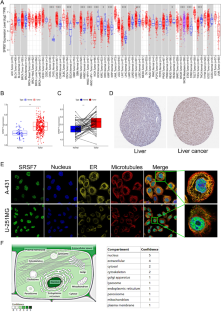
Results: Aberrant expression of SRSF7, which were referred as an independent prognostic risk factor, effectively predicts the prognosis of patients with HCC. Functional and gene enrichment analyses revealed that SRSF7 is linked with multiple immune and tumor progression-related pathways, including the B cell receptor signaling pathway, positive regulation of leukocyte and immunoglobulin receptor binding cell activation, nuclear division, membrane invagination, cell cycle, as well as mTOR signaling pathway. Furthermore, increased SRSF7 expression was associated with tumor-infiltrating inflammatory cells (CD4+, monocytes/macrophages, CD8 + and endothelial). Additionally, multiple immune checkpoint genes were markedly positively related to SRSF7. The efficiency of SRSF7 in predicting immunomodulator and chemokine responses were also assessed in microenvironment. Moreover, in vitro analyses demonstrated that knockdown of SRSF7 suppressed the malignant evolution of HCC possibly by deactivating the PI3K/AKT/mTOR signaling.
Conclusion: The role of SRSF7 in the tumor microenvironment has been successfully assessed. It may be a valid bio-index for predicting the HCC prognosis, thereby guiding individualized immunotherapy for cancer.
期刊介绍:
Genes & Genomics is an official journal of the Korean Genetics Society (http://kgenetics.or.kr/). Although it is an official publication of the Genetics Society of Korea, membership of the Society is not required for contributors. It is a peer-reviewed international journal publishing print (ISSN 1976-9571) and online version (E-ISSN 2092-9293). It covers all disciplines of genetics and genomics from prokaryotes to eukaryotes from fundamental heredity to molecular aspects. The articles can be reviews, research articles, and short communications.



 京公网安备 11010802042870号
京ICP备2023020795号-1
京公网安备 11010802042870号
京ICP备2023020795号-1

 分享
分享
 求助内容:
求助内容: 应助结果提醒方式:
 扫码关注我们
