{"title":"Comparison of robotic assistance and laparoscopy for pediatric choledochal cyst: advantages of robotic assistance.","authors":"Shunsuke Yamada, Hiroyuki Koga, Shogo Seo, Takanori Ochi, Souichi Shibuya, Yuta Yazaki, Masahiro Takeda, Naho Fujiwara, Geoffrey J Lane, Atsuyuki Yamataka","doi":"10.1007/s00383-023-05588-7","DOIUrl":null,"url":null,"abstract":"<p><strong>Aim: </strong>Surgery for pediatric choledochal cyst (CC), complete excision (CE), and Roux-en-Y hepaticojejunostomy anastomosis (HJA) can be performed using laparoscopy (Lap), robotic-assistance (Rob; da Vinci Xi/Si), or both (Lap/Rob).</p><p><strong>Methods: </strong>Lap was used exclusively between 2009 and 2021 (n = 31) and Rob was introduced in 2017 (n = 23). All subjects were matched for age, weight, BMI, and episodes of preoperative pancreatitis. For Rob, the first 15/23 were Lap-CE/Rob-HJA and the last 8/23 were Rob-CE/Rob-HJA.</p><p><strong>Results: </strong>Total anastomotic time (TAT), TAT per suture during HJA, and time taken for dissection during CE were significantly shorter with less variance for Rob, although overall operative times were similar. Serum amylase on postoperative days 3, 5, and 7 were significantly higher for Lap. Times taken to ambulate, for return of bowel sounds, and discharge home were all significantly shorter for Rob. All postoperative complications occurred after Lap; HJA leak (n = 1; 3.2%), HJA stricture (n = 1; 3.2%), both treated by open re-HJA; and pancreatic fistula (n = 6; 19%), all treated conservatively.</p><p><strong>Conclusion: </strong>Dissection and recovery were faster with Rob while overcoming Lap-associated shortcomings to prevent complications associated with suturing. Both CE and HJA were safer and more reliable with Rob, a reflection of Rob's superiority.</p>","PeriodicalId":19832,"journal":{"name":"Pediatric Surgery International","volume":"40 1","pages":"1"},"PeriodicalIF":1.6000,"publicationDate":"2023-11-21","publicationTypes":"Journal Article","fieldsOfStudy":null,"isOpenAccess":false,"openAccessPdf":"","citationCount":"0","resultStr":null,"platform":"Semanticscholar","paperid":null,"PeriodicalName":"Pediatric Surgery International","FirstCategoryId":"3","ListUrlMain":"https://doi.org/10.1007/s00383-023-05588-7","RegionNum":3,"RegionCategory":"医学","ArticlePicture":[],"TitleCN":null,"AbstractTextCN":null,"PMCID":null,"EPubDate":"","PubModel":"","JCR":"Q2","JCRName":"PEDIATRICS","Score":null,"Total":0}
引用次数: 0
Abstract
Aim: Surgery for pediatric choledochal cyst (CC), complete excision (CE), and Roux-en-Y hepaticojejunostomy anastomosis (HJA) can be performed using laparoscopy (Lap), robotic-assistance (Rob; da Vinci Xi/Si), or both (Lap/Rob).
Methods: Lap was used exclusively between 2009 and 2021 (n = 31) and Rob was introduced in 2017 (n = 23). All subjects were matched for age, weight, BMI, and episodes of preoperative pancreatitis. For Rob, the first 15/23 were Lap-CE/Rob-HJA and the last 8/23 were Rob-CE/Rob-HJA.
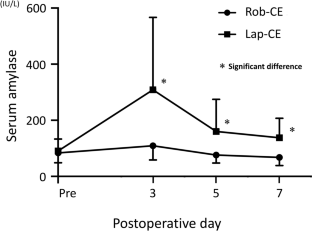
Results: Total anastomotic time (TAT), TAT per suture during HJA, and time taken for dissection during CE were significantly shorter with less variance for Rob, although overall operative times were similar. Serum amylase on postoperative days 3, 5, and 7 were significantly higher for Lap. Times taken to ambulate, for return of bowel sounds, and discharge home were all significantly shorter for Rob. All postoperative complications occurred after Lap; HJA leak (n = 1; 3.2%), HJA stricture (n = 1; 3.2%), both treated by open re-HJA; and pancreatic fistula (n = 6; 19%), all treated conservatively.
Conclusion: Dissection and recovery were faster with Rob while overcoming Lap-associated shortcomings to prevent complications associated with suturing. Both CE and HJA were safer and more reliable with Rob, a reflection of Rob's superiority.
期刊介绍:
Pediatric Surgery International is a journal devoted to the publication of new and important information from the entire spectrum of pediatric surgery. The major purpose of the journal is to promote postgraduate training and further education in the surgery of infants and children.
The contents will include articles in clinical and experimental surgery, as well as related fields. One section of each issue is devoted to a special topic, with invited contributions from recognized authorities. Other sections will include:
-Review articles-
Original articles-
Technical innovations-
Letters to the editor



 京公网安备 11010802042870号
京ICP备2023020795号-1
京公网安备 11010802042870号
京ICP备2023020795号-1

 分享
分享

 求助内容:
求助内容: 应助结果提醒方式:
 扫码关注我们
