Comment on “Hand grip strength-based cachexia index as a predictor of cancer cachexia and prognosis in patients with cancer” by Xie et al. — The authors reply
Hailun Xie, Lishuang Wei, Guotian Ruan, Heyang Zhang, Hanping Shi
{"title":"Comment on “Hand grip strength-based cachexia index as a predictor of cancer cachexia and prognosis in patients with cancer” by Xie et al. — The authors reply","authors":"Hailun Xie, Lishuang Wei, Guotian Ruan, Heyang Zhang, Hanping Shi","doi":"10.1002/jcsm.13386","DOIUrl":null,"url":null,"abstract":"<p>We have read the valuable external validation and expansion provided by Ding et al.<span><sup>1</sup></span> regarding our recently published study in the <i>Journal of Cachexia Sarcopenia and Muscle</i>.<span><sup>2</sup></span></p><p>In our study,<span><sup>2</sup></span> we developed the hand grip strength-based cachexia index (H-CXI) as a reliable and promising prognostic assessment tool for patients with cancer. We achieved this by replacing the complex and expensive skeletal muscle index (SMI) with a simple and effective measurement of hand grip strength (HGS). Additionally, we extensively validated H-CXI across three different cohorts: primary cohort (6592), internal validation cohort (2820) and external validation cohort (5270). The findings reaffirm the reliability of H-CXI in assessing prognosis and predicting cachexia in patients with cancer, while highlighting its broad prospects. However, as mentioned by Ding et al.,<span><sup>1</sup></span> different types of tumours with varying pathological factors may influence the results. Further validation of H-CXI's clinical applicability still requires prospective studies with strict inclusion criteria.</p><p>In the study conducted by Ding et al., they explored the clinical applicability of H-CXI as a prognostic factor for cancer cachexia and prognosis in patients with locally advanced gastric cancer (LAGC) through a cohort study registered under the identifier NCT01516944. The cohort prospectively recruited LAGC patients who underwent curative surgical resection. It was a prospective study with strict inclusion criteria, complete clinical and pathological data, and a long follow-up duration. They found that patients in the high H-CXI group had a significantly lower risk of cancer cachexia compared to those in the low H-CXI group. Additionally, the high H-CXI group had significantly better overall survival (OS) and disease-free survival (DFS) than the low H-CXI group. This study further confirmed the effectiveness of H-CXI in evaluating cancer cachexia and adverse prognosis of patients with cancer within an external prospective cohort, aiding in the clinical guidance of prognosis assessment and individualized treatment for patients with cancer. We sincerely appreciate Ding et al.<span><sup>1</sup></span> for their further exploration of the clinical effectiveness of the H-CXI tool. Their contribution is recognized and acknowledged.</p><p>Inspired by the study conducted by Ding et al., we further explored the prognostic value of H-CXI in GC patients. We also found that patients in the high H-CXI group had significantly better OS than those in the low H-CXI group (OS: 64.5% vs. 50.8%, <i>P</i> < 0.0001) (Figure 1A). Additionally, subgroup analysis showed that H-CXI could effectively stratify the prognosis of advanced-stage patients (Stage III-IV) rather than stage I-II patients, which is consistent with the findings of Ding et al.<span><sup>1</sup></span> to some extent (Figure 1B). These results suggest that H-CXI, as a comprehensive indicator reflecting muscle, nutrition, and inflammatory status, is a simple and effective tool for prognostic assessment and evaluation of cancer cachexia in GC patients, especially for those in advanced stages.</p><p>This study was supported by the National Key Research and Development Program (No. 2017YFC1309200, No. 2022YFC2009600) and Young Elite Scientists Sponsorship Program by CAST (2022QNRC001).</p><p>The authors declare no competing interests.</p>","PeriodicalId":48911,"journal":{"name":"Journal of Cachexia Sarcopenia and Muscle","volume":"15 1","pages":"455-456"},"PeriodicalIF":9.1000,"publicationDate":"2023-11-23","publicationTypes":"Journal Article","fieldsOfStudy":null,"isOpenAccess":false,"openAccessPdf":"https://onlinelibrary.wiley.com/doi/epdf/10.1002/jcsm.13386","citationCount":"0","resultStr":null,"platform":"Semanticscholar","paperid":null,"PeriodicalName":"Journal of Cachexia Sarcopenia and Muscle","FirstCategoryId":"3","ListUrlMain":"https://onlinelibrary.wiley.com/doi/10.1002/jcsm.13386","RegionNum":1,"RegionCategory":"医学","ArticlePicture":[],"TitleCN":null,"AbstractTextCN":null,"PMCID":null,"EPubDate":"","PubModel":"","JCR":"Q1","JCRName":"GERIATRICS & GERONTOLOGY","Score":null,"Total":0}
引用次数: 0
Abstract
We have read the valuable external validation and expansion provided by Ding et al.1 regarding our recently published study in the Journal of Cachexia Sarcopenia and Muscle.2
In our study,2 we developed the hand grip strength-based cachexia index (H-CXI) as a reliable and promising prognostic assessment tool for patients with cancer. We achieved this by replacing the complex and expensive skeletal muscle index (SMI) with a simple and effective measurement of hand grip strength (HGS). Additionally, we extensively validated H-CXI across three different cohorts: primary cohort (6592), internal validation cohort (2820) and external validation cohort (5270). The findings reaffirm the reliability of H-CXI in assessing prognosis and predicting cachexia in patients with cancer, while highlighting its broad prospects. However, as mentioned by Ding et al.,1 different types of tumours with varying pathological factors may influence the results. Further validation of H-CXI's clinical applicability still requires prospective studies with strict inclusion criteria.
In the study conducted by Ding et al., they explored the clinical applicability of H-CXI as a prognostic factor for cancer cachexia and prognosis in patients with locally advanced gastric cancer (LAGC) through a cohort study registered under the identifier NCT01516944. The cohort prospectively recruited LAGC patients who underwent curative surgical resection. It was a prospective study with strict inclusion criteria, complete clinical and pathological data, and a long follow-up duration. They found that patients in the high H-CXI group had a significantly lower risk of cancer cachexia compared to those in the low H-CXI group. Additionally, the high H-CXI group had significantly better overall survival (OS) and disease-free survival (DFS) than the low H-CXI group. This study further confirmed the effectiveness of H-CXI in evaluating cancer cachexia and adverse prognosis of patients with cancer within an external prospective cohort, aiding in the clinical guidance of prognosis assessment and individualized treatment for patients with cancer. We sincerely appreciate Ding et al.1 for their further exploration of the clinical effectiveness of the H-CXI tool. Their contribution is recognized and acknowledged.
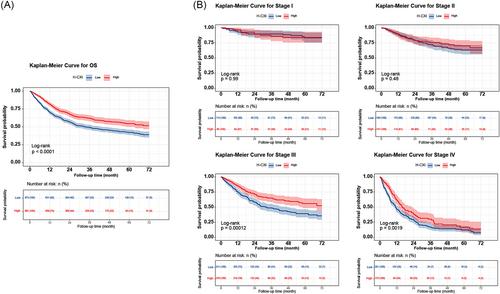
Inspired by the study conducted by Ding et al., we further explored the prognostic value of H-CXI in GC patients. We also found that patients in the high H-CXI group had significantly better OS than those in the low H-CXI group (OS: 64.5% vs. 50.8%, P < 0.0001) (Figure 1A). Additionally, subgroup analysis showed that H-CXI could effectively stratify the prognosis of advanced-stage patients (Stage III-IV) rather than stage I-II patients, which is consistent with the findings of Ding et al.1 to some extent (Figure 1B). These results suggest that H-CXI, as a comprehensive indicator reflecting muscle, nutrition, and inflammatory status, is a simple and effective tool for prognostic assessment and evaluation of cancer cachexia in GC patients, especially for those in advanced stages.
This study was supported by the National Key Research and Development Program (No. 2017YFC1309200, No. 2022YFC2009600) and Young Elite Scientists Sponsorship Program by CAST (2022QNRC001).
期刊介绍:
The Journal of Cachexia, Sarcopenia and Muscle is a peer-reviewed international journal dedicated to publishing materials related to cachexia and sarcopenia, as well as body composition and its physiological and pathophysiological changes across the lifespan and in response to various illnesses from all fields of life sciences. The journal aims to provide a reliable resource for professionals interested in related research or involved in the clinical care of affected patients, such as those suffering from AIDS, cancer, chronic heart failure, chronic lung disease, liver cirrhosis, chronic kidney failure, rheumatoid arthritis, or sepsis.



 京公网安备 11010802042870号
京ICP备2023020795号-1
京公网安备 11010802042870号
京ICP备2023020795号-1

 分享
分享
 求助内容:
求助内容: 应助结果提醒方式:
 扫码关注我们
