Juan José Gómez-Piña, Dulce Mariana Quiroz, Amairani Sierra-Hernández, Sergio Alberto Mendoza-Álvarez, Olga Lidia Vera-Lastra
{"title":"[Giant tongue leading to dysphagia in light chain amyloidosis patient].","authors":"Juan José Gómez-Piña, Dulce Mariana Quiroz, Amairani Sierra-Hernández, Sergio Alberto Mendoza-Álvarez, Olga Lidia Vera-Lastra","doi":"10.5281/zenodo.10064470","DOIUrl":null,"url":null,"abstract":"<p><strong>Introduction: </strong>Macroglossia as a clinical manifestation of systemic amyloidosis is a rare condition, occurring in less than 9% of all types of amyloidosis. The aim of this report is to present the diagnostic approach of a patient with macroglossia, providing a systematic approach and considering relevant diagnostic possibilities during their evaluation.</p><p><strong>Clinical case: </strong>We present the case of a 60-year-old man who presented with a progressively enlarging giant tongue for six months, causing dysphagia and reduced oral opening. A tongue biopsy was taken, which histopathologically exhibited homogenous eosinophilic amyloid-like material. Congo red staining showed amyloid material with red dye under light microscopy and apple-green birefringence under polarized light. Bone marrow biopsy showed 30% plasma cells, allowing for a definitive diagnosis of soft tissue amyloidosis. Although it is a benign lesion, localized amyloidosis should be differentiated from systemic forms.</p><p><strong>Conclusions: </strong>The approach of patients with macroglossia is complex due to the diagnostic possibilities, from endocrinological causes, neoplastic, and even by deposit; Being an isolated sign in a patient is a challenge in its approach, because the involvement of the airway is the main complication to avoid in these patients.</p>","PeriodicalId":94200,"journal":{"name":"Revista medica del Instituto Mexicano del Seguro Social","volume":"61 6","pages":"863-867"},"PeriodicalIF":0.0000,"publicationDate":"2023-11-06","publicationTypes":"Journal Article","fieldsOfStudy":null,"isOpenAccess":false,"openAccessPdf":"https://www.ncbi.nlm.nih.gov/pmc/articles/PMC10727766/pdf/","citationCount":"0","resultStr":null,"platform":"Semanticscholar","paperid":null,"PeriodicalName":"Revista medica del Instituto Mexicano del Seguro Social","FirstCategoryId":"1085","ListUrlMain":"https://doi.org/10.5281/zenodo.10064470","RegionNum":0,"RegionCategory":null,"ArticlePicture":[],"TitleCN":null,"AbstractTextCN":null,"PMCID":null,"EPubDate":"","PubModel":"","JCR":"","JCRName":"","Score":null,"Total":0}
引用次数: 0
Abstract
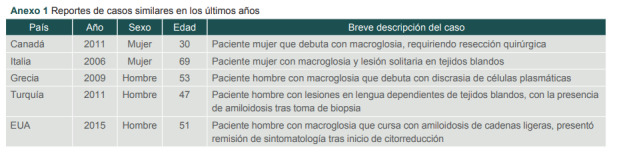
Introduction: Macroglossia as a clinical manifestation of systemic amyloidosis is a rare condition, occurring in less than 9% of all types of amyloidosis. The aim of this report is to present the diagnostic approach of a patient with macroglossia, providing a systematic approach and considering relevant diagnostic possibilities during their evaluation.
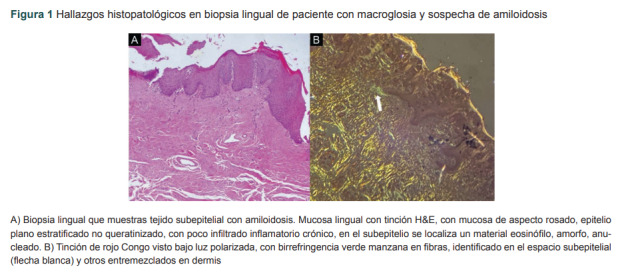
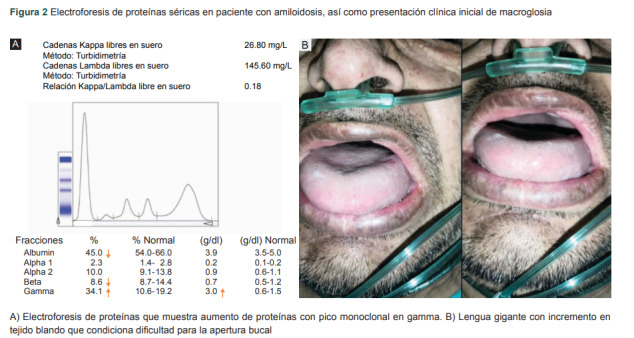
Clinical case: We present the case of a 60-year-old man who presented with a progressively enlarging giant tongue for six months, causing dysphagia and reduced oral opening. A tongue biopsy was taken, which histopathologically exhibited homogenous eosinophilic amyloid-like material. Congo red staining showed amyloid material with red dye under light microscopy and apple-green birefringence under polarized light. Bone marrow biopsy showed 30% plasma cells, allowing for a definitive diagnosis of soft tissue amyloidosis. Although it is a benign lesion, localized amyloidosis should be differentiated from systemic forms.
Conclusions: The approach of patients with macroglossia is complex due to the diagnostic possibilities, from endocrinological causes, neoplastic, and even by deposit; Being an isolated sign in a patient is a challenge in its approach, because the involvement of the airway is the main complication to avoid in these patients.



 京公网安备 11010802042870号
京ICP备2023020795号-1
京公网安备 11010802042870号
京ICP备2023020795号-1

 分享
分享

 求助内容:
求助内容: 应助结果提醒方式:
 扫码关注我们
