Teodoro Martín-Noguerol, Carolina Díaz-Angulo, Cristina Vilanova, Ariadna Barceló, Joaquim Barceló, Antonio Luna, Joan C Vilanova
{"title":"How to do and evaluate DWI and DCE-MRI sequences for diabetic foot assessment.","authors":"Teodoro Martín-Noguerol, Carolina Díaz-Angulo, Cristina Vilanova, Ariadna Barceló, Joaquim Barceló, Antonio Luna, Joan C Vilanova","doi":"10.1007/s00256-023-04518-x","DOIUrl":null,"url":null,"abstract":"<p><p>MRI evaluation of the diabetic foot is still a challenge not only from an interpretative but also from a technical point of view. The incorporation of advanced sequences such as diffusion-weighted imaging (DWI) and dynamic contrast-enhanced (DCE) MRI into standard protocols for diabetic foot assessment could aid radiologists in differentiating between neuropathic osteoarthropathy (Charcot's foot) and osteomyelitis. This distinction is crucial as both conditions can coexist in diabetic patients, and they require markedly different clinical management and have distinct prognoses. Over the past decade, several studies have explored the effectiveness of DWI and dynamic contrast-enhanced MRI (DCE-MRI) in distinguishing between septic and reactive bone marrow, as well as soft tissue involvement in diabetic patients, yielding promising results. DWI, without the need for exogenous contrast, can provide insights into the cellularity of bone marrow and soft tissues. DCE-MRI allows for a more precise evaluation of soft tissue and bone marrow perfusion compared to conventional post-gadolinium imaging. The data obtained from these sequences will complement the traditional MRI approach in assessing the diabetic foot. The objective of this review is to familiarize readers with the fundamental concepts of DWI and DCE-MRI, including technical adjustments and practical tips for image interpretation in diabetic foot cases.</p>","PeriodicalId":21783,"journal":{"name":"Skeletal Radiology","volume":" ","pages":"1979-1990"},"PeriodicalIF":2.2000,"publicationDate":"2024-10-01","publicationTypes":"Journal Article","fieldsOfStudy":null,"isOpenAccess":false,"openAccessPdf":"","citationCount":"0","resultStr":null,"platform":"Semanticscholar","paperid":null,"PeriodicalName":"Skeletal Radiology","FirstCategoryId":"3","ListUrlMain":"https://doi.org/10.1007/s00256-023-04518-x","RegionNum":3,"RegionCategory":"医学","ArticlePicture":[],"TitleCN":null,"AbstractTextCN":null,"PMCID":null,"EPubDate":"2023/11/25 0:00:00","PubModel":"Epub","JCR":"Q2","JCRName":"ORTHOPEDICS","Score":null,"Total":0}
引用次数: 0
Abstract
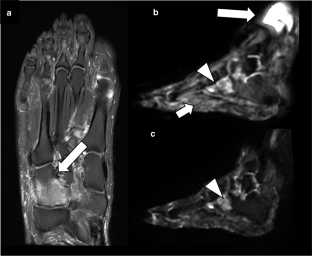
MRI evaluation of the diabetic foot is still a challenge not only from an interpretative but also from a technical point of view. The incorporation of advanced sequences such as diffusion-weighted imaging (DWI) and dynamic contrast-enhanced (DCE) MRI into standard protocols for diabetic foot assessment could aid radiologists in differentiating between neuropathic osteoarthropathy (Charcot's foot) and osteomyelitis. This distinction is crucial as both conditions can coexist in diabetic patients, and they require markedly different clinical management and have distinct prognoses. Over the past decade, several studies have explored the effectiveness of DWI and dynamic contrast-enhanced MRI (DCE-MRI) in distinguishing between septic and reactive bone marrow, as well as soft tissue involvement in diabetic patients, yielding promising results. DWI, without the need for exogenous contrast, can provide insights into the cellularity of bone marrow and soft tissues. DCE-MRI allows for a more precise evaluation of soft tissue and bone marrow perfusion compared to conventional post-gadolinium imaging. The data obtained from these sequences will complement the traditional MRI approach in assessing the diabetic foot. The objective of this review is to familiarize readers with the fundamental concepts of DWI and DCE-MRI, including technical adjustments and practical tips for image interpretation in diabetic foot cases.
期刊介绍:
Skeletal Radiology provides a forum for the dissemination of current knowledge and information dealing with disorders of the musculoskeletal system including the spine. While emphasizing the radiological aspects of the many varied skeletal abnormalities, the journal also adopts an interdisciplinary approach, reflecting the membership of the International Skeletal Society. Thus, the anatomical, pathological, physiological, clinical, metabolic and epidemiological aspects of the many entities affecting the skeleton receive appropriate consideration.
This is the Journal of the International Skeletal Society and the Official Journal of the Society of Skeletal Radiology and the Australasian Musculoskelelal Imaging Group.



 京公网安备 11010802042870号
京ICP备2023020795号-1
京公网安备 11010802042870号
京ICP备2023020795号-1

 分享
分享
 求助内容:
求助内容: 应助结果提醒方式:
 扫码关注我们
