Diana-Alexandra Ertl, Gerda Ratzinger-Stoeger, Adalbert Raimann, Maria Anzengruber, Katharina Skoll, Franz Gabor, Michaela F Hartmann, Stefan A Wudy, Gabriele Hartmann
{"title":"Successful Use of Metyrapone Suppositories in an Infant with Neonatal Cushing and McCune Albright Syndrome: A Case Report.","authors":"Diana-Alexandra Ertl, Gerda Ratzinger-Stoeger, Adalbert Raimann, Maria Anzengruber, Katharina Skoll, Franz Gabor, Michaela F Hartmann, Stefan A Wudy, Gabriele Hartmann","doi":"10.1159/000535266","DOIUrl":null,"url":null,"abstract":"<p><strong>Introduction: </strong>Perinatal hypercorticism, regardless of its cause, has a high mortality or leads to life-long lasting complications. Some publications reported on the use of metyrapone in children with McCune Albright syndrome (MAS) and hypercorticism but also mentioned its poor tolerability.</p><p><strong>Case presentation: </strong>We present the case of a toddler in whom we diagnosed MAS based on pseudo-precocious puberty and hypercorticism at the age of 10 months. In light of hepatopathy, we decided to start the off-label treatment with metyrapone. Being aware of the challenges of this treatment with the only available product (gelatine capsule containing liquid metyrapone) and reports on local irritation and significant side effects after the oral and intrarectal administration of liquid metyrapone, diluted or undiluted, we decided to use the rectal application as suppositories. We started with the dose of 300 mg/m2/day (one administration every 6 h), with the intention to \"block and replace,\" using repeated measurements of serum morning and 23:00 cortisol, salivary cortisol, and 24-h urine steroid profile. After just 2 weeks, we discharged our patient with normal cortisol levels, without additional hydrocortisone substitution and with a total metyrapone dose of 900 mg/m2/day. Lipid profile and arterial pressure normalized, while growth velocity improved progressively.</p><p><strong>Conclusion: </strong>We present the first successful, long-term use of metyrapone as suppositories, with no adverse side effects and striking clinical and biochemical improvement.</p><p><strong>Introduction: </strong>Perinatal hypercorticism, regardless of its cause, has a high mortality or leads to life-long lasting complications. Some publications reported on the use of metyrapone in children with McCune Albright syndrome (MAS) and hypercorticism but also mentioned its poor tolerability.</p><p><strong>Case presentation: </strong>We present the case of a toddler in whom we diagnosed MAS based on pseudo-precocious puberty and hypercorticism at the age of 10 months. In light of hepatopathy, we decided to start the off-label treatment with metyrapone. Being aware of the challenges of this treatment with the only available product (gelatine capsule containing liquid metyrapone) and reports on local irritation and significant side effects after the oral and intrarectal administration of liquid metyrapone, diluted or undiluted, we decided to use the rectal application as suppositories. We started with the dose of 300 mg/m2/day (one administration every 6 h), with the intention to \"block and replace,\" using repeated measurements of serum morning and 23:00 cortisol, salivary cortisol, and 24-h urine steroid profile. After just 2 weeks, we discharged our patient with normal cortisol levels, without additional hydrocortisone substitution and with a total metyrapone dose of 900 mg/m2/day. Lipid profile and arterial pressure normalized, while growth velocity improved progressively.</p><p><strong>Conclusion: </strong>We present the first successful, long-term use of metyrapone as suppositories, with no adverse side effects and striking clinical and biochemical improvement.</p>","PeriodicalId":13025,"journal":{"name":"Hormone Research in Paediatrics","volume":" ","pages":"103-108"},"PeriodicalIF":2.7000,"publicationDate":"2025-01-01","publicationTypes":"Journal Article","fieldsOfStudy":null,"isOpenAccess":false,"openAccessPdf":"https://www.ncbi.nlm.nih.gov/pmc/articles/PMC11854969/pdf/","citationCount":"0","resultStr":null,"platform":"Semanticscholar","paperid":null,"PeriodicalName":"Hormone Research in Paediatrics","FirstCategoryId":"3","ListUrlMain":"https://doi.org/10.1159/000535266","RegionNum":3,"RegionCategory":"医学","ArticlePicture":[],"TitleCN":null,"AbstractTextCN":null,"PMCID":null,"EPubDate":"2023/11/24 0:00:00","PubModel":"Epub","JCR":"Q3","JCRName":"ENDOCRINOLOGY & METABOLISM","Score":null,"Total":0}
引用次数: 0
Abstract
Introduction: Perinatal hypercorticism, regardless of its cause, has a high mortality or leads to life-long lasting complications. Some publications reported on the use of metyrapone in children with McCune Albright syndrome (MAS) and hypercorticism but also mentioned its poor tolerability.
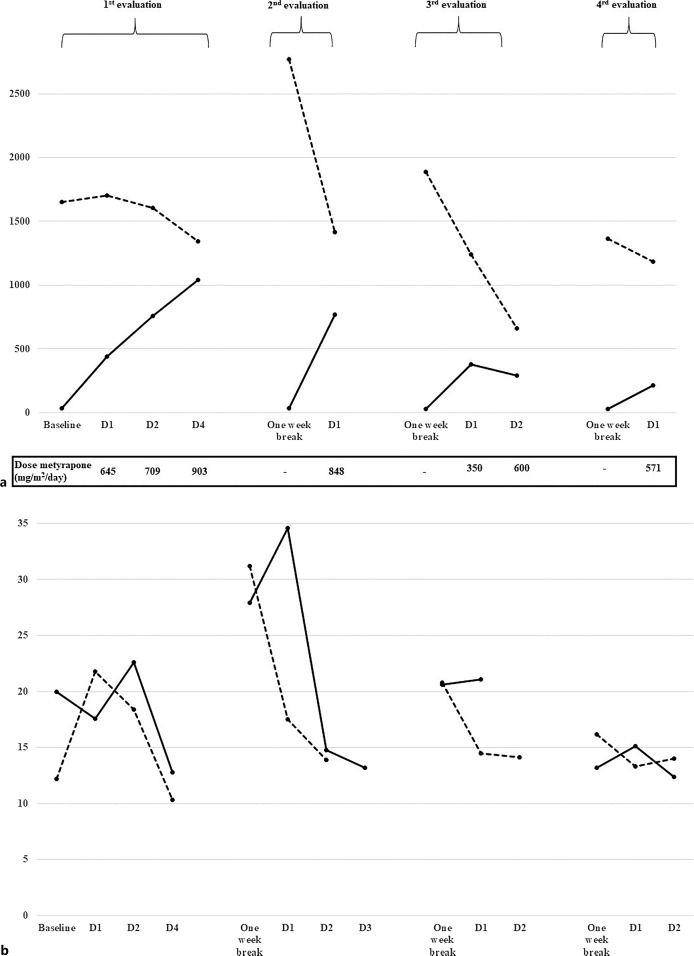
Case presentation: We present the case of a toddler in whom we diagnosed MAS based on pseudo-precocious puberty and hypercorticism at the age of 10 months. In light of hepatopathy, we decided to start the off-label treatment with metyrapone. Being aware of the challenges of this treatment with the only available product (gelatine capsule containing liquid metyrapone) and reports on local irritation and significant side effects after the oral and intrarectal administration of liquid metyrapone, diluted or undiluted, we decided to use the rectal application as suppositories. We started with the dose of 300 mg/m2/day (one administration every 6 h), with the intention to "block and replace," using repeated measurements of serum morning and 23:00 cortisol, salivary cortisol, and 24-h urine steroid profile. After just 2 weeks, we discharged our patient with normal cortisol levels, without additional hydrocortisone substitution and with a total metyrapone dose of 900 mg/m2/day. Lipid profile and arterial pressure normalized, while growth velocity improved progressively.
Conclusion: We present the first successful, long-term use of metyrapone as suppositories, with no adverse side effects and striking clinical and biochemical improvement.
Introduction: Perinatal hypercorticism, regardless of its cause, has a high mortality or leads to life-long lasting complications. Some publications reported on the use of metyrapone in children with McCune Albright syndrome (MAS) and hypercorticism but also mentioned its poor tolerability.
Case presentation: We present the case of a toddler in whom we diagnosed MAS based on pseudo-precocious puberty and hypercorticism at the age of 10 months. In light of hepatopathy, we decided to start the off-label treatment with metyrapone. Being aware of the challenges of this treatment with the only available product (gelatine capsule containing liquid metyrapone) and reports on local irritation and significant side effects after the oral and intrarectal administration of liquid metyrapone, diluted or undiluted, we decided to use the rectal application as suppositories. We started with the dose of 300 mg/m2/day (one administration every 6 h), with the intention to "block and replace," using repeated measurements of serum morning and 23:00 cortisol, salivary cortisol, and 24-h urine steroid profile. After just 2 weeks, we discharged our patient with normal cortisol levels, without additional hydrocortisone substitution and with a total metyrapone dose of 900 mg/m2/day. Lipid profile and arterial pressure normalized, while growth velocity improved progressively.
Conclusion: We present the first successful, long-term use of metyrapone as suppositories, with no adverse side effects and striking clinical and biochemical improvement.
期刊介绍:
The mission of ''Hormone Research in Paediatrics'' is to improve the care of children with endocrine disorders by promoting basic and clinical knowledge. The journal facilitates the dissemination of information through original papers, mini reviews, clinical guidelines and papers on novel insights from clinical practice. Periodic editorials from outstanding paediatric endocrinologists address the main published novelties by critically reviewing the major strengths and weaknesses of the studies.



 京公网安备 11010802042870号
京ICP备2023020795号-1
京公网安备 11010802042870号
京ICP备2023020795号-1

 分享
分享
 求助内容:
求助内容: 应助结果提醒方式:
 扫码关注我们
