Ravi A. Shah MB, BChir, MRCP , C. Anwar A. Chahal MBChB, MRCP, PhD, FACC, FESC, FHRS , Shaheryar Ranjha MD , Ghaith Sharaf Dabbagh MD , Babken Asatryan MD, PhD , Ivan Limongelli MEng, PhD , Mohammed Khanji MBBCh, PhD, MRCP , Fabrizio Ricci MD, PhD , Federica De Paoli MEng , Susanna Zucca MEng, PhD , Martin Tristani-Firouzi MD , Erik K. St. Louis MD, MS , Elson L. So MD , Virend K. Somers MD, PhD
{"title":"Cardiovascular Disease Burden, Mortality, and Sudden Death Risk in Epilepsy: A UK Biobank Study","authors":"Ravi A. Shah MB, BChir, MRCP , C. Anwar A. Chahal MBChB, MRCP, PhD, FACC, FESC, FHRS , Shaheryar Ranjha MD , Ghaith Sharaf Dabbagh MD , Babken Asatryan MD, PhD , Ivan Limongelli MEng, PhD , Mohammed Khanji MBBCh, PhD, MRCP , Fabrizio Ricci MD, PhD , Federica De Paoli MEng , Susanna Zucca MEng, PhD , Martin Tristani-Firouzi MD , Erik K. St. Louis MD, MS , Elson L. So MD , Virend K. Somers MD, PhD","doi":"10.1016/j.cjca.2023.11.021","DOIUrl":null,"url":null,"abstract":"<div><h3>Background</h3><p>Sudden death is the leading cause of mortality in medically refractory epilepsy. Middle-aged persons with epilepsy (PWE) are under investigated regarding their mortality risk and burden of cardiovascular disease (CVD).</p></div><div><h3>Methods</h3><p>Using UK Biobank, we identified 7786 (1.6%) participants with diagnoses of epilepsy and 6,171,803 person-years of follow-up (mean 12.30 years, standard deviation 1.74); 566 patients with previous histories of stroke were excluded. The 7220 PWE comprised the study cohort with the remaining 494,676 without epilepsy as the comparator group. Prevalence of CVD was determined using validated diagnostic codes. Cox proportional hazards regression was used to assess all-cause mortality and sudden death risk.</p></div><div><h3>Results</h3><p>Hypertension, coronary artery disease, heart failure, valvular heart disease, and congenital heart disease were more prevalent in PWE. Arrhythmias including atrial fibrillation/flutter (12.2% vs 6.9%; <em>P</em> < 0.01), bradyarrhythmias (7.7% vs 3.5%; <em>P</em> < 0.01), conduction defects (6.1% vs 2.6%; <em>P</em> < 0.01), and ventricular arrhythmias (2.3% vs 1.0%; <em>P</em> < 0.01), as well as cardiac implantable electric devices (4.6% vs 2.0%; <em>P</em> < 0.01) were more prevalent in PWE. PWE had higher adjusted all-cause mortality (hazard ratio [HR], 3.9; 95% confidence interval [CI], 3.01-3.39), and sudden death-specific mortality (HR, 6.65; 95% CI, 4.53-9.77); and were almost 2 years younger at death (68.1 vs 69.8; <em>P</em> < 0.001).</p></div><div><h3>Conclusions</h3><p>Middle-aged PWE have increased all-cause and sudden death-specific mortality and higher burden of CVD including arrhythmias and heart failure. Further work is required to elucidate mechanisms underlying all-cause mortality and sudden death risk in PWE of middle age, to identify prognostic biomarkers and develop preventative therapies in PWE.</p></div>","PeriodicalId":9555,"journal":{"name":"Canadian Journal of Cardiology","volume":"40 4","pages":"Pages 688-695"},"PeriodicalIF":5.3000,"publicationDate":"2024-04-01","publicationTypes":"Journal Article","fieldsOfStudy":null,"isOpenAccess":false,"openAccessPdf":"","citationCount":"0","resultStr":null,"platform":"Semanticscholar","paperid":null,"PeriodicalName":"Canadian Journal of Cardiology","FirstCategoryId":"3","ListUrlMain":"https://www.sciencedirect.com/science/article/pii/S0828282X23019487","RegionNum":2,"RegionCategory":"医学","ArticlePicture":[],"TitleCN":null,"AbstractTextCN":null,"PMCID":null,"EPubDate":"2023/11/25 0:00:00","PubModel":"Epub","JCR":"Q1","JCRName":"CARDIAC & CARDIOVASCULAR SYSTEMS","Score":null,"Total":0}
引用次数: 0
Abstract
Background
Sudden death is the leading cause of mortality in medically refractory epilepsy. Middle-aged persons with epilepsy (PWE) are under investigated regarding their mortality risk and burden of cardiovascular disease (CVD).
Methods
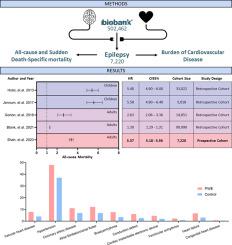
Using UK Biobank, we identified 7786 (1.6%) participants with diagnoses of epilepsy and 6,171,803 person-years of follow-up (mean 12.30 years, standard deviation 1.74); 566 patients with previous histories of stroke were excluded. The 7220 PWE comprised the study cohort with the remaining 494,676 without epilepsy as the comparator group. Prevalence of CVD was determined using validated diagnostic codes. Cox proportional hazards regression was used to assess all-cause mortality and sudden death risk.
Results
Hypertension, coronary artery disease, heart failure, valvular heart disease, and congenital heart disease were more prevalent in PWE. Arrhythmias including atrial fibrillation/flutter (12.2% vs 6.9%; P < 0.01), bradyarrhythmias (7.7% vs 3.5%; P < 0.01), conduction defects (6.1% vs 2.6%; P < 0.01), and ventricular arrhythmias (2.3% vs 1.0%; P < 0.01), as well as cardiac implantable electric devices (4.6% vs 2.0%; P < 0.01) were more prevalent in PWE. PWE had higher adjusted all-cause mortality (hazard ratio [HR], 3.9; 95% confidence interval [CI], 3.01-3.39), and sudden death-specific mortality (HR, 6.65; 95% CI, 4.53-9.77); and were almost 2 years younger at death (68.1 vs 69.8; P < 0.001).
Conclusions
Middle-aged PWE have increased all-cause and sudden death-specific mortality and higher burden of CVD including arrhythmias and heart failure. Further work is required to elucidate mechanisms underlying all-cause mortality and sudden death risk in PWE of middle age, to identify prognostic biomarkers and develop preventative therapies in PWE.
背景:猝死是医学上难治性癫痫死亡的主要原因。正在对中年癫痫患者(PWE)的死亡风险和心血管疾病(CVD)负担进行调查。方法:使用UK Biobank,我们确定了7786名(1.6%)癫痫诊断的参与者和6171803人年的随访(平均12.30年,SD 1.74);566名有中风病史的人被排除在外。7220名PWE组成了研究队列,其余494676名无癫痫患者作为比较组。使用经过验证的诊断代码确定心血管疾病的患病率。采用Cox比例风险回归评估全因死亡率和猝死风险。结果:高血压、冠状动脉疾病、心力衰竭、瓣膜性心脏病和先天性心脏病在PWE中更为普遍。心律失常包括心房颤动/扑动(12.2% vs 6.9%;结论:中年PWE患者的全因死亡率和猝死死亡率增加,心律失常和心力衰竭等心血管疾病负担增加。需要进一步的工作来阐明中年PWE的全因死亡率和猝死风险的机制,确定PWE的预后生物标志物并开发预防性治疗。
期刊介绍:
The Canadian Journal of Cardiology (CJC) is the official journal of the Canadian Cardiovascular Society (CCS). The CJC is a vehicle for the international dissemination of new knowledge in cardiology and cardiovascular science, particularly serving as the major venue for Canadian cardiovascular medicine.




 京公网安备 11010802042870号
京ICP备2023020795号-1
京公网安备 11010802042870号
京ICP备2023020795号-1

 分享
分享
 求助内容:
求助内容: 应助结果提醒方式:
 扫码关注我们
