{"title":"New records of the white-cheeked macaque provide range extension for the endangered primate in Gaoligong Mountains.","authors":"Wenqiang Hu, Hongjiao Wang, Xueyou Li, Xuelong Jiang","doi":"10.1007/s10329-023-01096-3","DOIUrl":null,"url":null,"abstract":"<p><p>White-cheeked macaque Macaca leucogenys is a recently described primate species discovered by camera-trap surveys in the Medog region in 2015. The species was thought to be narrowly distributed in southeastern Tibet. However, knowledge on the distribution and conservation of the species is quite limited. Based on a systematic camera-trapping survey, we report the occurrence of the species in the Gaoligong Mountains, over 350 km southeast of the nearest known population. We recorded 3025 photographs of white-cheeked macaques representing 481 independent records from 59 camera-trap stations with total trapping efforts of 18,437 camera days. Notably, part of the newly discovered locations of the white-cheeked macaque are outside of nature reserves without any formal protection and management. Our survey also confirms the occurrence of ten primate species in the Gaoligong Mountains, accounting for 35.7% of China's primates, including the Skywalker hoolock gibbon Hoolock tianxing and the Myanmar snub-nosed monkey Rhinopithecus strykeri etc. These findings reveal a new distribution record for the white-cheeked macaque and further highlight the conservation values of Gaoligong Mountains for globally threatened primate species. We also provide a preliminary report on the daily activity patterns of this endangered species, which enriches the bio-ecological data of the poorly studied species. We believe the report has significant implications for understanding the ecology of the species and improving conservation planning.</p>","PeriodicalId":20468,"journal":{"name":"Primates","volume":" ","pages":"15-19"},"PeriodicalIF":1.5000,"publicationDate":"2024-01-01","publicationTypes":"Journal Article","fieldsOfStudy":null,"isOpenAccess":false,"openAccessPdf":"","citationCount":"0","resultStr":null,"platform":"Semanticscholar","paperid":null,"PeriodicalName":"Primates","FirstCategoryId":"99","ListUrlMain":"https://doi.org/10.1007/s10329-023-01096-3","RegionNum":4,"RegionCategory":"生物学","ArticlePicture":[],"TitleCN":null,"AbstractTextCN":null,"PMCID":null,"EPubDate":"2023/11/6 0:00:00","PubModel":"Epub","JCR":"Q2","JCRName":"ZOOLOGY","Score":null,"Total":0}
引用次数: 0
Abstract
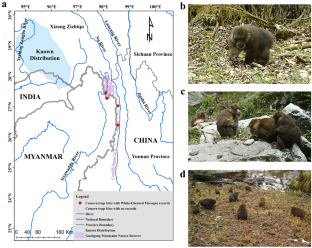
White-cheeked macaque Macaca leucogenys is a recently described primate species discovered by camera-trap surveys in the Medog region in 2015. The species was thought to be narrowly distributed in southeastern Tibet. However, knowledge on the distribution and conservation of the species is quite limited. Based on a systematic camera-trapping survey, we report the occurrence of the species in the Gaoligong Mountains, over 350 km southeast of the nearest known population. We recorded 3025 photographs of white-cheeked macaques representing 481 independent records from 59 camera-trap stations with total trapping efforts of 18,437 camera days. Notably, part of the newly discovered locations of the white-cheeked macaque are outside of nature reserves without any formal protection and management. Our survey also confirms the occurrence of ten primate species in the Gaoligong Mountains, accounting for 35.7% of China's primates, including the Skywalker hoolock gibbon Hoolock tianxing and the Myanmar snub-nosed monkey Rhinopithecus strykeri etc. These findings reveal a new distribution record for the white-cheeked macaque and further highlight the conservation values of Gaoligong Mountains for globally threatened primate species. We also provide a preliminary report on the daily activity patterns of this endangered species, which enriches the bio-ecological data of the poorly studied species. We believe the report has significant implications for understanding the ecology of the species and improving conservation planning.
期刊介绍:
Primates is an international journal of primatology whose aim is to provide a forum for the elucidation of all aspects of primates. The oldest primatological journal, Primates publishes original papers that advance the scientific study of primates, and its scope embraces work in diverse fields covering biological bases of behavior, socio-ecology, learning and cognition, social processes, systematics, evolution, and medicine. Contributions relevant to conservation of natural populations and welfare of captive primates are welcome. Studies focusing on nonprimate species may be considered if their relevance to primatology is clear. Original Articles as well as Review Articles, News and Perspectives, and Book Reviews are included. All manuscripts received are initially screened for suitability by members of the Editorial Board, taking into account style and ethical issues, leading to a swift decision about whether to send the manuscript for external review.



 京公网安备 11010802042870号
京ICP备2023020795号-1
京公网安备 11010802042870号
京ICP备2023020795号-1

 分享
分享
 求助内容:
求助内容: 应助结果提醒方式:
 扫码关注我们
