Fidan Turk, Jennifer Sweetman, Gail Allsopp, Michael Crooks, Dan J Cuthbertson, Mark Gabbay, Lyth Hishmeh, Gregory Y. H. Lip, W. David Strain, Nefyn Williams, Dan Wootton, Amitava Banerjee, Christina van der Feltz-Cornelis, STIMULATE-ICP Consortium
{"title":"Pathways to care for Long COVID and for long-term conditions from patients' and clinicians' perspective","authors":"Fidan Turk, Jennifer Sweetman, Gail Allsopp, Michael Crooks, Dan J Cuthbertson, Mark Gabbay, Lyth Hishmeh, Gregory Y. H. Lip, W. David Strain, Nefyn Williams, Dan Wootton, Amitava Banerjee, Christina van der Feltz-Cornelis, STIMULATE-ICP Consortium","doi":"10.1111/jebm.12563","DOIUrl":null,"url":null,"abstract":"<p>Long COVID (LC) affects approximately 45% of COVID-19 survivors,<span><sup>1</sup></span> featuring persistent symptoms lasting over 4 weeks without an alternative explanation.<span><sup>2</sup></span> The recent development of LC services aims to provide structured or integrated care.<span><sup>3</sup></span> Given the current challenges in the UK healthcare system, we explored access to care for people with LC. We compared this to other long-term conditions (LTCs), concerning four filters for accessing care as defined in the Pathways-to-Care model,<span><sup>4</sup></span> to inform policy and service planning across diseases and specialities. Those filters include the person's decision to seek care (filter 1), the decision of the General Practitioner (GP) to provide diagnosis and treatment in primary care (filter 2), the GP's decision to refer the patient to specialist care (filter 3), and the arrival of the patient in outpatient specialist care (filter 4). The second filter concerns a complex process combining the patient's perspective of their health problems being recognized by the GP and diagnostic, treatment, or referral actions taken by GPs that indicate that the GP recognized the patient's problem. We expanded this recognition concept to include other healthcare professionals (HCPs) in primary care.</p><p>We conducted an online survey from April to June 2022 as part of the STIMULATE-ICP-Delphi study. Using snowball sampling, we recruited 283 participants, including patients and HCPs, with experience in LC and LTCs. We incorporated patient and public involvement and used descriptive statistics. The protocol for this Delphi study was approved by the University of York Department of Health Sciences Research Governance Committee in 2021 (HSRGC/2021/ 478/A: STIMULATE-ICP) and has been published.<span><sup>5</sup></span></p><p>The process of seeking treatment, treatment(s) offered, and referring for specialist support was explored among patients, GPs, and other HCPs. Respondents' age, sex, relationship and employment status, ethnicity, and locations were collected. The survey included questions about the relevant disease experience as a patient or HCP. For filters 2, 3, and 4, patients were asked to indicate if they received any care and to specify the care offered (e.g., tests) using drop-down and free-response formats. Regarding filter 2—recognition by the HCP—this was operationalized as whether patients were offered diagnostic tests or treatment in primary care or referred by the GP to specialist care. Patients were also asked to provide their perspectives on their health problems being recognized by their HCP. Similar questions were asked of HCPs for filters 2, 3, and 4.</p><p>Table S1 provides demographic information for 283 participants. Figure S1 outlines participant screening, and Figure S2 displays responses and missing data. Ninety-six percent of patients with LC and 98% with LTCs sought health care (filter 1). The most common symptom leading to care-seeking for both groups was tiredness (for the full list, Table S2). LC patients had varying symptom durations, while most LTCs patients had symptoms lasting over 18 months (Table S2).</p><p>All patients with LC and with LTCs visiting their GP were provided access to care: diagnostic tests or treatment in primary care or referral to specialist services (filter 2). The proportion of LC and LTC patients who received diagnostic tests (mostly blood tests) and treatments was similar. For LC, 71% of HCPs indicated they provided diagnostic tests and 57% treatment in their practice. For LTCs, this was reported as 80% and 90%, respectively. Although all patients received access to primary care, only 51% of LC patients and 62% with LTCs reported that their HCPs recognized their problem when explicitly asked.</p><p>GPs referred 71% (LC patients) and 76% (LTC patients) to specialists. Of those with LC, 65 (35%) received referrals to post-COVID clinics, while others were referred to clinics relevant to their dominant symptoms, such as cardiology, neurology, or respiratory clinics. More than one referral was made for 46% of LC patients and 28% of LTC patients. All GPs reported referring patients with LC to a specialist, and all reported that they referred patients with LTCs for specialist care (filter 3).</p><p>Two-thirds of referred patients attended specialist appointments, while around one-third in each group were on a waiting list (filter 4). Figure 1 presents a revised model, reflecting the proportion of participants who progressed from seeking health care to accessing specialist care.</p><p>The original pathway-to-care model for mental health care described by Goldberg and Huxley has a pyramidal shape. However, the model emanating from our study, as reported by patients and HCPs, looks more block-shaped. Patients with LC and LTCs share similar experiences navigating the four filters to access care. Almost all patients with symptoms seek care, and all of those are provided access to primary care by the GP through diagnosis and treatment. This access level is 100%, whereas, in Goldberg and Huxley's findings, only 61% of patients passed filter 2 for mental health care. This might be explained by a difference in access to mental health services versus access to somatic health services. Another factor could be improved access to primary care since the 1980s. Primary care, led by GPs, has evolved to manage complex and multimorbid patients, with expanded support from practice nurses and allied health professionals. A Kings Fund report showed that the productivity of the NHS in terms of service provision has increased massively, and the majority of NHS activity is in primary care.<span><sup>6</sup></span> Also, LC clinics have been set up to address the new demands during the pandemic.</p><p>Referral rates to specialists were also high; however, in both groups, access to specialists for those referred needed to be completed. This might be caused by delays due to waiting lists, as the number of people deciding not to access specialist care was low. The percentage of people on a waiting list was alarming and this was a problem that had been highlighted by the King's Fund for elective hospital treatments. This study showed it also applied to outpatient specialist access to care and might need a similar, concerted, vigorous approach as suggested by the King's Fund.<span><sup>7</sup></span> Most patients referred to specialists would be seen, assessed, and treatment recommendations made before being discharged to primary care. Specialists would only hold onto patients if further investigations were planned or if treatment required ongoing secondary care input. The study highlighted the need for enhanced data exchange between primary and secondary care via a shared electronic health record. Such improvements support ongoing monitoring, case identification, and resource allocation decisions. The concept of the “learning health system,” with data flowing between routine care, science, and evidence, was crucial<span><sup>8</sup></span> to avoid difficulties moving forward and to prevent worsening inequalities.</p><p>Alternative care models, such as the Nuka model in Alaska, could be explored to improve access to specialist knowledge in primary care. The Nuka System of Care uses secondary care expertise to inform primary care practice, with multidisciplinary teams providing integrated health and care services in primary care centers and the community, coordinating with other services.<span><sup>9</sup></span> Other alternative models relevant to integrating primary and secondary care, especially for comorbid somatic and psychiatric LTCs, could be psychiatric consultation models in primary care. These were effective in comorbid depression and long-term somatic conditions, especially if embedded in collaborative care<span><sup>10</sup></span> and if after the consultation, a consultation letter was provided by the psychiatry consultant to the primary care team, to facilitate discussion with the patient about their future treatment.</p><p>The discrepancy between patients' perceived recognition of the problem and the high level of actions taken by HCPs was striking. In both patient' groups, having access did not necessarily mean that the HCP recognized their problem. For LC, this discrepancy might be explained by the fact that it was a new condition for which much was still unknown, or by the limited time for engagement between patients and their GPs. In other LTCs, this might be due to the delegation of treatment to practice nurses, resulting in less contact with GPs, as was typical for diabetes, or cardiovascular conditions.</p><p>This study was the first to explore barriers and facilitators to care access for people with LC and with other LTCs using the pathway-to-care filter model. The large and diverse sample provided the perspectives of patients and clinicians for all relevant filters. The finding that patient responses were similar to those of HCPs suggested that this survey gave a balanced perspective on pathways to care for LC and LTCs.</p><p>Self-reporting in this context could be considered as equivalent to a confirmed medical diagnosis, and the classification of LC or a LTC was probably correct in this sample.<span><sup>11</sup></span> Nevertheless, there might be bias in the classification of the main symptom. For example, breathlessness could be classified as cardiological but also as respiratory.</p><p>Future research could examine the factors that impede or promote access to care for patients with LC and other LTCs such as health inequalities and demographic characteristics. The extent to which primary care provided a holding relationship<span><sup>12</sup></span> for patients with LC and LTCs still needs to be explored, especially the interaction between primary care, specialist care, and A&E services. Research could help shape the reorganization of primary care services integrated with secondary care.</p>","PeriodicalId":16090,"journal":{"name":"Journal of Evidence‐Based Medicine","volume":"16 4","pages":"435-437"},"PeriodicalIF":3.5000,"publicationDate":"2023-11-30","publicationTypes":"Journal Article","fieldsOfStudy":null,"isOpenAccess":false,"openAccessPdf":"https://onlinelibrary.wiley.com/doi/epdf/10.1111/jebm.12563","citationCount":"0","resultStr":null,"platform":"Semanticscholar","paperid":null,"PeriodicalName":"Journal of Evidence‐Based Medicine","FirstCategoryId":"3","ListUrlMain":"https://onlinelibrary.wiley.com/doi/10.1111/jebm.12563","RegionNum":2,"RegionCategory":"医学","ArticlePicture":[],"TitleCN":null,"AbstractTextCN":null,"PMCID":null,"EPubDate":"","PubModel":"","JCR":"Q1","JCRName":"MEDICINE, GENERAL & INTERNAL","Score":null,"Total":0}
引用次数: 0
Abstract
Long COVID (LC) affects approximately 45% of COVID-19 survivors,1 featuring persistent symptoms lasting over 4 weeks without an alternative explanation.2 The recent development of LC services aims to provide structured or integrated care.3 Given the current challenges in the UK healthcare system, we explored access to care for people with LC. We compared this to other long-term conditions (LTCs), concerning four filters for accessing care as defined in the Pathways-to-Care model,4 to inform policy and service planning across diseases and specialities. Those filters include the person's decision to seek care (filter 1), the decision of the General Practitioner (GP) to provide diagnosis and treatment in primary care (filter 2), the GP's decision to refer the patient to specialist care (filter 3), and the arrival of the patient in outpatient specialist care (filter 4). The second filter concerns a complex process combining the patient's perspective of their health problems being recognized by the GP and diagnostic, treatment, or referral actions taken by GPs that indicate that the GP recognized the patient's problem. We expanded this recognition concept to include other healthcare professionals (HCPs) in primary care.
We conducted an online survey from April to June 2022 as part of the STIMULATE-ICP-Delphi study. Using snowball sampling, we recruited 283 participants, including patients and HCPs, with experience in LC and LTCs. We incorporated patient and public involvement and used descriptive statistics. The protocol for this Delphi study was approved by the University of York Department of Health Sciences Research Governance Committee in 2021 (HSRGC/2021/ 478/A: STIMULATE-ICP) and has been published.5
The process of seeking treatment, treatment(s) offered, and referring for specialist support was explored among patients, GPs, and other HCPs. Respondents' age, sex, relationship and employment status, ethnicity, and locations were collected. The survey included questions about the relevant disease experience as a patient or HCP. For filters 2, 3, and 4, patients were asked to indicate if they received any care and to specify the care offered (e.g., tests) using drop-down and free-response formats. Regarding filter 2—recognition by the HCP—this was operationalized as whether patients were offered diagnostic tests or treatment in primary care or referred by the GP to specialist care. Patients were also asked to provide their perspectives on their health problems being recognized by their HCP. Similar questions were asked of HCPs for filters 2, 3, and 4.
Table S1 provides demographic information for 283 participants. Figure S1 outlines participant screening, and Figure S2 displays responses and missing data. Ninety-six percent of patients with LC and 98% with LTCs sought health care (filter 1). The most common symptom leading to care-seeking for both groups was tiredness (for the full list, Table S2). LC patients had varying symptom durations, while most LTCs patients had symptoms lasting over 18 months (Table S2).
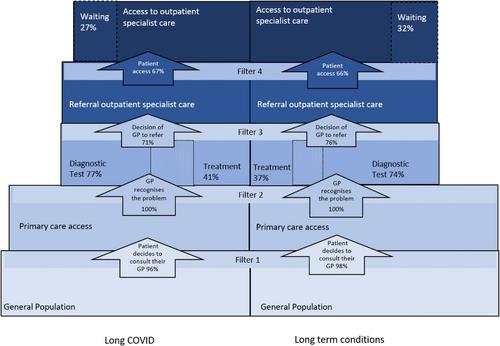
All patients with LC and with LTCs visiting their GP were provided access to care: diagnostic tests or treatment in primary care or referral to specialist services (filter 2). The proportion of LC and LTC patients who received diagnostic tests (mostly blood tests) and treatments was similar. For LC, 71% of HCPs indicated they provided diagnostic tests and 57% treatment in their practice. For LTCs, this was reported as 80% and 90%, respectively. Although all patients received access to primary care, only 51% of LC patients and 62% with LTCs reported that their HCPs recognized their problem when explicitly asked.
GPs referred 71% (LC patients) and 76% (LTC patients) to specialists. Of those with LC, 65 (35%) received referrals to post-COVID clinics, while others were referred to clinics relevant to their dominant symptoms, such as cardiology, neurology, or respiratory clinics. More than one referral was made for 46% of LC patients and 28% of LTC patients. All GPs reported referring patients with LC to a specialist, and all reported that they referred patients with LTCs for specialist care (filter 3).
Two-thirds of referred patients attended specialist appointments, while around one-third in each group were on a waiting list (filter 4). Figure 1 presents a revised model, reflecting the proportion of participants who progressed from seeking health care to accessing specialist care.
The original pathway-to-care model for mental health care described by Goldberg and Huxley has a pyramidal shape. However, the model emanating from our study, as reported by patients and HCPs, looks more block-shaped. Patients with LC and LTCs share similar experiences navigating the four filters to access care. Almost all patients with symptoms seek care, and all of those are provided access to primary care by the GP through diagnosis and treatment. This access level is 100%, whereas, in Goldberg and Huxley's findings, only 61% of patients passed filter 2 for mental health care. This might be explained by a difference in access to mental health services versus access to somatic health services. Another factor could be improved access to primary care since the 1980s. Primary care, led by GPs, has evolved to manage complex and multimorbid patients, with expanded support from practice nurses and allied health professionals. A Kings Fund report showed that the productivity of the NHS in terms of service provision has increased massively, and the majority of NHS activity is in primary care.6 Also, LC clinics have been set up to address the new demands during the pandemic.
Referral rates to specialists were also high; however, in both groups, access to specialists for those referred needed to be completed. This might be caused by delays due to waiting lists, as the number of people deciding not to access specialist care was low. The percentage of people on a waiting list was alarming and this was a problem that had been highlighted by the King's Fund for elective hospital treatments. This study showed it also applied to outpatient specialist access to care and might need a similar, concerted, vigorous approach as suggested by the King's Fund.7 Most patients referred to specialists would be seen, assessed, and treatment recommendations made before being discharged to primary care. Specialists would only hold onto patients if further investigations were planned or if treatment required ongoing secondary care input. The study highlighted the need for enhanced data exchange between primary and secondary care via a shared electronic health record. Such improvements support ongoing monitoring, case identification, and resource allocation decisions. The concept of the “learning health system,” with data flowing between routine care, science, and evidence, was crucial8 to avoid difficulties moving forward and to prevent worsening inequalities.
Alternative care models, such as the Nuka model in Alaska, could be explored to improve access to specialist knowledge in primary care. The Nuka System of Care uses secondary care expertise to inform primary care practice, with multidisciplinary teams providing integrated health and care services in primary care centers and the community, coordinating with other services.9 Other alternative models relevant to integrating primary and secondary care, especially for comorbid somatic and psychiatric LTCs, could be psychiatric consultation models in primary care. These were effective in comorbid depression and long-term somatic conditions, especially if embedded in collaborative care10 and if after the consultation, a consultation letter was provided by the psychiatry consultant to the primary care team, to facilitate discussion with the patient about their future treatment.
The discrepancy between patients' perceived recognition of the problem and the high level of actions taken by HCPs was striking. In both patient' groups, having access did not necessarily mean that the HCP recognized their problem. For LC, this discrepancy might be explained by the fact that it was a new condition for which much was still unknown, or by the limited time for engagement between patients and their GPs. In other LTCs, this might be due to the delegation of treatment to practice nurses, resulting in less contact with GPs, as was typical for diabetes, or cardiovascular conditions.
This study was the first to explore barriers and facilitators to care access for people with LC and with other LTCs using the pathway-to-care filter model. The large and diverse sample provided the perspectives of patients and clinicians for all relevant filters. The finding that patient responses were similar to those of HCPs suggested that this survey gave a balanced perspective on pathways to care for LC and LTCs.
Self-reporting in this context could be considered as equivalent to a confirmed medical diagnosis, and the classification of LC or a LTC was probably correct in this sample.11 Nevertheless, there might be bias in the classification of the main symptom. For example, breathlessness could be classified as cardiological but also as respiratory.
Future research could examine the factors that impede or promote access to care for patients with LC and other LTCs such as health inequalities and demographic characteristics. The extent to which primary care provided a holding relationship12 for patients with LC and LTCs still needs to be explored, especially the interaction between primary care, specialist care, and A&E services. Research could help shape the reorganization of primary care services integrated with secondary care.
期刊介绍:
The Journal of Evidence-Based Medicine (EMB) is an esteemed international healthcare and medical decision-making journal, dedicated to publishing groundbreaking research outcomes in evidence-based decision-making, research, practice, and education. Serving as the official English-language journal of the Cochrane China Centre and West China Hospital of Sichuan University, we eagerly welcome editorials, commentaries, and systematic reviews encompassing various topics such as clinical trials, policy, drug and patient safety, education, and knowledge translation.




 京公网安备 11010802042870号
京ICP备2023020795号-1
京公网安备 11010802042870号
京ICP备2023020795号-1

 分享
分享
 求助内容:
求助内容: 应助结果提醒方式:
 扫码关注我们
