Michelle Bezanson, Liliana Cortés-Ortiz, Júlio César Bicca-Marques, Ramesh Boonratana, Susana Carvalho, Marina Cords, Stella de la Torre, Catherine Hobaiter, Tatyana Humle, Patrícia Izar, Jessica W Lynch, Tetsuro Matsuzawa, Joanna M Setchell, Gladys Kalema Zikusoka, Karen B Strier
{"title":"News and Perspectives: Words matter in primatology.","authors":"Michelle Bezanson, Liliana Cortés-Ortiz, Júlio César Bicca-Marques, Ramesh Boonratana, Susana Carvalho, Marina Cords, Stella de la Torre, Catherine Hobaiter, Tatyana Humle, Patrícia Izar, Jessica W Lynch, Tetsuro Matsuzawa, Joanna M Setchell, Gladys Kalema Zikusoka, Karen B Strier","doi":"10.1007/s10329-023-01104-6","DOIUrl":null,"url":null,"abstract":"<p><p>Postings on social media on Twitter (now X), BioAnthropology News (Facebook), and other venues, as well as recent publications in prominent journals, show that primatologists, ecologists, and other researchers are questioning the terms \"Old World\" and \"New World\" due to their colonial implications and history. The terms are offensive if they result in erasing Indigenous voices and history, ignoring the fact that Indigenous peoples were in the Americas long before European colonization. Language use is not without context, but alternative terminology is not always obvious and available. In this perspective, we share opinions expressed by an international group of primatologists who considered questions about the use of these terms, whether primatologists should adjust language use, and how to move forward. The diversity of opinions provides insight into how conventional terms used in primatological research and conservation may impact our effectiveness in these domains.</p>","PeriodicalId":20468,"journal":{"name":"Primates","volume":" ","pages":"33-39"},"PeriodicalIF":1.5000,"publicationDate":"2024-01-01","publicationTypes":"Journal Article","fieldsOfStudy":null,"isOpenAccess":false,"openAccessPdf":"https://www.ncbi.nlm.nih.gov/pmc/articles/PMC10796633/pdf/","citationCount":"0","resultStr":null,"platform":"Semanticscholar","paperid":null,"PeriodicalName":"Primates","FirstCategoryId":"99","ListUrlMain":"https://doi.org/10.1007/s10329-023-01104-6","RegionNum":4,"RegionCategory":"生物学","ArticlePicture":[],"TitleCN":null,"AbstractTextCN":null,"PMCID":null,"EPubDate":"2023/11/30 0:00:00","PubModel":"Epub","JCR":"Q2","JCRName":"ZOOLOGY","Score":null,"Total":0}
引用次数: 0
Abstract
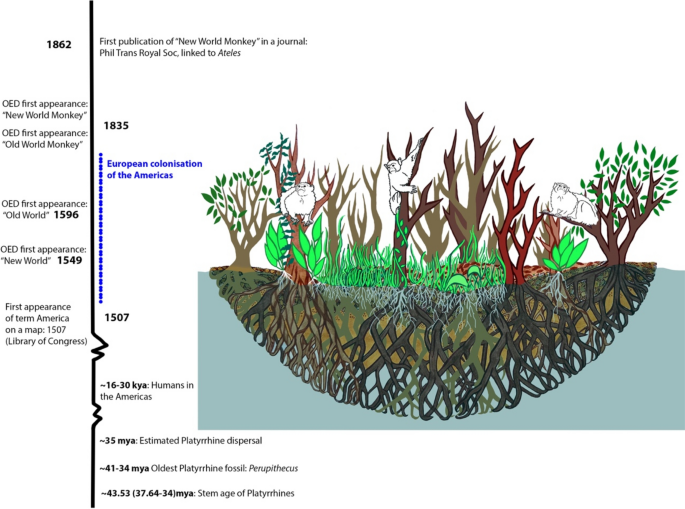
Postings on social media on Twitter (now X), BioAnthropology News (Facebook), and other venues, as well as recent publications in prominent journals, show that primatologists, ecologists, and other researchers are questioning the terms "Old World" and "New World" due to their colonial implications and history. The terms are offensive if they result in erasing Indigenous voices and history, ignoring the fact that Indigenous peoples were in the Americas long before European colonization. Language use is not without context, but alternative terminology is not always obvious and available. In this perspective, we share opinions expressed by an international group of primatologists who considered questions about the use of these terms, whether primatologists should adjust language use, and how to move forward. The diversity of opinions provides insight into how conventional terms used in primatological research and conservation may impact our effectiveness in these domains.
期刊介绍:
Primates is an international journal of primatology whose aim is to provide a forum for the elucidation of all aspects of primates. The oldest primatological journal, Primates publishes original papers that advance the scientific study of primates, and its scope embraces work in diverse fields covering biological bases of behavior, socio-ecology, learning and cognition, social processes, systematics, evolution, and medicine. Contributions relevant to conservation of natural populations and welfare of captive primates are welcome. Studies focusing on nonprimate species may be considered if their relevance to primatology is clear. Original Articles as well as Review Articles, News and Perspectives, and Book Reviews are included. All manuscripts received are initially screened for suitability by members of the Editorial Board, taking into account style and ethical issues, leading to a swift decision about whether to send the manuscript for external review.



 京公网安备 11010802042870号
京ICP备2023020795号-1
京公网安备 11010802042870号
京ICP备2023020795号-1

 分享
分享
 求助内容:
求助内容: 应助结果提醒方式:
 扫码关注我们
