{"title":"Exercise and Ischemia-Activated Pathways in Limb Muscle Angiogenesis and Vascular Regeneration.","authors":"Vihang A Narkar","doi":"10.14797/mdcvj.1304","DOIUrl":null,"url":null,"abstract":"<p><p>Exercise has a profound effect on cardiovascular disease, particularly through vascular remodeling and regeneration. Peripheral artery disease (PAD) is one such cardiovascular condition that benefits from regular exercise or rehabilitative physical therapy in terms of slowing the progression of disease and delaying amputations. Various rodent pre-clinical studies using models of PAD and exercise have shed light on molecular pathways of vascular regeneration. Here, I review key exercise-activated signaling pathways (nuclear receptors, kinases, and hypoxia inducible factors) in the skeletal muscle that drive paracrine regenerative angiogenesis. The rationale for highlighting the skeletal muscle is that it is the largest organ recruited during exercise. During exercise, skeletal muscle releases several myokines, including angiogenic factors and cytokines that drive tissue vascular regeneration via activation of endothelial cells, as well as by recruiting immune and endothelial progenitor cells. Some of these core exercise-activated pathways can be extrapolated to vascular regeneration in other organs. I also highlight future areas of exercise research (including metabolomics, single cell transcriptomics, and extracellular vesicle biology) to advance our understanding of how exercise induces vascular regeneration at the molecular level, and propose the idea of \"exercise-mimicking\" therapeutics for vascular recovery.</p>","PeriodicalId":39207,"journal":{"name":"Methodist DeBakey cardiovascular journal","volume":"19 5","pages":"58-68"},"PeriodicalIF":0.0000,"publicationDate":"2023-11-16","publicationTypes":"Journal Article","fieldsOfStudy":null,"isOpenAccess":false,"openAccessPdf":"https://www.ncbi.nlm.nih.gov/pmc/articles/PMC10655757/pdf/","citationCount":"0","resultStr":null,"platform":"Semanticscholar","paperid":null,"PeriodicalName":"Methodist DeBakey cardiovascular journal","FirstCategoryId":"1085","ListUrlMain":"https://doi.org/10.14797/mdcvj.1304","RegionNum":0,"RegionCategory":null,"ArticlePicture":[],"TitleCN":null,"AbstractTextCN":null,"PMCID":null,"EPubDate":"2023/1/1 0:00:00","PubModel":"eCollection","JCR":"Q2","JCRName":"Medicine","Score":null,"Total":0}
引用次数: 0
Abstract
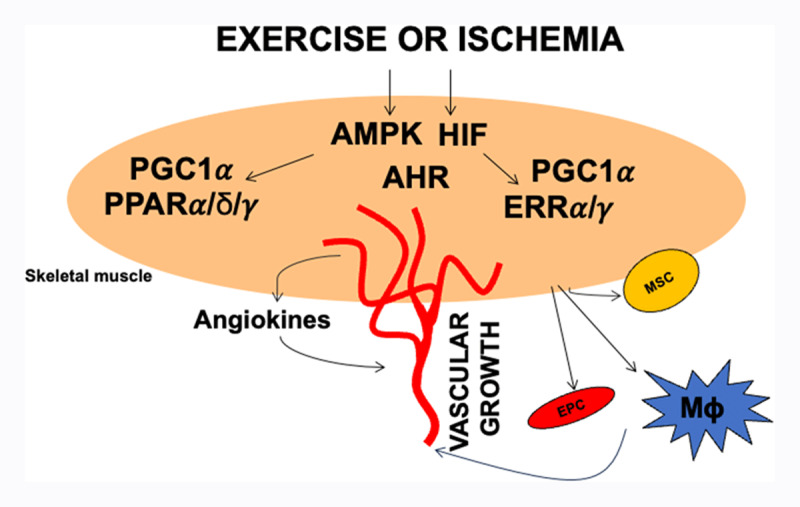
Exercise has a profound effect on cardiovascular disease, particularly through vascular remodeling and regeneration. Peripheral artery disease (PAD) is one such cardiovascular condition that benefits from regular exercise or rehabilitative physical therapy in terms of slowing the progression of disease and delaying amputations. Various rodent pre-clinical studies using models of PAD and exercise have shed light on molecular pathways of vascular regeneration. Here, I review key exercise-activated signaling pathways (nuclear receptors, kinases, and hypoxia inducible factors) in the skeletal muscle that drive paracrine regenerative angiogenesis. The rationale for highlighting the skeletal muscle is that it is the largest organ recruited during exercise. During exercise, skeletal muscle releases several myokines, including angiogenic factors and cytokines that drive tissue vascular regeneration via activation of endothelial cells, as well as by recruiting immune and endothelial progenitor cells. Some of these core exercise-activated pathways can be extrapolated to vascular regeneration in other organs. I also highlight future areas of exercise research (including metabolomics, single cell transcriptomics, and extracellular vesicle biology) to advance our understanding of how exercise induces vascular regeneration at the molecular level, and propose the idea of "exercise-mimicking" therapeutics for vascular recovery.





 京公网安备 11010802042870号
京ICP备2023020795号-1
京公网安备 11010802042870号
京ICP备2023020795号-1

 分享
分享
 求助内容:
求助内容: 应助结果提醒方式:
 扫码关注我们
