E Zhu, Fuguo Li, Qian Zhao, Xuehan An, Siddique Farah, Kenan Yao
{"title":"Phase transformation and deformation behavior under isothermal compression in β-quenched metastable Ti-10V-2Fe-3Al alloy","authors":"E Zhu, Fuguo Li, Qian Zhao, Xuehan An, Siddique Farah, Kenan Yao","doi":"10.1016/j.mtcomm.2023.107727","DOIUrl":null,"url":null,"abstract":"<p>Comprehensive knowledge on the hot deformation behavior and microstructure evolution of metastable titanium alloys is critical for process optimization and microstructure regulation. The isothermal compression of β-quenched metastable titanium alloys (Ti-10V-2Fe-3Al) was experimented at different temperatures (600 ℃-800 ℃) with the strain rate of 10<sup>-3</sup>s<sup>-1</sup> in present work. The stress-strain curves show that the flow stress reduces with increasing temperature, and the characteristics of the stress-strain curve at low temperature (600 ℃) are clearly distinct from those at other high temperatures. During the isothermal compression process at 600 °C, the deformation went through four stages: initial linear hardening (stage Ⅰ), <em>Discontinuous yielding phenomenon</em> (<em>DYP</em>, stage Ⅱ) followed by work hardening (stage Ⅲ) and final flow softening (stage Ⅳ). Further observations of the microstructure throughout each deformation stage revealed that the precipitation of α<sub>GB</sub> and the proliferation of dislocation lead to initial linear hardening behavior. The softening of deformation behavior during the discontinuous yield stage is originated from the fragmentation of α<sub>GB</sub> and the generation of a large amount of moving dislocations. Almost all β phase transformed into lamellar α phase as the deformation degree increased, which is the main cause of work hardening after discontinuous yield. The major causes of final flow softening are the formation of deformation bands and spheroidization of α phase. The present work analyses the correlation between the deformation behavior and microstructure features on the deformation mechanisms of metastable β titanium alloys and reveals the potential mechanism of metastable β alloy under thermal deformation and provides more comprehensive information for the optimization of the process parameters of hot deformation.</p>","PeriodicalId":18477,"journal":{"name":"Materials Today Communications","volume":"89 2","pages":""},"PeriodicalIF":4.5000,"publicationDate":"2023-11-30","publicationTypes":"Journal Article","fieldsOfStudy":null,"isOpenAccess":false,"openAccessPdf":"","citationCount":"0","resultStr":null,"platform":"Semanticscholar","paperid":null,"PeriodicalName":"Materials Today Communications","FirstCategoryId":"88","ListUrlMain":"https://doi.org/10.1016/j.mtcomm.2023.107727","RegionNum":3,"RegionCategory":"材料科学","ArticlePicture":[],"TitleCN":null,"AbstractTextCN":null,"PMCID":null,"EPubDate":"","PubModel":"","JCR":"Q2","JCRName":"MATERIALS SCIENCE, MULTIDISCIPLINARY","Score":null,"Total":0}
引用次数: 0
Abstract
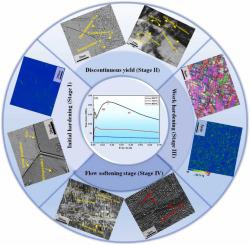
Comprehensive knowledge on the hot deformation behavior and microstructure evolution of metastable titanium alloys is critical for process optimization and microstructure regulation. The isothermal compression of β-quenched metastable titanium alloys (Ti-10V-2Fe-3Al) was experimented at different temperatures (600 ℃-800 ℃) with the strain rate of 10-3s-1 in present work. The stress-strain curves show that the flow stress reduces with increasing temperature, and the characteristics of the stress-strain curve at low temperature (600 ℃) are clearly distinct from those at other high temperatures. During the isothermal compression process at 600 °C, the deformation went through four stages: initial linear hardening (stage Ⅰ), Discontinuous yielding phenomenon (DYP, stage Ⅱ) followed by work hardening (stage Ⅲ) and final flow softening (stage Ⅳ). Further observations of the microstructure throughout each deformation stage revealed that the precipitation of αGB and the proliferation of dislocation lead to initial linear hardening behavior. The softening of deformation behavior during the discontinuous yield stage is originated from the fragmentation of αGB and the generation of a large amount of moving dislocations. Almost all β phase transformed into lamellar α phase as the deformation degree increased, which is the main cause of work hardening after discontinuous yield. The major causes of final flow softening are the formation of deformation bands and spheroidization of α phase. The present work analyses the correlation between the deformation behavior and microstructure features on the deformation mechanisms of metastable β titanium alloys and reveals the potential mechanism of metastable β alloy under thermal deformation and provides more comprehensive information for the optimization of the process parameters of hot deformation.
期刊介绍:
Materials Today Communications is a primary research journal covering all areas of materials science. The journal offers the materials community an innovative, efficient and flexible route for the publication of original research which has not found the right home on first submission.




 京公网安备 11010802042870号
京ICP备2023020795号-1
京公网安备 11010802042870号
京ICP备2023020795号-1

 分享
分享
 求助内容:
求助内容: 应助结果提醒方式:
 扫码关注我们
