{"title":"Chemical Composition Analysis and Multi-index Component Content Determination of Compounds in Goupi Plaster Based on UPLC–Q-Exactive-MS and UPLC–MS/MS","authors":"Yunfeng Xue, Tong Guan, Jia Liu, Jiajing Wang, Zhixin Yang, Feng Guan, Weinan Li, Yanhong Wang","doi":"10.1007/s10337-023-04296-7","DOIUrl":null,"url":null,"abstract":"<div><h3>Objective</h3><p>This study sought to evaluate and validate a method for chemical composition analysis and content determination of Goupi plaster components, a conventional prescription preparation of traditional Chinese medicine. This is geared toward providing a basis for quality control research and future development of Goupi plaster.</p><h3>Methods</h3><p>UPLC–Q-Exactive-MS was used to qualitatively analyze the chemical components of Goupi plaster from different manufacturers in positive and negative ion modes. UPLC–MS/MS method was used to establish the determination methods for the detection of sinomenine, osthole, and cinnamaldehyde in Goupi plaster from different manufacturers.</p><h3>Results</h3><p>A total of 291 chemical components were identified in Goupi plaster from four manufacturers, including 97 chemical components with known source and pharmacological activity. Further, we determined the contents of sinomenine, osthole, and cinnamaldehyde.</p><h3>Conclusion</h3><p>In summary, the UPLC–Q-Exactive-MS method was used to analyze the chemical components of Goupi plaster from different manufacturers. We established the UPLC–MS/MS method to determine the contents of sinomenine, osthole, and cinnamaldehyde in Goupi plaster from different manufacturers. The findings indicated that the method was comprehensive, rapid, and accurate, preliminarily revealing the material basis of Goupi plaster and providing a reference for follow-up development of Goupi plaster.</p></div>","PeriodicalId":518,"journal":{"name":"Chromatographia","volume":"87 1","pages":"45 - 57"},"PeriodicalIF":1.3000,"publicationDate":"2023-11-20","publicationTypes":"Journal Article","fieldsOfStudy":null,"isOpenAccess":false,"openAccessPdf":"https://link.springer.com/content/pdf/10.1007/s10337-023-04296-7.pdf","citationCount":"0","resultStr":null,"platform":"Semanticscholar","paperid":null,"PeriodicalName":"Chromatographia","FirstCategoryId":"92","ListUrlMain":"https://link.springer.com/article/10.1007/s10337-023-04296-7","RegionNum":4,"RegionCategory":"化学","ArticlePicture":[],"TitleCN":null,"AbstractTextCN":null,"PMCID":null,"EPubDate":"","PubModel":"","JCR":"Q4","JCRName":"BIOCHEMICAL RESEARCH METHODS","Score":null,"Total":0}
引用次数: 0
Abstract
Objective
This study sought to evaluate and validate a method for chemical composition analysis and content determination of Goupi plaster components, a conventional prescription preparation of traditional Chinese medicine. This is geared toward providing a basis for quality control research and future development of Goupi plaster.
Methods
UPLC–Q-Exactive-MS was used to qualitatively analyze the chemical components of Goupi plaster from different manufacturers in positive and negative ion modes. UPLC–MS/MS method was used to establish the determination methods for the detection of sinomenine, osthole, and cinnamaldehyde in Goupi plaster from different manufacturers.
Results
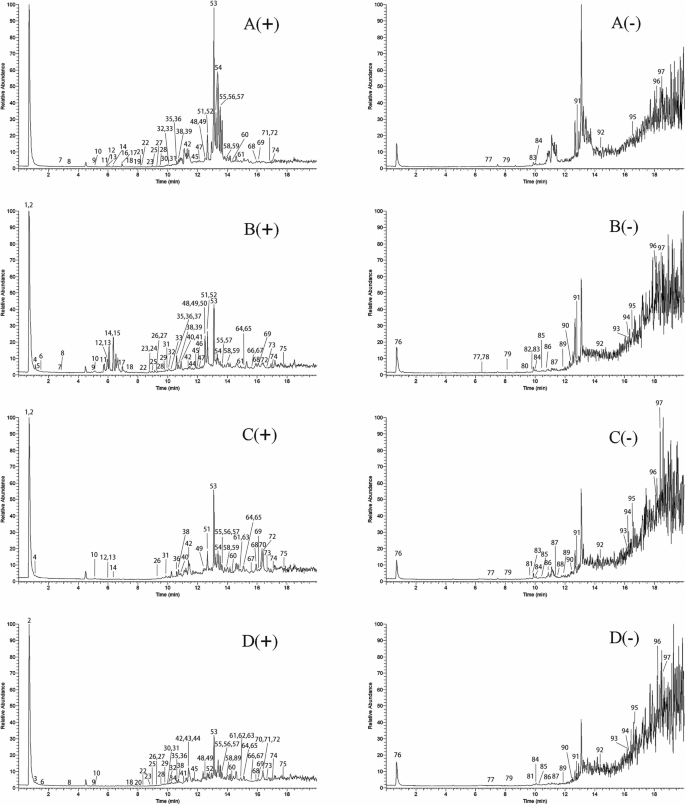
A total of 291 chemical components were identified in Goupi plaster from four manufacturers, including 97 chemical components with known source and pharmacological activity. Further, we determined the contents of sinomenine, osthole, and cinnamaldehyde.
Conclusion
In summary, the UPLC–Q-Exactive-MS method was used to analyze the chemical components of Goupi plaster from different manufacturers. We established the UPLC–MS/MS method to determine the contents of sinomenine, osthole, and cinnamaldehyde in Goupi plaster from different manufacturers. The findings indicated that the method was comprehensive, rapid, and accurate, preliminarily revealing the material basis of Goupi plaster and providing a reference for follow-up development of Goupi plaster.
期刊介绍:
Separation sciences, in all their various forms such as chromatography, field-flow fractionation, and electrophoresis, provide some of the most powerful techniques in analytical chemistry and are applied within a number of important application areas, including archaeology, biotechnology, clinical, environmental, food, medical, petroleum, pharmaceutical, polymer and biopolymer research. Beyond serving analytical purposes, separation techniques are also used for preparative and process-scale applications. The scope and power of separation sciences is significantly extended by combination with spectroscopic detection methods (e.g., laser-based approaches, nuclear-magnetic resonance, Raman, chemiluminescence) and particularly, mass spectrometry, to create hyphenated techniques. In addition to exciting new developments in chromatography, such as ultra high-pressure systems, multidimensional separations, and high-temperature approaches, there have also been great advances in hybrid methods combining chromatography and electro-based separations, especially on the micro- and nanoscale. Integrated biological procedures (e.g., enzymatic, immunological, receptor-based assays) can also be part of the overall analytical process.



 京公网安备 11010802042870号
京ICP备2023020795号-1
京公网安备 11010802042870号
京ICP备2023020795号-1

 分享
分享
 求助内容:
求助内容: 应助结果提醒方式:
 扫码关注我们
