Daniel T. O’Brien, Alina Ristea, Forrest Hangen, Riley Tucker
{"title":"Different places, different problems: profiles of crime and disorder at residential parcels","authors":"Daniel T. O’Brien, Alina Ristea, Forrest Hangen, Riley Tucker","doi":"10.1186/s40163-022-00165-0","DOIUrl":null,"url":null,"abstract":"<p>Certain places generate inordinate amounts of crime and disorder. We examine how places differ in their nature of crime and disorder, with three objectives: (1) identifying a typology of profiles of crime and disorder; (2) assessing whether different forms of crime and disorder co-locate at parcels; and (3) determining whether problematic parcels explain crime and disorder across neighborhoods. The study uses 911 and 311 records to quantify physical and social disorder and violent crime at residential parcels in Boston, MA (<i>n</i> = 81,673). K-means cluster analyses identified the typology of problematic parcels and how those types were distributed across census block groups. Cluster analysis identified five types of problematic parcels, four specializing in one form of crime or disorder and one that combined all issues. The second cluster analysis found that the distribution of problematic parcels described the spectrum from low- to high-crime neighborhoods, plus commercial districts with many parcels with public physical disorder. Problematic parcels modestly explained levels of crime across neighborhoods. The results suggest a need for diverse intervention strategies to support different types of problematic parcels; and that neighborhood dynamics pertaining to crime are greater than problematic properties alone.</p>","PeriodicalId":37844,"journal":{"name":"Crime Science","volume":"171 1","pages":""},"PeriodicalIF":2.6000,"publicationDate":"2022-06-19","publicationTypes":"Journal Article","fieldsOfStudy":null,"isOpenAccess":false,"openAccessPdf":"","citationCount":"2","resultStr":null,"platform":"Semanticscholar","paperid":null,"PeriodicalName":"Crime Science","FirstCategoryId":"1085","ListUrlMain":"https://doi.org/10.1186/s40163-022-00165-0","RegionNum":0,"RegionCategory":null,"ArticlePicture":[],"TitleCN":null,"AbstractTextCN":null,"PMCID":null,"EPubDate":"","PubModel":"","JCR":"Q1","JCRName":"CRIMINOLOGY & PENOLOGY","Score":null,"Total":0}
引用次数: 2
Abstract
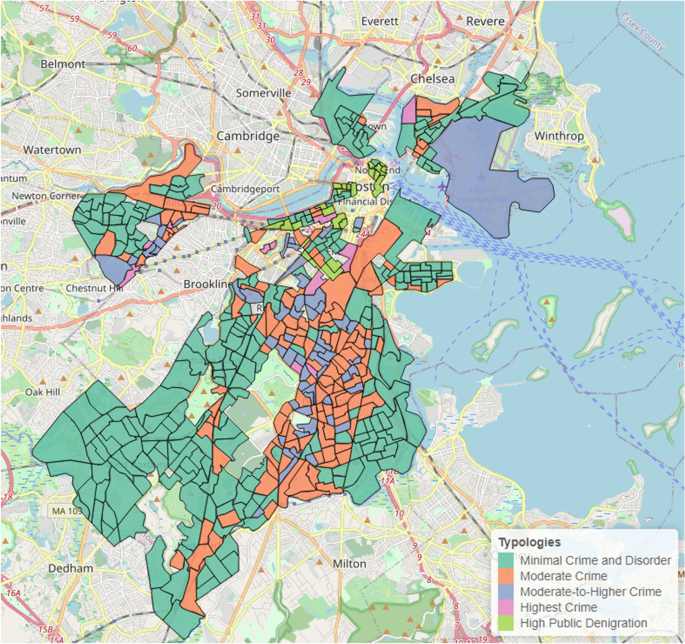
Certain places generate inordinate amounts of crime and disorder. We examine how places differ in their nature of crime and disorder, with three objectives: (1) identifying a typology of profiles of crime and disorder; (2) assessing whether different forms of crime and disorder co-locate at parcels; and (3) determining whether problematic parcels explain crime and disorder across neighborhoods. The study uses 911 and 311 records to quantify physical and social disorder and violent crime at residential parcels in Boston, MA (n = 81,673). K-means cluster analyses identified the typology of problematic parcels and how those types were distributed across census block groups. Cluster analysis identified five types of problematic parcels, four specializing in one form of crime or disorder and one that combined all issues. The second cluster analysis found that the distribution of problematic parcels described the spectrum from low- to high-crime neighborhoods, plus commercial districts with many parcels with public physical disorder. Problematic parcels modestly explained levels of crime across neighborhoods. The results suggest a need for diverse intervention strategies to support different types of problematic parcels; and that neighborhood dynamics pertaining to crime are greater than problematic properties alone.
期刊介绍:
Crime Science is an international, interdisciplinary, peer-reviewed journal with an applied focus. The journal''s main focus is on research articles and systematic reviews that reflect the growing cooperation among a variety of fields, including environmental criminology, economics, engineering, geography, public health, psychology, statistics and urban planning, on improving the detection, prevention and understanding of crime and disorder. Crime Science will publish theoretical articles that are relevant to the field, for example, approaches that integrate theories from different disciplines. The goal of the journal is to broaden the scientific base for the understanding, analysis and control of crime and disorder. It is aimed at researchers, practitioners and policy-makers with an interest in crime reduction. It will also publish short contributions on timely topics including crime patterns, technological advances for detection and prevention, and analytical techniques, and on the crime reduction applications of research from a wide range of fields. Crime Science publishes research articles, systematic reviews, short contributions and theoretical articles. While Crime Science uses the APA reference style, the journal welcomes submissions using alternative reference styles on a case-by-case basis.



 京公网安备 11010802042870号
京ICP备2023020795号-1
京公网安备 11010802042870号
京ICP备2023020795号-1

 分享
分享
 求助内容:
求助内容: 应助结果提醒方式:
 扫码关注我们
