{"title":"Mountains of research: Where and whom high-altitude physiology has overlooked","authors":"Joshua C. Tremblay","doi":"10.1113/JP285454","DOIUrl":null,"url":null,"abstract":"<p>High altitude is a natural setting in which to study human acclimatization and adaptation. Here, I identify where and in whom high-altitude physiology research has occurred. There has been a mismatch between countries with large high-altitude populations <i>vs</i>. where high-altitude research has been conducted. From 1970 to 2020, 83% of high-altitude physiology research took place in just seven countries: Nepal, China, USA, Peru, India, Bolivia and Italy. Collectively, these countries account for only 35% of the global population living above 2500 m. Furthermore, high-altitude physiology research has predominantly studied low-altitude residents visiting high altitude and female participants are under-represented. Accordingly, the included populations are not necessarily a proportional representation of high-altitude residents. Here, I discuss how this influences our understanding of high-altitude adaptation. Finally, I highlight past initiatives to increase diversity in high-altitude research. By identifying the broad gaps in high-altitude physiology research, I propose exciting, inclusive opportunities to study human high-altitude physiology.\n\n <figure>\n <div><picture>\n <source></source></picture><p></p>\n </div>\n </figure></p>","PeriodicalId":50088,"journal":{"name":"Journal of Physiology-London","volume":"602 21","pages":"5409-5417"},"PeriodicalIF":4.4000,"publicationDate":"2023-12-08","publicationTypes":"Journal Article","fieldsOfStudy":null,"isOpenAccess":false,"openAccessPdf":"https://onlinelibrary.wiley.com/doi/epdf/10.1113/JP285454","citationCount":"0","resultStr":null,"platform":"Semanticscholar","paperid":null,"PeriodicalName":"Journal of Physiology-London","FirstCategoryId":"3","ListUrlMain":"https://physoc.onlinelibrary.wiley.com/doi/10.1113/JP285454","RegionNum":2,"RegionCategory":"医学","ArticlePicture":[],"TitleCN":null,"AbstractTextCN":null,"PMCID":null,"EPubDate":"","PubModel":"","JCR":"Q1","JCRName":"NEUROSCIENCES","Score":null,"Total":0}
引用次数: 0
Abstract
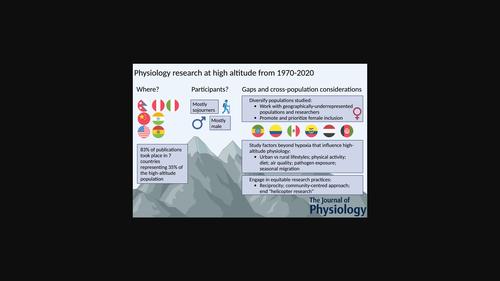
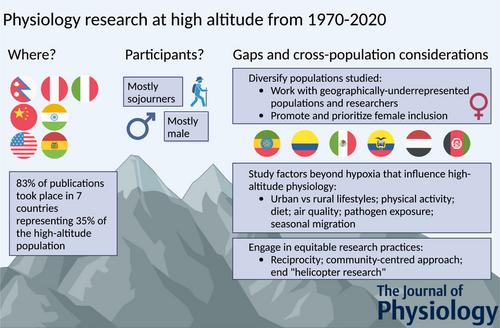
High altitude is a natural setting in which to study human acclimatization and adaptation. Here, I identify where and in whom high-altitude physiology research has occurred. There has been a mismatch between countries with large high-altitude populations vs. where high-altitude research has been conducted. From 1970 to 2020, 83% of high-altitude physiology research took place in just seven countries: Nepal, China, USA, Peru, India, Bolivia and Italy. Collectively, these countries account for only 35% of the global population living above 2500 m. Furthermore, high-altitude physiology research has predominantly studied low-altitude residents visiting high altitude and female participants are under-represented. Accordingly, the included populations are not necessarily a proportional representation of high-altitude residents. Here, I discuss how this influences our understanding of high-altitude adaptation. Finally, I highlight past initiatives to increase diversity in high-altitude research. By identifying the broad gaps in high-altitude physiology research, I propose exciting, inclusive opportunities to study human high-altitude physiology.
期刊介绍:
The Journal of Physiology publishes full-length original Research Papers and Techniques for Physiology, which are short papers aimed at disseminating new techniques for physiological research. Articles solicited by the Editorial Board include Perspectives, Symposium Reports and Topical Reviews, which highlight areas of special physiological interest. CrossTalk articles are short editorial-style invited articles framing a debate between experts in the field on controversial topics. Letters to the Editor and Journal Club articles are also published. All categories of papers are subjected to peer reivew.
The Journal of Physiology welcomes submitted research papers in all areas of physiology. Authors should present original work that illustrates new physiological principles or mechanisms. Papers on work at the molecular level, at the level of the cell membrane, single cells, tissues or organs and on systems physiology are all acceptable. Theoretical papers and papers that use computational models to further our understanding of physiological processes will be considered if based on experimentally derived data and if the hypothesis advanced is directly amenable to experimental testing. While emphasis is on human and mammalian physiology, work on lower vertebrate or invertebrate preparations may be suitable if it furthers the understanding of the functioning of other organisms including mammals.




 京公网安备 11010802042870号
京ICP备2023020795号-1
京公网安备 11010802042870号
京ICP备2023020795号-1

 分享
分享
 求助内容:
求助内容: 应助结果提醒方式:
 扫码关注我们
