{"title":"Coloaded Surface–Modified PLGA Nanoparticles for Sustained Ocular Delivery of Levofloxacin and Flurbiprofen","authors":"Ujwala Shinde, Yusra Barkat, Kavita Singh","doi":"10.1007/s12247-023-09796-5","DOIUrl":null,"url":null,"abstract":"<h3 data-test=\"abstract-sub-heading\">Purpose</h3><p>The purpose of the present work was to develop levofloxacin-flurbiprofen coloaded PLGA (LEV-FLU-PLGA) nanoparticles with surface modification using chitosan to attain mucoadhesion for the treatment of bacterial conjunctivitis.</p><h3 data-test=\"abstract-sub-heading\">Method</h3><p>Polymeric nanoparticles were prepared by nanoprecipitation method and evaluated for parameters like particle size, PDI, zeta potential, entrapment efficiency (%), in vitro drug release, ex vivo permeation studies, microbial assay against <i>Staphylococcus aureus</i> and ocular tolerance using Hen’s egg test-chorioallantoic membrane (HET-CAM). Furthermore, surface of optimized PLGA nanoparticle formulation was modified by coating with chitosan.</p><h3 data-test=\"abstract-sub-heading\">Results</h3><p>LEV-FLU-PLGA nanoparticles demonstrated particle size of 166.1 nm with PDI of 0.137 and zeta potential of − 16.8 mV. The entrapment efficiency was found to be 39.37% for levofloxacin (LEV) and 48.33% for flurbiprofen (FLU), whereas for surface-modified nanoparticles, it was found to be 42.05% for LEV and 45.26% for FLU. LEV-FLU chitosan-coated PLGA nanoparticles showed an increase in particle size, i.e., 333.6 nm with PDI of 0.319 and an inversion of zeta potential to 37.67 mV. The developed nanosystems showed sustained release and improved eye permeability. Microbiological studies showed equivalent zone of inhibition to that of marketed formulation. HET-CAM assay revealed the non-irritant nature of drug-loaded PLGA nanoparticles; however, chitosan-coated PLGA nanoparticles were found to be moderately irritating owing to the acidic nature of formulation.</p><h3 data-test=\"abstract-sub-heading\">Conclusion</h3><p>The nanoparticulate system provides prolonged drug release making it a promising alternative to conventional dosage forms. It reduces systemic effects of locally acting drugs, improving therapeutic efficacy and patient compliance.</p>","PeriodicalId":656,"journal":{"name":"Journal of Pharmaceutical Innovation","volume":"7 12","pages":""},"PeriodicalIF":2.7000,"publicationDate":"2023-12-12","publicationTypes":"Journal Article","fieldsOfStudy":null,"isOpenAccess":false,"openAccessPdf":"","citationCount":"0","resultStr":null,"platform":"Semanticscholar","paperid":null,"PeriodicalName":"Journal of Pharmaceutical Innovation","FirstCategoryId":"3","ListUrlMain":"https://doi.org/10.1007/s12247-023-09796-5","RegionNum":4,"RegionCategory":"医学","ArticlePicture":[],"TitleCN":null,"AbstractTextCN":null,"PMCID":null,"EPubDate":"","PubModel":"","JCR":"Q2","JCRName":"PHARMACOLOGY & PHARMACY","Score":null,"Total":0}
引用次数: 0
Abstract
Purpose
The purpose of the present work was to develop levofloxacin-flurbiprofen coloaded PLGA (LEV-FLU-PLGA) nanoparticles with surface modification using chitosan to attain mucoadhesion for the treatment of bacterial conjunctivitis.
Method
Polymeric nanoparticles were prepared by nanoprecipitation method and evaluated for parameters like particle size, PDI, zeta potential, entrapment efficiency (%), in vitro drug release, ex vivo permeation studies, microbial assay against Staphylococcus aureus and ocular tolerance using Hen’s egg test-chorioallantoic membrane (HET-CAM). Furthermore, surface of optimized PLGA nanoparticle formulation was modified by coating with chitosan.
Results
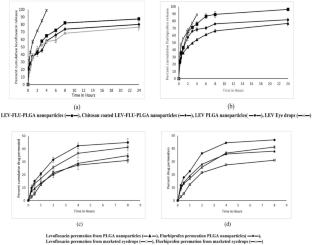
LEV-FLU-PLGA nanoparticles demonstrated particle size of 166.1 nm with PDI of 0.137 and zeta potential of − 16.8 mV. The entrapment efficiency was found to be 39.37% for levofloxacin (LEV) and 48.33% for flurbiprofen (FLU), whereas for surface-modified nanoparticles, it was found to be 42.05% for LEV and 45.26% for FLU. LEV-FLU chitosan-coated PLGA nanoparticles showed an increase in particle size, i.e., 333.6 nm with PDI of 0.319 and an inversion of zeta potential to 37.67 mV. The developed nanosystems showed sustained release and improved eye permeability. Microbiological studies showed equivalent zone of inhibition to that of marketed formulation. HET-CAM assay revealed the non-irritant nature of drug-loaded PLGA nanoparticles; however, chitosan-coated PLGA nanoparticles were found to be moderately irritating owing to the acidic nature of formulation.
Conclusion
The nanoparticulate system provides prolonged drug release making it a promising alternative to conventional dosage forms. It reduces systemic effects of locally acting drugs, improving therapeutic efficacy and patient compliance.
期刊介绍:
The Journal of Pharmaceutical Innovation (JPI), is an international, multidisciplinary peer-reviewed scientific journal dedicated to publishing high quality papers emphasizing innovative research and applied technologies within the pharmaceutical and biotechnology industries. JPI''s goal is to be the premier communication vehicle for the critical body of knowledge that is needed for scientific evolution and technical innovation, from R&D to market. Topics will fall under the following categories:
Materials science,
Product design,
Process design, optimization, automation and control,
Facilities; Information management,
Regulatory policy and strategy,
Supply chain developments ,
Education and professional development,
Journal of Pharmaceutical Innovation publishes four issues a year.



 京公网安备 11010802042870号
京ICP备2023020795号-1
京公网安备 11010802042870号
京ICP备2023020795号-1

 分享
分享
 求助内容:
求助内容: 应助结果提醒方式:
 扫码关注我们
