Efficacy of scalp stimulation for multidomain cognitive impairment in patients with post-stroke cognitive impairment and dementia: A network meta-analysis and meta-regression of moderators
Minjie Xu, Ying Li, Chi Zhang, Yanan Ma, Leyi Zhang, Yuai Yang, Zihan Zhang, Tiantian Meng, Junyi He, Haifang Wang, Shuren Li, Georg S Kranz, Mingjing Zhao, Jingling Chang
{"title":"Efficacy of scalp stimulation for multidomain cognitive impairment in patients with post-stroke cognitive impairment and dementia: A network meta-analysis and meta-regression of moderators","authors":"Minjie Xu, Ying Li, Chi Zhang, Yanan Ma, Leyi Zhang, Yuai Yang, Zihan Zhang, Tiantian Meng, Junyi He, Haifang Wang, Shuren Li, Georg S Kranz, Mingjing Zhao, Jingling Chang","doi":"10.1111/jebm.12568","DOIUrl":null,"url":null,"abstract":"<div>\n \n \n <section>\n \n <h3> Background</h3>\n \n <p>Scalp stimulation has gained more traction for post-stroke cognitive impairment and dementia (PSCID); the interaction between stimulation targets and parameters influences the response to the stimulation. However, the most efficacious treatment for improving different domains of cognitive impairment remains unknown.</p>\n </section>\n \n <section>\n \n <h3> Objective</h3>\n \n <p>We aimed to conduct a systematic review and network meta-analysis (NMA) to compare the efficacy of various scalp stimulation protocols used in PSCID treatment.</p>\n </section>\n \n <section>\n \n <h3> Methods</h3>\n \n <p>Randomized controlled trials of scalp stimulation in patients with PSCID were searched in eight databases over the past 20 years. Standardized mean differences (SMDs) for global and subdomain cognitive scores were pooled in Bayesian NMA. Moderators were examined using meta-regression analysis.</p>\n </section>\n \n <section>\n \n <h3> Results</h3>\n \n <p>A total of 90 trials, with 6199 patients, were included. Low-frequency repetitive transcranial magnetic stimulation (rTMS) over the unaffected dorsolateral prefrontal cortex (DLPFC) was highly suggested for alleviating global severity (SMD = 1.11, 95% CI (0.64, 1.57)). High-frequency rTMS over the left DLPFC was recommended for language use (1.85 (1.18, 2.52)), executive function (0.85 (0.36, 1.33)), orientation deficits (0.59 (0.07, 1.13)), and attention (0.85 (0.27, 1.43)). Anodal transcranial direct current stimulation over the affected DLPFC (2.03 (0.72, 3.34)) was recommended for treating memory impairment. Meta-regression analyses showed significant associations within attention, language and orientation.</p>\n </section>\n \n <section>\n \n <h3> Conclusion</h3>\n \n <p>Overall, different cognitive domains have different optimal scalp stimulation prescriptions, and activating the affected key brain regions and inhibiting the unaffected area is still the most effective treatment.</p>\n </section>\n </div>","PeriodicalId":16090,"journal":{"name":"Journal of Evidence‐Based Medicine","volume":"16 4","pages":"505-519"},"PeriodicalIF":3.5000,"publicationDate":"2023-12-15","publicationTypes":"Journal Article","fieldsOfStudy":null,"isOpenAccess":false,"openAccessPdf":"https://onlinelibrary.wiley.com/doi/epdf/10.1111/jebm.12568","citationCount":"0","resultStr":null,"platform":"Semanticscholar","paperid":null,"PeriodicalName":"Journal of Evidence‐Based Medicine","FirstCategoryId":"3","ListUrlMain":"https://onlinelibrary.wiley.com/doi/10.1111/jebm.12568","RegionNum":2,"RegionCategory":"医学","ArticlePicture":[],"TitleCN":null,"AbstractTextCN":null,"PMCID":null,"EPubDate":"","PubModel":"","JCR":"Q1","JCRName":"MEDICINE, GENERAL & INTERNAL","Score":null,"Total":0}
引用次数: 0
Abstract
Background
Scalp stimulation has gained more traction for post-stroke cognitive impairment and dementia (PSCID); the interaction between stimulation targets and parameters influences the response to the stimulation. However, the most efficacious treatment for improving different domains of cognitive impairment remains unknown.
Objective
We aimed to conduct a systematic review and network meta-analysis (NMA) to compare the efficacy of various scalp stimulation protocols used in PSCID treatment.
Methods
Randomized controlled trials of scalp stimulation in patients with PSCID were searched in eight databases over the past 20 years. Standardized mean differences (SMDs) for global and subdomain cognitive scores were pooled in Bayesian NMA. Moderators were examined using meta-regression analysis.
Results
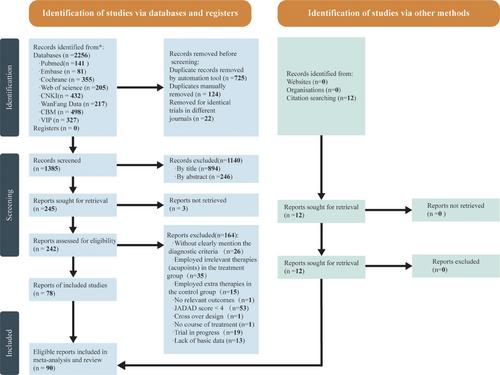
A total of 90 trials, with 6199 patients, were included. Low-frequency repetitive transcranial magnetic stimulation (rTMS) over the unaffected dorsolateral prefrontal cortex (DLPFC) was highly suggested for alleviating global severity (SMD = 1.11, 95% CI (0.64, 1.57)). High-frequency rTMS over the left DLPFC was recommended for language use (1.85 (1.18, 2.52)), executive function (0.85 (0.36, 1.33)), orientation deficits (0.59 (0.07, 1.13)), and attention (0.85 (0.27, 1.43)). Anodal transcranial direct current stimulation over the affected DLPFC (2.03 (0.72, 3.34)) was recommended for treating memory impairment. Meta-regression analyses showed significant associations within attention, language and orientation.
Conclusion
Overall, different cognitive domains have different optimal scalp stimulation prescriptions, and activating the affected key brain regions and inhibiting the unaffected area is still the most effective treatment.
期刊介绍:
The Journal of Evidence-Based Medicine (EMB) is an esteemed international healthcare and medical decision-making journal, dedicated to publishing groundbreaking research outcomes in evidence-based decision-making, research, practice, and education. Serving as the official English-language journal of the Cochrane China Centre and West China Hospital of Sichuan University, we eagerly welcome editorials, commentaries, and systematic reviews encompassing various topics such as clinical trials, policy, drug and patient safety, education, and knowledge translation.