Başak İnce, Matthew D. Phillips, Zohra Zenasni, James Shearer, Bethan Dalton, Madeleine Irish, Daniela Mercado, Hannah Webb, Catherine McCombie, Katie Au, Nikola Kern, Sam Clark-Stone, Frances Connan, A. Louise Johnston, Stanimira Lazarova, Ewa Zadeh, Ciarán Newell, Tayeem Pathan, Jackie Wales, Rebecca Cashmore, Sandra Marshall, Jon Arcelus, Paul Robinson, Sarah Byford, Sabine Landau, Vanessa Lawrence, Hubertus Himmerich, Janet Treasure, Ulrike Schmidt
{"title":"Autopsy of a failed trial part 2: Outcomes, challenges, and lessons learnt from the DAISIES trial","authors":"Başak İnce, Matthew D. Phillips, Zohra Zenasni, James Shearer, Bethan Dalton, Madeleine Irish, Daniela Mercado, Hannah Webb, Catherine McCombie, Katie Au, Nikola Kern, Sam Clark-Stone, Frances Connan, A. Louise Johnston, Stanimira Lazarova, Ewa Zadeh, Ciarán Newell, Tayeem Pathan, Jackie Wales, Rebecca Cashmore, Sandra Marshall, Jon Arcelus, Paul Robinson, Sarah Byford, Sabine Landau, Vanessa Lawrence, Hubertus Himmerich, Janet Treasure, Ulrike Schmidt","doi":"10.1002/erv.3058","DOIUrl":null,"url":null,"abstract":"<div>\n \n \n <section>\n \n <h3> Objective</h3>\n \n <p>The relative merits of inpatient or day-treatment for adults with anorexia nervosa (AN) are unknown. The DAISIES trial aimed to establish the non-inferiority of a stepped-care day patient treatment (DPT) approach versus inpatient treatment as usual (IP-TAU) for improving body mass index (BMI) at 12 months in adults with AN. The trial was terminated due to poor recruitment. This paper presents outcomes and investigates the reasons behind the trial's failure.</p>\n </section>\n \n <section>\n \n <h3> Method</h3>\n \n <p>Fifteen patients with AN (of 53 approached) participated and were followed-up to 6 or 12 months. Summary statistics were calculated due to low sample size, and qualitative data concerning treatment experiences were analysed using thematic analysis.</p>\n </section>\n \n <section>\n \n <h3> Results</h3>\n \n <p>At baseline, participants in both trial arms rated stepped-care DPT as more acceptable. At 12 months, participants' BMIs had increased in both trial arms. Qualitative analysis highlighted valued and challenging aspects of care across settings. Only 6/12 sites opened for recruitment. Among patients approached, the most common reason for declining participation was their treatment preference (<i>n</i> = 12/38).</p>\n </section>\n \n <section>\n \n <h3> Conclusions</h3>\n \n <p>No conclusions can be drawn concerning the effectiveness of IP-TAU and stepped-care DPT, but the latter was perceived more positively. Patient-related, service-related and systemic factors (COVID-19) contributed to the trial's failure. Lessons learnt can inform future studies.</p>\n </section>\n </div>","PeriodicalId":48117,"journal":{"name":"European Eating Disorders Review","volume":"32 3","pages":"476-489"},"PeriodicalIF":3.4000,"publicationDate":"2023-12-18","publicationTypes":"Journal Article","fieldsOfStudy":null,"isOpenAccess":false,"openAccessPdf":"https://onlinelibrary.wiley.com/doi/epdf/10.1002/erv.3058","citationCount":"0","resultStr":null,"platform":"Semanticscholar","paperid":null,"PeriodicalName":"European Eating Disorders Review","FirstCategoryId":"102","ListUrlMain":"https://onlinelibrary.wiley.com/doi/10.1002/erv.3058","RegionNum":2,"RegionCategory":"心理学","ArticlePicture":[],"TitleCN":null,"AbstractTextCN":null,"PMCID":null,"EPubDate":"","PubModel":"","JCR":"Q1","JCRName":"PSYCHIATRY","Score":null,"Total":0}
引用次数: 0
Abstract
Objective
The relative merits of inpatient or day-treatment for adults with anorexia nervosa (AN) are unknown. The DAISIES trial aimed to establish the non-inferiority of a stepped-care day patient treatment (DPT) approach versus inpatient treatment as usual (IP-TAU) for improving body mass index (BMI) at 12 months in adults with AN. The trial was terminated due to poor recruitment. This paper presents outcomes and investigates the reasons behind the trial's failure.
Method
Fifteen patients with AN (of 53 approached) participated and were followed-up to 6 or 12 months. Summary statistics were calculated due to low sample size, and qualitative data concerning treatment experiences were analysed using thematic analysis.
Results
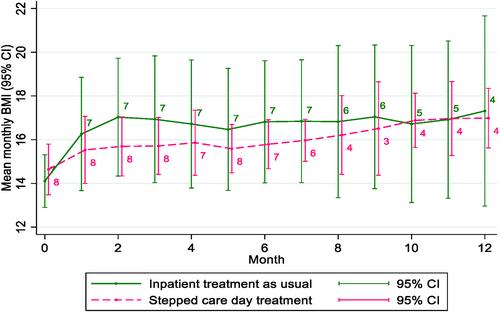
At baseline, participants in both trial arms rated stepped-care DPT as more acceptable. At 12 months, participants' BMIs had increased in both trial arms. Qualitative analysis highlighted valued and challenging aspects of care across settings. Only 6/12 sites opened for recruitment. Among patients approached, the most common reason for declining participation was their treatment preference (n = 12/38).
Conclusions
No conclusions can be drawn concerning the effectiveness of IP-TAU and stepped-care DPT, but the latter was perceived more positively. Patient-related, service-related and systemic factors (COVID-19) contributed to the trial's failure. Lessons learnt can inform future studies.
期刊介绍:
European Eating Disorders Review publishes authoritative and accessible articles, from all over the world, which review or report original research that has implications for the treatment and care of people with eating disorders, and articles which report innovations and experience in the clinical management of eating disorders. The journal focuses on implications for best practice in diagnosis and treatment. The journal also provides a forum for discussion of the causes and prevention of eating disorders, and related health policy. The aims of the journal are to offer a channel of communication between researchers, practitioners, administrators and policymakers who need to report and understand developments in the field of eating disorders.



 京公网安备 11010802042870号
京ICP备2023020795号-1
京公网安备 11010802042870号
京ICP备2023020795号-1

 分享
分享
 求助内容:
求助内容: 应助结果提醒方式:
 扫码关注我们
