Emanuel Fryk, Åsa Wilsson, Andrea Tompa, Per-Anders Jansson, Maria Faresjö
{"title":"Galectin-1 correlates with inflammatory markers and T regulatory cells in children with type 1 diabetes and/or celiac disease.","authors":"Emanuel Fryk, Åsa Wilsson, Andrea Tompa, Per-Anders Jansson, Maria Faresjö","doi":"10.1093/cei/uxad131","DOIUrl":null,"url":null,"abstract":"<p><p>Type 1 diabetes (T1D) and celiac disease (CeD) are common autoimmune diseases in children where the pathophysiology is not fully characterized. The autoimmune process involves a complex scenario of both inflammatory and regulatory features. Galectin-1 (GAL-1) has a wide range of biological activities e.g. interaction with immune cells. We examined the relationship between GAL-1 and soluble immune markers and T-cell subsets in a cohort of children with T1D and/or CeD relative to healthy children. GAL-1, together with several soluble immune markers [e.g. interleukins (IL)], tumor necrosis factor (TNF), acute phase proteins, and matrix metalloproteinases (MMP) were measured in sera from children with T1D and/or CeD by fluorochrome (Luminex) technique using children without these diseases as a reference. Subgroups of T cells, including T-regulatory (Treg) cells, were analysed by flow cytometry. Association between GAL-1, pro-inflammatory markers, and Treg cells differed depending on which illness combination was present. In children with both T1D and CeD, GAL-1 correlated positively with pro-inflammatory markers (IL-1β, IL-6, and TNF-α). Composite scores increased the strength of correlation between GAL-1 and pro-inflammatory markers, Th1-associated interferon (IFN)-γ, and T1D-associated visfatin. Contrary, in children diagnosed with exclusively T1D, GAL-1 was positively correlated to CD25hi and CD25hiCD101+ Treg cells. For children with only CeD, no association between GAL-1 and other immune markers was observed. In conclusion, the association observed between GAL-1, soluble immune markers, and Treg cells may indicate a role for GAL-1 in the pathophysiology of T1D and, to some extent, also in CeD.</p>","PeriodicalId":10268,"journal":{"name":"Clinical and experimental immunology","volume":" ","pages":"240-250"},"PeriodicalIF":3.8000,"publicationDate":"2024-02-19","publicationTypes":"Journal Article","fieldsOfStudy":null,"isOpenAccess":false,"openAccessPdf":"https://www.ncbi.nlm.nih.gov/pmc/articles/PMC10876110/pdf/","citationCount":"0","resultStr":null,"platform":"Semanticscholar","paperid":null,"PeriodicalName":"Clinical and experimental immunology","FirstCategoryId":"3","ListUrlMain":"https://doi.org/10.1093/cei/uxad131","RegionNum":3,"RegionCategory":"医学","ArticlePicture":[],"TitleCN":null,"AbstractTextCN":null,"PMCID":null,"EPubDate":"","PubModel":"","JCR":"Q3","JCRName":"IMMUNOLOGY","Score":null,"Total":0}
引用次数: 0
Abstract
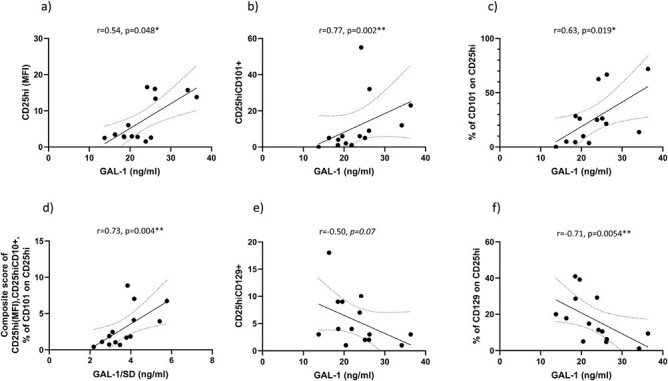
Type 1 diabetes (T1D) and celiac disease (CeD) are common autoimmune diseases in children where the pathophysiology is not fully characterized. The autoimmune process involves a complex scenario of both inflammatory and regulatory features. Galectin-1 (GAL-1) has a wide range of biological activities e.g. interaction with immune cells. We examined the relationship between GAL-1 and soluble immune markers and T-cell subsets in a cohort of children with T1D and/or CeD relative to healthy children. GAL-1, together with several soluble immune markers [e.g. interleukins (IL)], tumor necrosis factor (TNF), acute phase proteins, and matrix metalloproteinases (MMP) were measured in sera from children with T1D and/or CeD by fluorochrome (Luminex) technique using children without these diseases as a reference. Subgroups of T cells, including T-regulatory (Treg) cells, were analysed by flow cytometry. Association between GAL-1, pro-inflammatory markers, and Treg cells differed depending on which illness combination was present. In children with both T1D and CeD, GAL-1 correlated positively with pro-inflammatory markers (IL-1β, IL-6, and TNF-α). Composite scores increased the strength of correlation between GAL-1 and pro-inflammatory markers, Th1-associated interferon (IFN)-γ, and T1D-associated visfatin. Contrary, in children diagnosed with exclusively T1D, GAL-1 was positively correlated to CD25hi and CD25hiCD101+ Treg cells. For children with only CeD, no association between GAL-1 and other immune markers was observed. In conclusion, the association observed between GAL-1, soluble immune markers, and Treg cells may indicate a role for GAL-1 in the pathophysiology of T1D and, to some extent, also in CeD.
期刊介绍:
Clinical & Experimental Immunology (established in 1966) is an authoritative international journal publishing high-quality research studies in translational and clinical immunology that have the potential to transform our understanding of the immunopathology of human disease and/or change clinical practice.
The journal is focused on translational and clinical immunology and is among the foremost journals in this field, attracting high-quality papers from across the world. Translation is viewed as a process of applying ideas, insights and discoveries generated through scientific studies to the treatment, prevention or diagnosis of human disease. Clinical immunology has evolved as a field to encompass the application of state-of-the-art technologies such as next-generation sequencing, metagenomics and high-dimensional phenotyping to understand mechanisms that govern the outcomes of clinical trials.





 京公网安备 11010802042870号
京ICP备2023020795号-1
京公网安备 11010802042870号
京ICP备2023020795号-1

 分享
分享
 求助内容:
求助内容: 应助结果提醒方式:
 扫码关注我们
