{"title":"Efficacy of eHealth Technologies on Medication Adherence in Patients With Acute Coronary Syndrome: Systematic Review and Meta-Analysis.","authors":"Akshaya Srikanth Bhagavathula, Wafa Ali Aldhaleei, Tesfay Mehari Atey, Solomon Assefa, Wubshet Tesfaye","doi":"10.2196/52697","DOIUrl":null,"url":null,"abstract":"<p><strong>Background: </strong>Suboptimal adherence to cardiac pharmacotherapy, recommended by the guidelines after acute coronary syndrome (ACS) has been recognized and is associated with adverse outcomes. Several randomized controlled trials (RCTs) have shown that eHealth technologies are useful in reducing cardiovascular risk factors. However, little is known about the effect of eHealth interventions on medication adherence in patients following ACS.</p><p><strong>Objective: </strong>The aim of this study is to examine the efficacy of the eHealth interventions on medication adherence to selected 5 cardioprotective medication classes in patients with ACS.</p><p><strong>Methods: </strong>A systematic literature search of PubMed, Embase, Scopus, and Web of Science was conducted between May and October 2022, with an update in October 2023 to identify RCTs that evaluated the effectiveness of eHealth technologies, including texting, smartphone apps, or web-based apps, to improve medication adherence in patients after ACS. The risk of bias was evaluated using the modified Cochrane risk-of-bias tool for RCTs. A pooled meta-analysis was performed using a fixed-effect Mantel-Haenszel model and assessed the medication adherence to the medications of statins, aspirin, P2Y12 inhibitors, angiotensin-converting enzyme inhibitors or angiotensin receptor blockers, and β-blockers.</p><p><strong>Results: </strong>We identified 5 RCTs, applicable to 4100 participants (2093 intervention vs 2007 control), for inclusion in the meta-analysis. In patients who recently had an ACS, compared to the control group, the use of eHealth intervention was not associated with improved adherence to statins at different time points (risk difference [RD] -0.01, 95% CI -0.03 to 0.03 at 6 months and RD -0.02, 95% CI -0.05 to 0.02 at 12 months), P2Y12 inhibitors (RD -0.01, 95% CI -0.04 to 0.02 and RD -0.01, 95% CI -0.03 to 0.02), aspirin (RD 0.00, 95% CI -0.06 to 0.07 and RD -0.00, 95% CI -0.07 to 0.06), angiotensin-converting enzyme inhibitors or angiotensin receptor blockers (RD -0.01, 95% CI -0.04 to 0.02 and RD 0.01, 95% CI -0.04 to 0.05), and β-blockers (RD 0.00, 95% CI -0.03 to 0.03 and RD -0.01, 95% CI -0.05 to 0.03). The intervention was also not associated with improved adherence irrespective of the adherence assessment method used (self-report or objective).</p><p><strong>Conclusions: </strong>This review identified limited evidence on the effectiveness of eHealth interventions on adherence to guideline-recommended medications after ACS. While the pooled analyses suggested a lack of effectiveness of such interventions on adherence improvement, further studies are warranted to better understand the role of different eHealth approaches in the post-ACS context.</p>","PeriodicalId":14706,"journal":{"name":"JMIR Cardio","volume":"7 ","pages":"e52697"},"PeriodicalIF":2.2000,"publicationDate":"2023-12-19","publicationTypes":"Journal Article","fieldsOfStudy":null,"isOpenAccess":false,"openAccessPdf":"https://www.ncbi.nlm.nih.gov/pmc/articles/PMC10762619/pdf/","citationCount":"0","resultStr":null,"platform":"Semanticscholar","paperid":null,"PeriodicalName":"JMIR Cardio","FirstCategoryId":"1085","ListUrlMain":"https://doi.org/10.2196/52697","RegionNum":0,"RegionCategory":null,"ArticlePicture":[],"TitleCN":null,"AbstractTextCN":null,"PMCID":null,"EPubDate":"","PubModel":"","JCR":"Q2","JCRName":"Medicine","Score":null,"Total":0}
引用次数: 0
Abstract
Background: Suboptimal adherence to cardiac pharmacotherapy, recommended by the guidelines after acute coronary syndrome (ACS) has been recognized and is associated with adverse outcomes. Several randomized controlled trials (RCTs) have shown that eHealth technologies are useful in reducing cardiovascular risk factors. However, little is known about the effect of eHealth interventions on medication adherence in patients following ACS.
Objective: The aim of this study is to examine the efficacy of the eHealth interventions on medication adherence to selected 5 cardioprotective medication classes in patients with ACS.
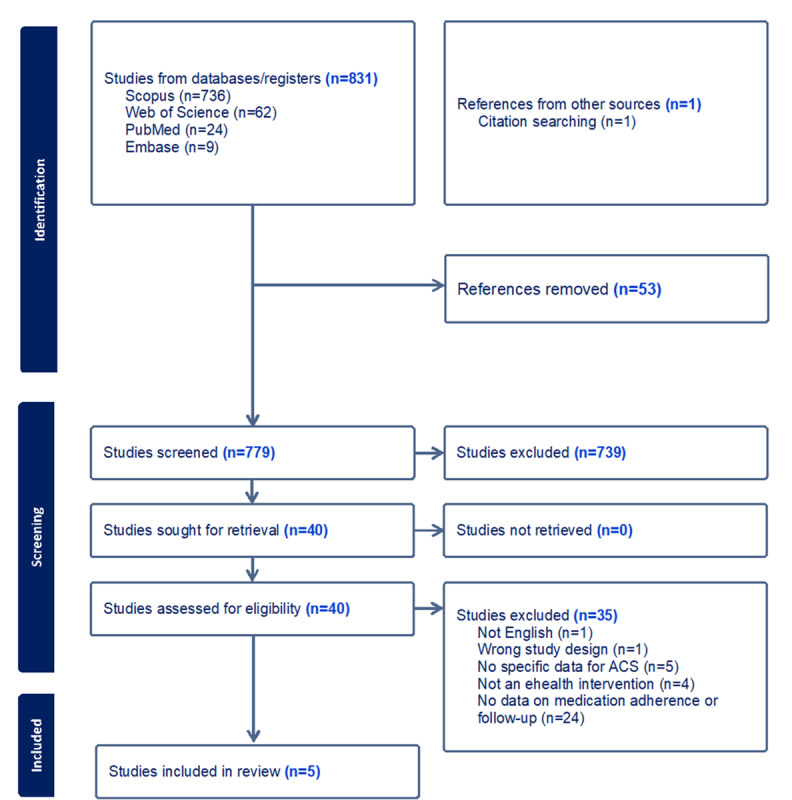
Methods: A systematic literature search of PubMed, Embase, Scopus, and Web of Science was conducted between May and October 2022, with an update in October 2023 to identify RCTs that evaluated the effectiveness of eHealth technologies, including texting, smartphone apps, or web-based apps, to improve medication adherence in patients after ACS. The risk of bias was evaluated using the modified Cochrane risk-of-bias tool for RCTs. A pooled meta-analysis was performed using a fixed-effect Mantel-Haenszel model and assessed the medication adherence to the medications of statins, aspirin, P2Y12 inhibitors, angiotensin-converting enzyme inhibitors or angiotensin receptor blockers, and β-blockers.
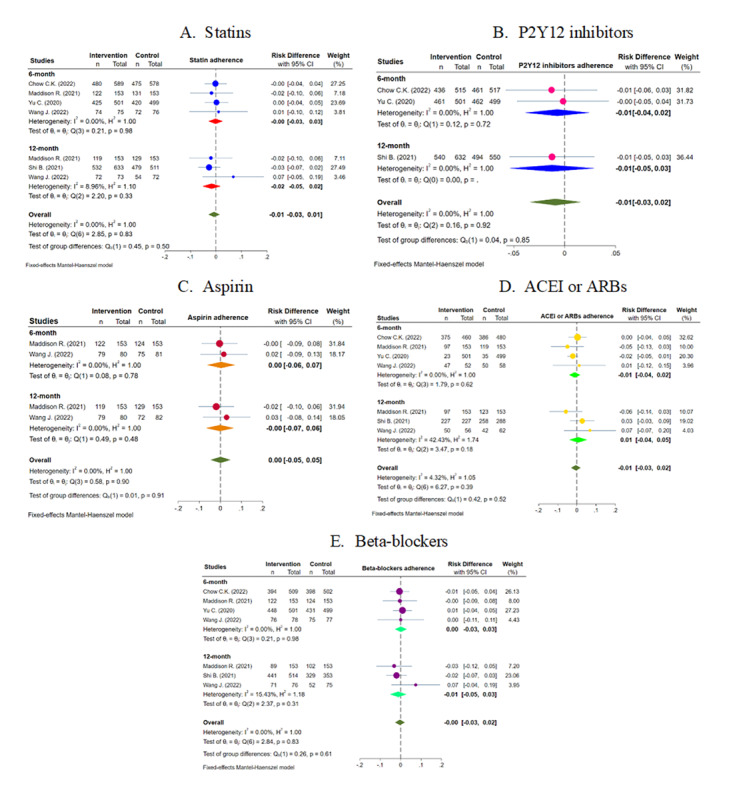
Results: We identified 5 RCTs, applicable to 4100 participants (2093 intervention vs 2007 control), for inclusion in the meta-analysis. In patients who recently had an ACS, compared to the control group, the use of eHealth intervention was not associated with improved adherence to statins at different time points (risk difference [RD] -0.01, 95% CI -0.03 to 0.03 at 6 months and RD -0.02, 95% CI -0.05 to 0.02 at 12 months), P2Y12 inhibitors (RD -0.01, 95% CI -0.04 to 0.02 and RD -0.01, 95% CI -0.03 to 0.02), aspirin (RD 0.00, 95% CI -0.06 to 0.07 and RD -0.00, 95% CI -0.07 to 0.06), angiotensin-converting enzyme inhibitors or angiotensin receptor blockers (RD -0.01, 95% CI -0.04 to 0.02 and RD 0.01, 95% CI -0.04 to 0.05), and β-blockers (RD 0.00, 95% CI -0.03 to 0.03 and RD -0.01, 95% CI -0.05 to 0.03). The intervention was also not associated with improved adherence irrespective of the adherence assessment method used (self-report or objective).
Conclusions: This review identified limited evidence on the effectiveness of eHealth interventions on adherence to guideline-recommended medications after ACS. While the pooled analyses suggested a lack of effectiveness of such interventions on adherence improvement, further studies are warranted to better understand the role of different eHealth approaches in the post-ACS context.




 京公网安备 11010802042870号
京ICP备2023020795号-1
京公网安备 11010802042870号
京ICP备2023020795号-1

 分享
分享
 求助内容:
求助内容: 应助结果提醒方式:
 扫码关注我们
