Bi Tra Aimé Vroh, Affoua Ane Emmanuelle Akoa, Abdoulaye Koné
{"title":"Diversity of beneficial and drawback plant species and their influences on cocoa trees in the south of Côte d'Ivoire","authors":"Bi Tra Aimé Vroh, Affoua Ane Emmanuelle Akoa, Abdoulaye Koné","doi":"10.1007/s10457-023-00938-9","DOIUrl":null,"url":null,"abstract":"<div><p>Forest species have long been associated with cocoa farming systems based on farmers' perceptions. However, in the absence of scientific evidence, there is a lack of consensus on farmers' knowledge of desirable and undesirable cocoa shade species. This study aimed to identify farmers' criteria for selecting tree species in cocoa systems, and to analyse cocoa tree planting density and aboveground biomass (ABG) around shade trees. In the south of Côte d'Ivoire, 154 farmers were interviewed on the advantages and disadvantages of cocoa tree species. Botanical inventories were carried out to record the presence of all identified shade species. Cocoa tree planting density and biomass around the 15 most common shade species were calculated. The results showed that cocoa farmers have a lot of knowledge about the advantages and disadvantages of 35 shade trees. <i>Ricinodendron heudelotii, Xylopia aethiopica</i> and <i>Terminalia spp.</i> were the most beneficial species for cocoa. They increased soil moisture and provided good shade. <i>Cola nitida, Elaeis guineensis, Musa paradisiaca</i> and <i>Cocos nucifera</i> were the most detrimental species to cocoa. They attracted pests and diseases and competed for nutrients and water. But these detrimental species were present in more than 50% of farms. While these beneficial and detrimental species did not significantly affect cocoa tree AGB, farmers preferred to reduce cocoa density by two species: <i>Elaeis guineensis</i> and <i>Citrus sinensis</i>. Further research should be conducted to highlight the influences of shade species on the full phenology of the cocoa tree.</p></div>","PeriodicalId":7610,"journal":{"name":"Agroforestry Systems","volume":"98 3","pages":"665 - 677"},"PeriodicalIF":2.2000,"publicationDate":"2023-12-22","publicationTypes":"Journal Article","fieldsOfStudy":null,"isOpenAccess":false,"openAccessPdf":"","citationCount":"0","resultStr":null,"platform":"Semanticscholar","paperid":null,"PeriodicalName":"Agroforestry Systems","FirstCategoryId":"97","ListUrlMain":"https://link.springer.com/article/10.1007/s10457-023-00938-9","RegionNum":3,"RegionCategory":"农林科学","ArticlePicture":[],"TitleCN":null,"AbstractTextCN":null,"PMCID":null,"EPubDate":"","PubModel":"","JCR":"Q2","JCRName":"AGRONOMY","Score":null,"Total":0}
引用次数: 0
Abstract
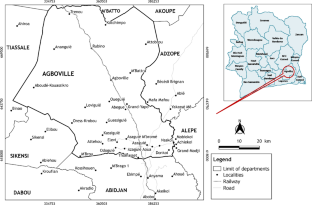
Forest species have long been associated with cocoa farming systems based on farmers' perceptions. However, in the absence of scientific evidence, there is a lack of consensus on farmers' knowledge of desirable and undesirable cocoa shade species. This study aimed to identify farmers' criteria for selecting tree species in cocoa systems, and to analyse cocoa tree planting density and aboveground biomass (ABG) around shade trees. In the south of Côte d'Ivoire, 154 farmers were interviewed on the advantages and disadvantages of cocoa tree species. Botanical inventories were carried out to record the presence of all identified shade species. Cocoa tree planting density and biomass around the 15 most common shade species were calculated. The results showed that cocoa farmers have a lot of knowledge about the advantages and disadvantages of 35 shade trees. Ricinodendron heudelotii, Xylopia aethiopica and Terminalia spp. were the most beneficial species for cocoa. They increased soil moisture and provided good shade. Cola nitida, Elaeis guineensis, Musa paradisiaca and Cocos nucifera were the most detrimental species to cocoa. They attracted pests and diseases and competed for nutrients and water. But these detrimental species were present in more than 50% of farms. While these beneficial and detrimental species did not significantly affect cocoa tree AGB, farmers preferred to reduce cocoa density by two species: Elaeis guineensis and Citrus sinensis. Further research should be conducted to highlight the influences of shade species on the full phenology of the cocoa tree.
期刊介绍:
Agroforestry Systems is an international scientific journal that publishes results of novel, high impact original research, critical reviews and short communications on any aspect of agroforestry. The journal particularly encourages contributions that demonstrate the role of agroforestry in providing commodity as well non-commodity benefits such as ecosystem services. Papers dealing with both biophysical and socioeconomic aspects are welcome. These include results of investigations of a fundamental or applied nature dealing with integrated systems involving trees and crops and/or livestock. Manuscripts that are purely descriptive in nature or confirmatory in nature of well-established findings, and with limited international scope are discouraged. To be acceptable for publication, the information presented must be relevant to a context wider than the specific location where the study was undertaken, and provide new insight or make a significant contribution to the agroforestry knowledge base




 京公网安备 11010802042870号
京ICP备2023020795号-1
京公网安备 11010802042870号
京ICP备2023020795号-1

 分享
分享
 求助内容:
求助内容: 应助结果提醒方式:
 扫码关注我们
