{"title":"Subtypes of Dementia with Lewy Bodies: Clinical Features, Survival, and Apolipoprotein E Effect.","authors":"Alya Gharbi, Amina Nasri, Ikram Sghaier, Imen Kacem, Saloua Mrabet, Amira Souissi, Mouna Ben Djebara, Amina Gargouri, Riadh Gouider","doi":"10.3233/ADR-230064","DOIUrl":null,"url":null,"abstract":"<p><strong>Background: </strong>Dementia with Lewy bodies (DLB) is a progressive neurodegenerative disease with various clinical symptoms. Limited data have described the clinical subtypes of DLB.</p><p><strong>Objective: </strong>We aimed to compare clinical subtypes of DLB according to initial symptoms and to study the effect of Apolipoprotein E (<i>APOE</i>) gene in DLB.</p><p><strong>Methods: </strong>We included DLB patients classified into three groups based on initial symptoms: non-motor onset (cognitive and/or psychiatric) (NMO-DLB), motor onset (parkinsonism and/or gait disorders) (MO-DLB), and mixed onset (non-motor and motor symptoms) (MXO-DLB). Clinical and <i>APOE</i> genotype associations and survival were analyzed.</p><p><strong>Results: </strong>A total of 268 patients were included (NMO-DLB = 75%, MXO-DLB = 15.3%, MO-DLB = 9.7%). Visual hallucinations were more frequent (<i>p</i> = 0.025), and attention was less commonly impaired in MXO-DLB (<i>p</i> = 0.047). When adjusting with <i>APOE</i> <i>ɛ</i>4 status (<i>APOE</i> genotype performed in 155 patients), earlier falls and frontal lobe syndrome were more common in MXO-DLB (<i>p</i> = 0.044 and <i>p</i> = 0.023, respectively). The median MMSE decline was 2.1 points/year and the median FAB decline was 1.9 points/year, with no effect of clinical subtypes. Median survival was 6 years. It was similar in DLB subtypes (<i>p</i> = 0.62), but shorter for patients with memory symptoms at onset (<i>p</i> = 0.04) and for males (<i>p</i> = 0.0058).</p><p><strong>Conclusions: </strong>Our study revealed a few differences between DLB clinical subtypes. <i>APOE</i> <i>ɛ</i>4 appears to be associated with earlier falls and a higher prevalence of frontal syndrome in MXO-DLB. However, DLB clinical subtypes did not impact on survival. Nevertheless, survival analysis identified other poor prognosis factors, notably inaugural memory impairment and male gender.</p>","PeriodicalId":73594,"journal":{"name":"Journal of Alzheimer's disease reports","volume":"7 1","pages":"1277-1288"},"PeriodicalIF":2.8000,"publicationDate":"2023-11-27","publicationTypes":"Journal Article","fieldsOfStudy":null,"isOpenAccess":false,"openAccessPdf":"https://www.ncbi.nlm.nih.gov/pmc/articles/PMC10741894/pdf/","citationCount":"0","resultStr":null,"platform":"Semanticscholar","paperid":null,"PeriodicalName":"Journal of Alzheimer's disease reports","FirstCategoryId":"1085","ListUrlMain":"https://doi.org/10.3233/ADR-230064","RegionNum":0,"RegionCategory":null,"ArticlePicture":[],"TitleCN":null,"AbstractTextCN":null,"PMCID":null,"EPubDate":"2023/1/1 0:00:00","PubModel":"eCollection","JCR":"Q2","JCRName":"NEUROSCIENCES","Score":null,"Total":0}
引用次数: 0
Abstract
Background: Dementia with Lewy bodies (DLB) is a progressive neurodegenerative disease with various clinical symptoms. Limited data have described the clinical subtypes of DLB.
Objective: We aimed to compare clinical subtypes of DLB according to initial symptoms and to study the effect of Apolipoprotein E (APOE) gene in DLB.
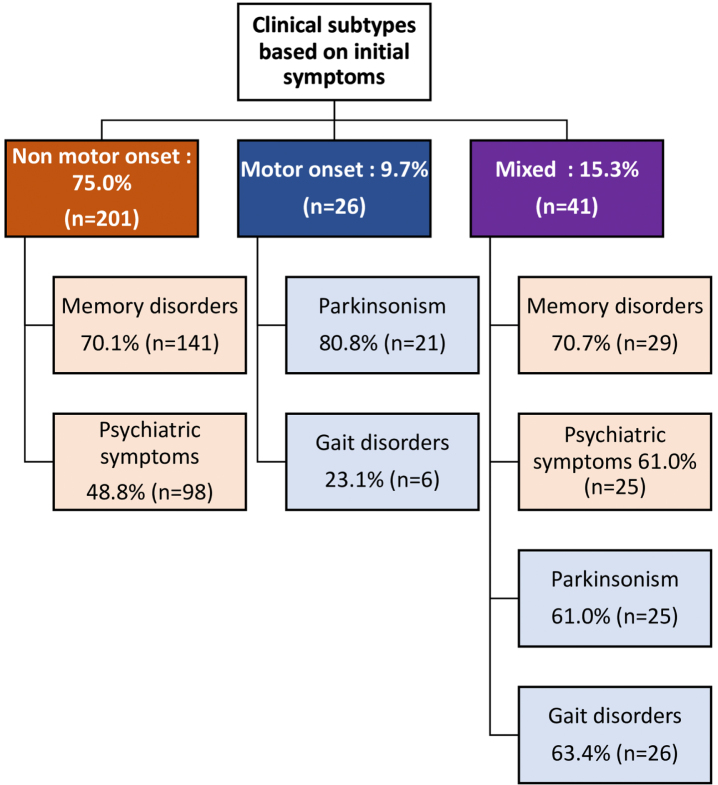
Methods: We included DLB patients classified into three groups based on initial symptoms: non-motor onset (cognitive and/or psychiatric) (NMO-DLB), motor onset (parkinsonism and/or gait disorders) (MO-DLB), and mixed onset (non-motor and motor symptoms) (MXO-DLB). Clinical and APOE genotype associations and survival were analyzed.
Results: A total of 268 patients were included (NMO-DLB = 75%, MXO-DLB = 15.3%, MO-DLB = 9.7%). Visual hallucinations were more frequent (p = 0.025), and attention was less commonly impaired in MXO-DLB (p = 0.047). When adjusting with APOEɛ4 status (APOE genotype performed in 155 patients), earlier falls and frontal lobe syndrome were more common in MXO-DLB (p = 0.044 and p = 0.023, respectively). The median MMSE decline was 2.1 points/year and the median FAB decline was 1.9 points/year, with no effect of clinical subtypes. Median survival was 6 years. It was similar in DLB subtypes (p = 0.62), but shorter for patients with memory symptoms at onset (p = 0.04) and for males (p = 0.0058).
Conclusions: Our study revealed a few differences between DLB clinical subtypes. APOEɛ4 appears to be associated with earlier falls and a higher prevalence of frontal syndrome in MXO-DLB. However, DLB clinical subtypes did not impact on survival. Nevertheless, survival analysis identified other poor prognosis factors, notably inaugural memory impairment and male gender.




 京公网安备 11010802042870号
京ICP备2023020795号-1
京公网安备 11010802042870号
京ICP备2023020795号-1

 分享
分享

 求助内容:
求助内容: 应助结果提醒方式:
 扫码关注我们
