{"title":"Synseed germination, conversion, and acclimatization of seedless watermelon ‘Quality’","authors":"Putri Santika, Jong-Yi Fang","doi":"10.1007/s11627-023-10403-y","DOIUrl":null,"url":null,"abstract":"<p>Seedless watermelons are triploid hybrids (3n) that have been growing in popularity since the 1990s. However, the high production cost and low germination rate of the hybrid seeds pose a major problem in their production. The synseed technology could make a promising alternative for seedless watermelon propagation; however, this alternative has not yet been explored. This study aimed at producing synseeds of seedless watermelon ‘Quality’ using shoot tips as the propagules after which their germination and conversion were evaluated under <i>in vitro</i> and <i>ex vitro</i> conditions. <i>In vitro</i> shoot multiplication with different concentrations of 6-benzylaminopurine (BAP), synseed production from BAP-multiplied shoot tips, synseed sowing <i>in vitro</i> using several substrates and medium supplements, and synseed sowing <i>ex vitro</i> using different antimicrobial agents were investigated. Results indicated that 1.0 mg L<sup>−1</sup> BAP resulted in the highest number of shoots per shoot tip explant. Synseeds produced from BAP-multiplied shoot tips achieved faster germination compared to synseeds from non-BAP-derived shoot tips, but there was no difference in terms of conversion and acclimatization survival rates. Agar showed greater conversion and acclimatization survival rates as well as root number, root length, and shoot length than the other substrates especially when indole-3-butyric acid (IBA) at 1.0 mg L<sup>−1</sup> was added to the medium. However, this study demonstrated the possibility of using vermiculite as an alternative substrate to agar. PPM at 0.5% was a better microbial agent than 100.0 mg L<sup>−1</sup> mancozeb for <i>ex vitro</i> synseed sowing as it achieved zero contamination and maintained the growing potential of synseeds with 65% germination, 85% survival, and 25% rooting rates.</p>","PeriodicalId":13293,"journal":{"name":"In Vitro Cellular & Developmental Biology - Plant","volume":"123 1","pages":""},"PeriodicalIF":1.9000,"publicationDate":"2023-12-29","publicationTypes":"Journal Article","fieldsOfStudy":null,"isOpenAccess":false,"openAccessPdf":"","citationCount":"0","resultStr":null,"platform":"Semanticscholar","paperid":null,"PeriodicalName":"In Vitro Cellular & Developmental Biology - Plant","FirstCategoryId":"99","ListUrlMain":"https://doi.org/10.1007/s11627-023-10403-y","RegionNum":3,"RegionCategory":"生物学","ArticlePicture":[],"TitleCN":null,"AbstractTextCN":null,"PMCID":null,"EPubDate":"","PubModel":"","JCR":"Q4","JCRName":"CELL BIOLOGY","Score":null,"Total":0}
引用次数: 0
Abstract
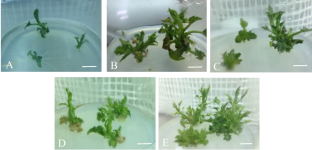
Seedless watermelons are triploid hybrids (3n) that have been growing in popularity since the 1990s. However, the high production cost and low germination rate of the hybrid seeds pose a major problem in their production. The synseed technology could make a promising alternative for seedless watermelon propagation; however, this alternative has not yet been explored. This study aimed at producing synseeds of seedless watermelon ‘Quality’ using shoot tips as the propagules after which their germination and conversion were evaluated under in vitro and ex vitro conditions. In vitro shoot multiplication with different concentrations of 6-benzylaminopurine (BAP), synseed production from BAP-multiplied shoot tips, synseed sowing in vitro using several substrates and medium supplements, and synseed sowing ex vitro using different antimicrobial agents were investigated. Results indicated that 1.0 mg L−1 BAP resulted in the highest number of shoots per shoot tip explant. Synseeds produced from BAP-multiplied shoot tips achieved faster germination compared to synseeds from non-BAP-derived shoot tips, but there was no difference in terms of conversion and acclimatization survival rates. Agar showed greater conversion and acclimatization survival rates as well as root number, root length, and shoot length than the other substrates especially when indole-3-butyric acid (IBA) at 1.0 mg L−1 was added to the medium. However, this study demonstrated the possibility of using vermiculite as an alternative substrate to agar. PPM at 0.5% was a better microbial agent than 100.0 mg L−1 mancozeb for ex vitro synseed sowing as it achieved zero contamination and maintained the growing potential of synseeds with 65% germination, 85% survival, and 25% rooting rates.
期刊介绍:
Founded in 1965, In Vitro Cellular & Developmental Biology - Plant is the only journal devoted solely to worldwide coverage of in vitro biology in plants. Its high-caliber original research and reviews make it required reading for anyone who needs comprehensive coverage of the latest developments and state-of-the-art research in plant cell and tissue culture and biotechnology from around the world.




 京公网安备 11010802042870号
京ICP备2023020795号-1
京公网安备 11010802042870号
京ICP备2023020795号-1

 分享
分享
 求助内容:
求助内容: 应助结果提醒方式:
 扫码关注我们
