Pamela Silveira, Ícaro William Valler, Zelinda Maria Braga Hirano, Aline Naíssa Dada, Matthias Laska, Laura Teresa Hernandez Salazar
{"title":"Food preferences and nutrient composition in captive Southern brown howler monkeys, Alouatta guariba clamitans","authors":"Pamela Silveira, Ícaro William Valler, Zelinda Maria Braga Hirano, Aline Naíssa Dada, Matthias Laska, Laura Teresa Hernandez Salazar","doi":"10.1007/s10329-023-01109-1","DOIUrl":null,"url":null,"abstract":"<p>Studies of food preferences in captive primates have so far mainly been restricted to frugivorous species. It was therefore the aim of the present study to assess the occurrence of spontaneous food preferences in a mainly folivorous primate, the captive Southern brown howler monkey, and to analyze whether these preferences correlate with nutrient composition. Using a two-alternative choice test, we presented ten male and five female adult <i>Alouatta guariba clamitans</i> with all possible binary combinations of ten types of food that are part of their diet in captivity and recorded their choice behavior. We found the howler monkeys to display the following rank order of preference: banana > mango > watermelon > papaya > beetroot > apple > pear > orange > cucumber > tomato. This preference ranking significantly and positively correlated with the total carbohydrate content and with the sucrose content of the food items. We also found significant positive correlations between the food preference ranking and the content of the minerals copper and magnesium. Male and female howler monkeys did not differ significantly in their food preference rankings. These results suggest this howler monkeys under human care are not opportunistic, but selective feeders with regard to maximizing their net gain of energy as only the content of carbohydrates, but not the contents of total energy, proteins, or lipids significantly correlated with the displayed food preferences. Thus, the food preferences of this primate are similar to those reported in several species of frugivorous primates tested with cultivated fruits and vegetables.</p>","PeriodicalId":20468,"journal":{"name":"Primates","volume":"9 1","pages":""},"PeriodicalIF":1.5000,"publicationDate":"2024-01-03","publicationTypes":"Journal Article","fieldsOfStudy":null,"isOpenAccess":false,"openAccessPdf":"","citationCount":"0","resultStr":null,"platform":"Semanticscholar","paperid":null,"PeriodicalName":"Primates","FirstCategoryId":"99","ListUrlMain":"https://doi.org/10.1007/s10329-023-01109-1","RegionNum":4,"RegionCategory":"生物学","ArticlePicture":[],"TitleCN":null,"AbstractTextCN":null,"PMCID":null,"EPubDate":"","PubModel":"","JCR":"Q2","JCRName":"ZOOLOGY","Score":null,"Total":0}
引用次数: 0
Abstract
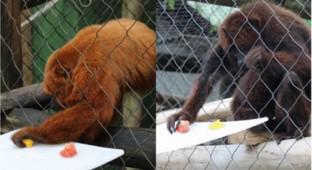
Studies of food preferences in captive primates have so far mainly been restricted to frugivorous species. It was therefore the aim of the present study to assess the occurrence of spontaneous food preferences in a mainly folivorous primate, the captive Southern brown howler monkey, and to analyze whether these preferences correlate with nutrient composition. Using a two-alternative choice test, we presented ten male and five female adult Alouatta guariba clamitans with all possible binary combinations of ten types of food that are part of their diet in captivity and recorded their choice behavior. We found the howler monkeys to display the following rank order of preference: banana > mango > watermelon > papaya > beetroot > apple > pear > orange > cucumber > tomato. This preference ranking significantly and positively correlated with the total carbohydrate content and with the sucrose content of the food items. We also found significant positive correlations between the food preference ranking and the content of the minerals copper and magnesium. Male and female howler monkeys did not differ significantly in their food preference rankings. These results suggest this howler monkeys under human care are not opportunistic, but selective feeders with regard to maximizing their net gain of energy as only the content of carbohydrates, but not the contents of total energy, proteins, or lipids significantly correlated with the displayed food preferences. Thus, the food preferences of this primate are similar to those reported in several species of frugivorous primates tested with cultivated fruits and vegetables.
期刊介绍:
Primates is an international journal of primatology whose aim is to provide a forum for the elucidation of all aspects of primates. The oldest primatological journal, Primates publishes original papers that advance the scientific study of primates, and its scope embraces work in diverse fields covering biological bases of behavior, socio-ecology, learning and cognition, social processes, systematics, evolution, and medicine. Contributions relevant to conservation of natural populations and welfare of captive primates are welcome. Studies focusing on nonprimate species may be considered if their relevance to primatology is clear. Original Articles as well as Review Articles, News and Perspectives, and Book Reviews are included. All manuscripts received are initially screened for suitability by members of the Editorial Board, taking into account style and ethical issues, leading to a swift decision about whether to send the manuscript for external review.



 京公网安备 11010802042870号
京ICP备2023020795号-1
京公网安备 11010802042870号
京ICP备2023020795号-1

 分享
分享
 求助内容:
求助内容: 应助结果提醒方式:
 扫码关注我们
