Jing Li, Shengping Jiang, Chengyun Huang, Baihui Lu, Xiaolong Yang
{"title":"Identification and validation of genes associated with aging-related cardiovascular disease","authors":"Jing Li, Shengping Jiang, Chengyun Huang, Baihui Lu, Xiaolong Yang","doi":"10.1096/fj.202301270RR","DOIUrl":null,"url":null,"abstract":"<p>Aging is acknowledged as the most significant risk factor for cardiovascular disease (CVD). This study sought to identify and validate potential aging-related genes associated with CVD by using bioinformatics. The confluence of the limma test, weighted correlation network analysis (WGCNA), and 2129 aging and senescence-associated genes led to the identification of aging-related differential expression genes (ARDEGs). By using Gene Ontology (GO) and Kyoto Encyclopedia of Genes and Genomes (KEGG), potential biological roles and pathways of ARDEGs were identified. To find the significantly different functions between CVD and non-cardiovascular disease (nCVD) and to reckon the processes score, enrichment analysis of all genes was carried out using gene set enrichment analysis (GSEA) and gene set variation analysis (GSVA). By using GO and KEGG, potential biological roles and pathways of ARDEGs were identified. To evaluate the immune cell composition of the immune microenvironment, we performed an immune infiltration analysis on the dataset from the training group. We were able to acquire four ARDEGs (PTGS2, MMP9, HBEGF, and FN1). Aging, cellular senescence, and nitric oxide signal transduction were selected for biological function analysis. The diagnostic value of the four ARDEGs in distinguishing CVD from nCVD samples was deemed to be favorable. This research identified four ARDEGs that are associated with CVD. This study provides insight into prospective novel biomarkers for aging-related CVD diagnosis and progression monitoring.</p>","PeriodicalId":50455,"journal":{"name":"The FASEB Journal","volume":"38 1","pages":""},"PeriodicalIF":4.2000,"publicationDate":"2024-01-03","publicationTypes":"Journal Article","fieldsOfStudy":null,"isOpenAccess":false,"openAccessPdf":"","citationCount":"0","resultStr":null,"platform":"Semanticscholar","paperid":null,"PeriodicalName":"The FASEB Journal","FirstCategoryId":"99","ListUrlMain":"https://faseb.onlinelibrary.wiley.com/doi/10.1096/fj.202301270RR","RegionNum":2,"RegionCategory":"生物学","ArticlePicture":[],"TitleCN":null,"AbstractTextCN":null,"PMCID":null,"EPubDate":"","PubModel":"","JCR":"Q2","JCRName":"BIOCHEMISTRY & MOLECULAR BIOLOGY","Score":null,"Total":0}
引用次数: 0
Abstract
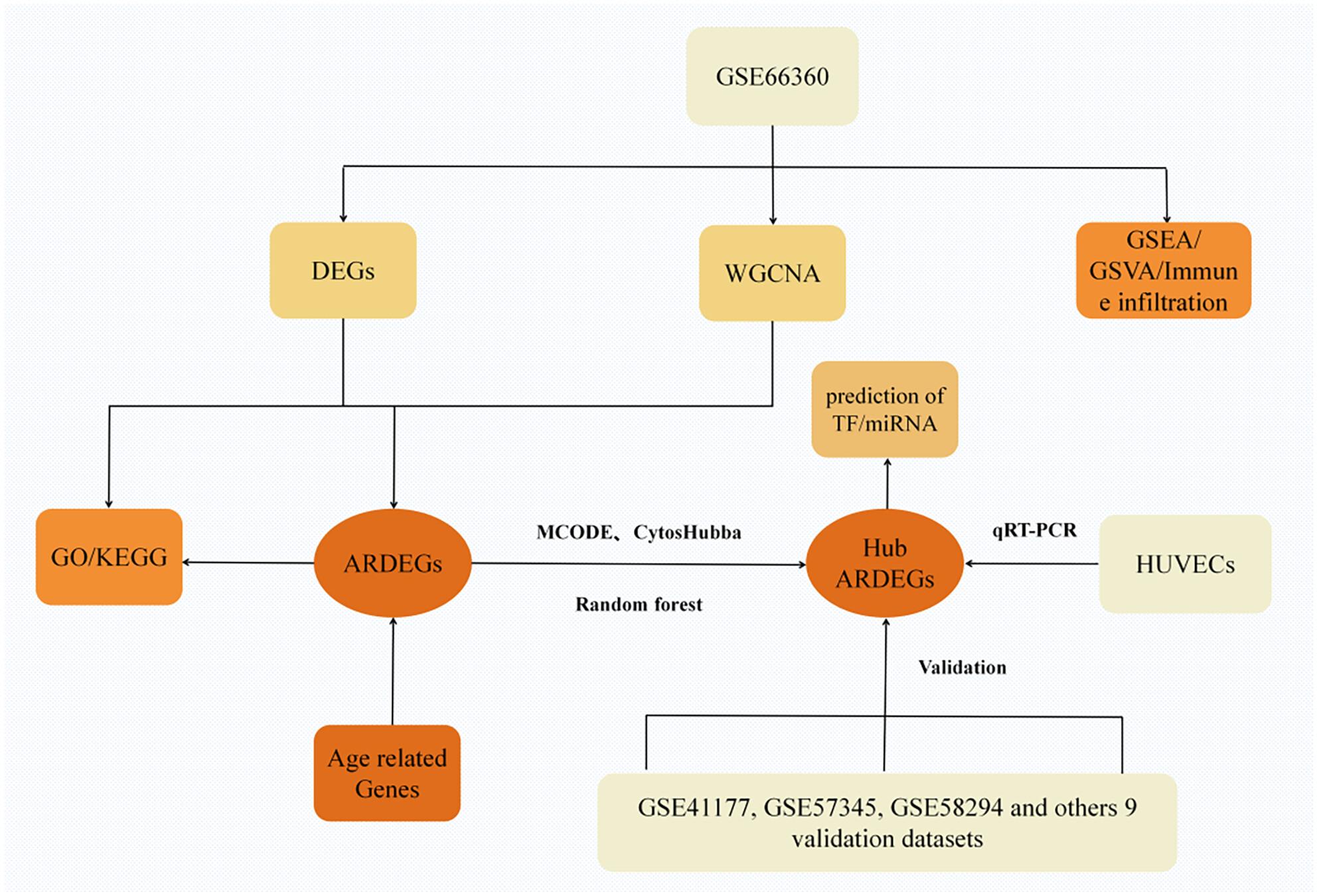
Aging is acknowledged as the most significant risk factor for cardiovascular disease (CVD). This study sought to identify and validate potential aging-related genes associated with CVD by using bioinformatics. The confluence of the limma test, weighted correlation network analysis (WGCNA), and 2129 aging and senescence-associated genes led to the identification of aging-related differential expression genes (ARDEGs). By using Gene Ontology (GO) and Kyoto Encyclopedia of Genes and Genomes (KEGG), potential biological roles and pathways of ARDEGs were identified. To find the significantly different functions between CVD and non-cardiovascular disease (nCVD) and to reckon the processes score, enrichment analysis of all genes was carried out using gene set enrichment analysis (GSEA) and gene set variation analysis (GSVA). By using GO and KEGG, potential biological roles and pathways of ARDEGs were identified. To evaluate the immune cell composition of the immune microenvironment, we performed an immune infiltration analysis on the dataset from the training group. We were able to acquire four ARDEGs (PTGS2, MMP9, HBEGF, and FN1). Aging, cellular senescence, and nitric oxide signal transduction were selected for biological function analysis. The diagnostic value of the four ARDEGs in distinguishing CVD from nCVD samples was deemed to be favorable. This research identified four ARDEGs that are associated with CVD. This study provides insight into prospective novel biomarkers for aging-related CVD diagnosis and progression monitoring.
期刊介绍:
The FASEB Journal publishes international, transdisciplinary research covering all fields of biology at every level of organization: atomic, molecular, cell, tissue, organ, organismic and population. While the journal strives to include research that cuts across the biological sciences, it also considers submissions that lie within one field, but may have implications for other fields as well. The journal seeks to publish basic and translational research, but also welcomes reports of pre-clinical and early clinical research. In addition to research, review, and hypothesis submissions, The FASEB Journal also seeks perspectives, commentaries, book reviews, and similar content related to the life sciences in its Up Front section.




 京公网安备 11010802042870号
京ICP备2023020795号-1
京公网安备 11010802042870号
京ICP备2023020795号-1

 分享
分享
 求助内容:
求助内容: 应助结果提醒方式:
 扫码关注我们
