E. A. Gan’shina, V. V. Garshin, N. N. Perova, I. M. Pripechenkov, A. N. Yurasov, M. M. Yashin, V. V. Rylkov, A. B. Granovskii
{"title":"Magnetooptical Kerr Spectroscopy of Nanocomposites","authors":"E. A. Gan’shina, V. V. Garshin, N. N. Perova, I. M. Pripechenkov, A. N. Yurasov, M. M. Yashin, V. V. Rylkov, A. B. Granovskii","doi":"10.1134/S1063776123100151","DOIUrl":null,"url":null,"abstract":"<p>Magnetooptical spectroscopy is an effective method for studying the magnetic microstructure of homogeneous and heterogeneous magnets. This review is devoted to analysis of numerous factors affecting the intensity and spectral dependence of a magnetooptical signal of the equatorial Kerr effect in nanocomposites “ferromagnetic metal–dielectric” in the visible and near infrared spectral regions. Examples of the influence of the metal concentration, nanoparticle size and shape, the substrate, the material of the dielectric, the amorphization of grains, the deposition method, and other factors on the magnetooptical spectrum are considered. The differences in the magnetooptical spectra for the superparamagnetic, superferromagnetic, and ferromagnetic states are demonstrated. It is noted that in the presence of fractions with different field dependences of the magnetization in a nanocomposite, the magnetooptical signal is not proportional to the total magnetization. Examples of enhancement and sign inversion of the magnetooptical signal in nanocomposites are considered. The possibility of the description of magnetooptical spectra using the methods of the effective medium (the Bruggeman method and the Maxwell–Garnett symmetrized approximation) is discussed.</p>","PeriodicalId":629,"journal":{"name":"Journal of Experimental and Theoretical Physics","volume":"137 :","pages":"572 - 581"},"PeriodicalIF":0.8000,"publicationDate":"2023-12-10","publicationTypes":"Journal Article","fieldsOfStudy":null,"isOpenAccess":false,"openAccessPdf":"","citationCount":"0","resultStr":null,"platform":"Semanticscholar","paperid":null,"PeriodicalName":"Journal of Experimental and Theoretical Physics","FirstCategoryId":"101","ListUrlMain":"https://link.springer.com/article/10.1134/S1063776123100151","RegionNum":4,"RegionCategory":"物理与天体物理","ArticlePicture":[],"TitleCN":null,"AbstractTextCN":null,"PMCID":null,"EPubDate":"","PubModel":"","JCR":"Q3","JCRName":"PHYSICS, MULTIDISCIPLINARY","Score":null,"Total":0}
引用次数: 0
Abstract
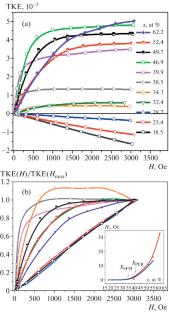
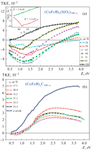
Magnetooptical spectroscopy is an effective method for studying the magnetic microstructure of homogeneous and heterogeneous magnets. This review is devoted to analysis of numerous factors affecting the intensity and spectral dependence of a magnetooptical signal of the equatorial Kerr effect in nanocomposites “ferromagnetic metal–dielectric” in the visible and near infrared spectral regions. Examples of the influence of the metal concentration, nanoparticle size and shape, the substrate, the material of the dielectric, the amorphization of grains, the deposition method, and other factors on the magnetooptical spectrum are considered. The differences in the magnetooptical spectra for the superparamagnetic, superferromagnetic, and ferromagnetic states are demonstrated. It is noted that in the presence of fractions with different field dependences of the magnetization in a nanocomposite, the magnetooptical signal is not proportional to the total magnetization. Examples of enhancement and sign inversion of the magnetooptical signal in nanocomposites are considered. The possibility of the description of magnetooptical spectra using the methods of the effective medium (the Bruggeman method and the Maxwell–Garnett symmetrized approximation) is discussed.
期刊介绍:
Journal of Experimental and Theoretical Physics is one of the most influential physics research journals. Originally based on Russia, this international journal now welcomes manuscripts from all countries in the English or Russian language. It publishes original papers on fundamental theoretical and experimental research in all fields of physics: from solids and liquids to elementary particles and astrophysics.



 京公网安备 11010802042870号
京ICP备2023020795号-1
京公网安备 11010802042870号
京ICP备2023020795号-1

 分享
分享
 求助内容:
求助内容: 应助结果提醒方式:
 扫码关注我们
