Claudia J. Bautista , Nidia Arango , Consuelo Plata , Irma B. Mitre-Aguilar , Joyce Trujillo , Victoria Ramírez
{"title":"Mechanism of cadmium-induced nephrotoxicity","authors":"Claudia J. Bautista , Nidia Arango , Consuelo Plata , Irma B. Mitre-Aguilar , Joyce Trujillo , Victoria Ramírez","doi":"10.1016/j.tox.2024.153726","DOIUrl":null,"url":null,"abstract":"<div><p><span>Heavy metals are found naturally in our environment and have many uses and applications in daily life. However, high concentrations of metals may be a result of pollution due to industrialization. In particular, cadmium (Cd), a white metal abundantly distributed in the terrestrial crust, is found in mines together with zinc, which accumulates after volcanic eruption or is found naturally in the sea and earth. High levels of Cd have been associated with disease. In the human body, Cd accumulates in two ways: via inhalation or consumption, mainly of plants or fish contaminated with high concentrations. Several international organizations have been working to establish the limit values of heavy metals in food, water, and the environment to avoid their toxic effects. Increased Cd levels may induce kidney, liver, or </span>neurological diseases<span>. Cd mainly accumulates in the kidney, causing renal disease in people exposed to moderate to high levels, which leads to the development of end-stage chronic kidney disease<span> or death. The aim of this review is to provide an overview of Cd-induced nephrotoxicity, the mechanisms of Cd damage, and the current treatments used to reduce the toxic effects of Cd exposure.</span></span></p></div>","PeriodicalId":23159,"journal":{"name":"Toxicology","volume":"502 ","pages":"Article 153726"},"PeriodicalIF":4.6000,"publicationDate":"2024-01-06","publicationTypes":"Journal Article","fieldsOfStudy":null,"isOpenAccess":false,"openAccessPdf":"","citationCount":"0","resultStr":null,"platform":"Semanticscholar","paperid":null,"PeriodicalName":"Toxicology","FirstCategoryId":"3","ListUrlMain":"https://www.sciencedirect.com/science/article/pii/S0300483X24000076","RegionNum":3,"RegionCategory":"医学","ArticlePicture":[],"TitleCN":null,"AbstractTextCN":null,"PMCID":null,"EPubDate":"","PubModel":"","JCR":"Q1","JCRName":"PHARMACOLOGY & PHARMACY","Score":null,"Total":0}
引用次数: 0
Abstract
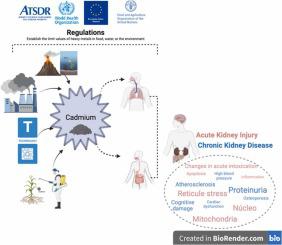
Heavy metals are found naturally in our environment and have many uses and applications in daily life. However, high concentrations of metals may be a result of pollution due to industrialization. In particular, cadmium (Cd), a white metal abundantly distributed in the terrestrial crust, is found in mines together with zinc, which accumulates after volcanic eruption or is found naturally in the sea and earth. High levels of Cd have been associated with disease. In the human body, Cd accumulates in two ways: via inhalation or consumption, mainly of plants or fish contaminated with high concentrations. Several international organizations have been working to establish the limit values of heavy metals in food, water, and the environment to avoid their toxic effects. Increased Cd levels may induce kidney, liver, or neurological diseases. Cd mainly accumulates in the kidney, causing renal disease in people exposed to moderate to high levels, which leads to the development of end-stage chronic kidney disease or death. The aim of this review is to provide an overview of Cd-induced nephrotoxicity, the mechanisms of Cd damage, and the current treatments used to reduce the toxic effects of Cd exposure.
期刊介绍:
Toxicology is an international, peer-reviewed journal that publishes only the highest quality original scientific research and critical reviews describing hypothesis-based investigations into mechanisms of toxicity associated with exposures to xenobiotic chemicals, particularly as it relates to human health. In this respect "mechanisms" is defined on both the macro (e.g. physiological, biological, kinetic, species, sex, etc.) and molecular (genomic, transcriptomic, metabolic, etc.) scale. Emphasis is placed on findings that identify novel hazards and that can be extrapolated to exposures and mechanisms that are relevant to estimating human risk. Toxicology also publishes brief communications, personal commentaries and opinion articles, as well as concise expert reviews on contemporary topics. All research and review articles published in Toxicology are subject to rigorous peer review. Authors are asked to contact the Editor-in-Chief prior to submitting review articles or commentaries for consideration for publication in Toxicology.



 京公网安备 11010802042870号
京ICP备2023020795号-1
京公网安备 11010802042870号
京ICP备2023020795号-1

 分享
分享
 求助内容:
求助内容: 应助结果提醒方式:
 扫码关注我们
