Victor Pitron, Michael Witthöft, Cédric Lemogne, Damien Léger, Susan Clayton, Omer Van den Bergh
{"title":"How climate-change awareness can provoke physical symptoms","authors":"Victor Pitron, Michael Witthöft, Cédric Lemogne, Damien Léger, Susan Clayton, Omer Van den Bergh","doi":"10.1002/fee.2700","DOIUrl":null,"url":null,"abstract":"<p>The Intergovernmental Panel on Climate Change has described the risks to humans from a changing climate. Although difficult to specify precisely, health outcomes of climate changes are potentially enormous (Rising <i>et al</i>. <span>2022</span>). They include the risks associated with excessive temperatures, extreme weather events, biodiversity loss, air pollution, and so forth, which threaten both physical and mental health. Climate experts emphasize the need for rapid and fundamental changes in behaviors, lifestyles, and social organizations to minimize and adapt to global warming, but effective responses are often inhibited by false information and denial in social media as well as by political resistance. Information campaigns are important to induce accurate risk perception, awareness of the necessity of lifestyle changes, and beliefs that these changes will be effective in order to motivate pro-environmental behaviors. However, such awareness has also been associated with anxiety and depression and may impact mental health (Clayton <span>2020</span>). In this letter, our goal is to describe how greater awareness of climate change may also provoke physical symptoms.</p><p>Recent models of physical symptom formation show how cognitive and emotional factors such as health beliefs and symptom expectations can outweigh sensory information in the process of developing symptoms (Henningsen <i>et al</i>. <span>2018</span>). Given that the human brain is hardwired to reduce uncertainty (Anderson <i>et al</i>. <span>2019</span>) and ensure bodily protection (Van den Bergh <i>et al</i>. <span>2021</span>), physical symptoms can arise in response to health information that is perceived as alarming even if the body is not affected. These nocebo-based symptoms, the evil twins of placebo effects, are routinely observed in medicine (Colloca and Barsky <span>2020</span>). Negative expectations promote the development of symptoms in the same way that positive expectations increase the benefit of treatments. Nocebo-based symptoms are as real as externally caused symptoms, and neurobiological studies have described the underlying processes explaining how the brain translates negative expectations into physical symptoms (Wager and Atlas <span>2015</span>).</p><p>Health worries about modern environmental changes have already been shown to provoke nocebo-based physical symptoms. For example, symptoms that sufferers attribute to electromagnetic fields result from worries about mobile phones and Wi-Fi networks: when affected individuals were convinced that electromagnetic radiation was present, they experienced symptoms (eg fatigue, headache) regardless of whether real radiation was present or absent (Rubin <i>et al</i>. <span>2010</span>). These conditions are not anecdotal. In laboratory experiments, the induction of negative expectations regarding Wi-Fi radiation can provoke somatic sensory experiences in healthy volunteers exposed to sham-Wi-Fi (Bräscher <i>et al</i>. <span>2017</span>).</p><p>Climate-change awareness could provoke nocebo-based symptoms in several ways. Excessive worries about climate change, potentially aggravated by inadequate governmental response (Hickman <i>et al</i>. <span>2021</span>), can lead to increasing concerns about environmental health and produce physical symptoms associated with environmental factors. For instance, individuals worried about temperature rise may experience airways discomfort and breathlessness even with moderate temperatures. Nocebo-based symptoms could also result from excessive health worries about new technologies trying to mitigate climate-change impacts (eg tinnitus [sound perception with no external causes] attributed to wind turbines) or helping to endure them (eg brain fog attributed to air-conditioning) (Dömötör <i>et al</i>. <span>2019</span>). If not properly attended to in climate-change communication, these nocebo-based symptoms may add on to climate change's physiological-based symptoms.</p><p>Probable risk factors of nocebo-based physical symptoms associated with environmental worries include individual attributes such as negative affectivity, health anxiety, and catastrophism (the tendency to expect the worst) (Van den Bergh <i>et al</i>. <span>2017</span>). Furthermore, although media coverage that informs about climate change is necessary, it may describe health hazards in a rather sensationalist way that may elicit adverse effects. For example, the incidence of symptoms associated with electromagnetic fields correlates with the spread of alarming information about electromagnetic fields in newspaper articles (Huang <i>et al</i>. <span>2018</span>). Conversely, nocebo-based physical symptoms can be prevented by the promotion of balanced and scientifically sound information about health hazards and appropriate explanations about underlying mechanisms of the nocebo effect (Crichton and Petrie <span>2015</span>).</p><p>Greater awareness of climate change and its impacts on health is necessary; so too is attention to the possible physical and psychological health impacts and consequences of such awareness. We propose that: (1) policy makers should promote climate-change awareness in collaboration with expert researchers and health practitioners to develop and evaluate specific collective prevention strategies using dedicated toolkits, such as the Yale Program of Climate Change Communication (Campbell <i>et al</i>. <span>2023</span>); (2) health practitioners can impact beliefs and behaviors about climate change (Maibach <i>et al</i>. <span>2021</span>) and, therefore, should be educated also about the risk of growing climate-change awareness for mental disorders and physical symptoms, and the ways to prevent them; medical education and clinical settings should incorporate concepts drawn from health psychology and bio-psycho-social health to reduce these risks; (3) journalists and weather forecasters can be trained to report more efficiently about climate change (Yagatich <i>et al</i>. <span>2022</span>) and encouraged to: (i) disseminate scientifically grounded and tailored information, and (ii) inform the public about effective ways to minimize the risks associated with climate-change awareness; and (4) researchers should investigate the moderators and mediators of impacts of climate-change awareness on both mental and physical health.</p><p>Insights about the potential for unintended consequences are necessary to promote climate-change awareness in a safe, constructive, and effective way.</p><p><i>This letter benefited from a FIAS fellowship to SC at the Paris Institute for Advanced Study (France), which received funding from the European Union's Horizon 2020 research and innovation program under the Marie Sklowdowska-Curie grant agreement No 945408, and from the French State program “Investissements d'avenir” managed by the Agence Nationale de la Recherche (ANR-11-LABX-0027-01 Labex RFIEA+). This letter was also supported by a grant from the Fondation pour la Recherche Médicale (ENV202109013786). Data availability statement: no data were collected for this study</i>.</p>","PeriodicalId":171,"journal":{"name":"Frontiers in Ecology and the Environment","volume":"22 1","pages":""},"PeriodicalIF":7.6000,"publicationDate":"2024-01-09","publicationTypes":"Journal Article","fieldsOfStudy":null,"isOpenAccess":false,"openAccessPdf":"https://onlinelibrary.wiley.com/doi/epdf/10.1002/fee.2700","citationCount":"0","resultStr":null,"platform":"Semanticscholar","paperid":null,"PeriodicalName":"Frontiers in Ecology and the Environment","FirstCategoryId":"93","ListUrlMain":"https://esajournals.onlinelibrary.wiley.com/doi/10.1002/fee.2700","RegionNum":1,"RegionCategory":"环境科学与生态学","ArticlePicture":[],"TitleCN":null,"AbstractTextCN":null,"PMCID":null,"EPubDate":"","PubModel":"","JCR":"Q1","JCRName":"ECOLOGY","Score":null,"Total":0}
引用次数: 0
Abstract
The Intergovernmental Panel on Climate Change has described the risks to humans from a changing climate. Although difficult to specify precisely, health outcomes of climate changes are potentially enormous (Rising et al. 2022). They include the risks associated with excessive temperatures, extreme weather events, biodiversity loss, air pollution, and so forth, which threaten both physical and mental health. Climate experts emphasize the need for rapid and fundamental changes in behaviors, lifestyles, and social organizations to minimize and adapt to global warming, but effective responses are often inhibited by false information and denial in social media as well as by political resistance. Information campaigns are important to induce accurate risk perception, awareness of the necessity of lifestyle changes, and beliefs that these changes will be effective in order to motivate pro-environmental behaviors. However, such awareness has also been associated with anxiety and depression and may impact mental health (Clayton 2020). In this letter, our goal is to describe how greater awareness of climate change may also provoke physical symptoms.
Recent models of physical symptom formation show how cognitive and emotional factors such as health beliefs and symptom expectations can outweigh sensory information in the process of developing symptoms (Henningsen et al. 2018). Given that the human brain is hardwired to reduce uncertainty (Anderson et al. 2019) and ensure bodily protection (Van den Bergh et al. 2021), physical symptoms can arise in response to health information that is perceived as alarming even if the body is not affected. These nocebo-based symptoms, the evil twins of placebo effects, are routinely observed in medicine (Colloca and Barsky 2020). Negative expectations promote the development of symptoms in the same way that positive expectations increase the benefit of treatments. Nocebo-based symptoms are as real as externally caused symptoms, and neurobiological studies have described the underlying processes explaining how the brain translates negative expectations into physical symptoms (Wager and Atlas 2015).
Health worries about modern environmental changes have already been shown to provoke nocebo-based physical symptoms. For example, symptoms that sufferers attribute to electromagnetic fields result from worries about mobile phones and Wi-Fi networks: when affected individuals were convinced that electromagnetic radiation was present, they experienced symptoms (eg fatigue, headache) regardless of whether real radiation was present or absent (Rubin et al. 2010). These conditions are not anecdotal. In laboratory experiments, the induction of negative expectations regarding Wi-Fi radiation can provoke somatic sensory experiences in healthy volunteers exposed to sham-Wi-Fi (Bräscher et al. 2017).
Climate-change awareness could provoke nocebo-based symptoms in several ways. Excessive worries about climate change, potentially aggravated by inadequate governmental response (Hickman et al. 2021), can lead to increasing concerns about environmental health and produce physical symptoms associated with environmental factors. For instance, individuals worried about temperature rise may experience airways discomfort and breathlessness even with moderate temperatures. Nocebo-based symptoms could also result from excessive health worries about new technologies trying to mitigate climate-change impacts (eg tinnitus [sound perception with no external causes] attributed to wind turbines) or helping to endure them (eg brain fog attributed to air-conditioning) (Dömötör et al. 2019). If not properly attended to in climate-change communication, these nocebo-based symptoms may add on to climate change's physiological-based symptoms.
Probable risk factors of nocebo-based physical symptoms associated with environmental worries include individual attributes such as negative affectivity, health anxiety, and catastrophism (the tendency to expect the worst) (Van den Bergh et al. 2017). Furthermore, although media coverage that informs about climate change is necessary, it may describe health hazards in a rather sensationalist way that may elicit adverse effects. For example, the incidence of symptoms associated with electromagnetic fields correlates with the spread of alarming information about electromagnetic fields in newspaper articles (Huang et al. 2018). Conversely, nocebo-based physical symptoms can be prevented by the promotion of balanced and scientifically sound information about health hazards and appropriate explanations about underlying mechanisms of the nocebo effect (Crichton and Petrie 2015).
Greater awareness of climate change and its impacts on health is necessary; so too is attention to the possible physical and psychological health impacts and consequences of such awareness. We propose that: (1) policy makers should promote climate-change awareness in collaboration with expert researchers and health practitioners to develop and evaluate specific collective prevention strategies using dedicated toolkits, such as the Yale Program of Climate Change Communication (Campbell et al. 2023); (2) health practitioners can impact beliefs and behaviors about climate change (Maibach et al. 2021) and, therefore, should be educated also about the risk of growing climate-change awareness for mental disorders and physical symptoms, and the ways to prevent them; medical education and clinical settings should incorporate concepts drawn from health psychology and bio-psycho-social health to reduce these risks; (3) journalists and weather forecasters can be trained to report more efficiently about climate change (Yagatich et al. 2022) and encouraged to: (i) disseminate scientifically grounded and tailored information, and (ii) inform the public about effective ways to minimize the risks associated with climate-change awareness; and (4) researchers should investigate the moderators and mediators of impacts of climate-change awareness on both mental and physical health.
Insights about the potential for unintended consequences are necessary to promote climate-change awareness in a safe, constructive, and effective way.
This letter benefited from a FIAS fellowship to SC at the Paris Institute for Advanced Study (France), which received funding from the European Union's Horizon 2020 research and innovation program under the Marie Sklowdowska-Curie grant agreement No 945408, and from the French State program “Investissements d'avenir” managed by the Agence Nationale de la Recherche (ANR-11-LABX-0027-01 Labex RFIEA+). This letter was also supported by a grant from the Fondation pour la Recherche Médicale (ENV202109013786). Data availability statement: no data were collected for this study.
政府间气候变化专门委员会描述了气候变化给人类带来的风险。虽然难以精确地说明,但气候变化对健康的影响可能是巨大的(Rising et al. 2022)。它们包括与温度过高、极端天气事件、生物多样性丧失、空气污染等相关的风险,这些风险威胁着身心健康。气候专家强调,需要在行为、生活方式和社会组织方面做出迅速而根本的改变,以最大限度地减少和适应全球变暖,但有效的应对措施往往受到社交媒体上虚假信息和否认以及政治阻力的抑制。宣传活动对于诱导准确的风险认知、对改变生活方式的必要性的认识以及对这些改变将有效地激励亲环境行为的信念非常重要。然而,这种意识也与焦虑和抑郁有关,并可能影响心理健康(Clayton 2020)。在这封信中,我们的目标是描述提高对气候变化的认识如何也可能引发身体症状。最近的身体症状形成模型显示,在症状形成过程中,认知和情感因素(如健康信念和症状预期)如何超过感官信息(Henningsen et al. 2018)。鉴于人类大脑天生就会减少不确定性(Anderson et al. 2019)并确保身体保护(Van den Bergh et al. 2021),即使身体没有受到影响,也可能会对被认为令人担忧的健康信息做出反应,从而出现身体症状。这些以反安慰剂为基础的症状,是安慰剂效应的邪恶双胞胎,在医学上经常观察到(Colloca和Barsky, 2020)。消极的期望会促进症状的发展,就像积极的期望会增加治疗的好处一样。基于反安慰剂的症状与外部引起的症状一样真实,神经生物学研究已经描述了解释大脑如何将负面期望转化为身体症状的潜在过程(Wager和Atlas 2015)。对现代环境变化的健康担忧已经被证明会引发以反安慰剂为基础的身体症状。例如,患者将症状归因于对移动电话和Wi-Fi网络的担忧:当受影响的个人确信电磁辐射存在时,无论是否存在真实的辐射,他们都会出现症状(如疲劳、头痛)(Rubin et al. 2010)。这些情况并非坊间传闻。在实验室实验中,对Wi-Fi辐射的负面预期的诱导可以激发暴露于假Wi-Fi的健康志愿者的躯体感觉体验(Bräscher et al. 2017)。对气候变化的认识可能在几个方面引发反安慰剂相关症状。对气候变化的过度担忧,可能因政府应对不力而加剧(Hickman et al. 2021),可能导致对环境健康的担忧日益增加,并产生与环境因素相关的身体症状。例如,担心温度升高的人即使在中等温度下也可能会感到呼吸道不适和呼吸困难。以反安慰剂为基础的症状也可能是由于对试图减轻气候变化影响的新技术(例如风力涡轮机导致的耳鸣[无外部原因的声音感知])或帮助忍受这些影响(例如空调导致的脑雾)的过度健康担忧造成的(Dömötör et al. 2019)。如果在气候变化传播中得不到适当的关注,这些以反安慰剂为基础的症状可能会加重气候变化的生理症状。与环境担忧相关的以反安慰剂为基础的身体症状的可能风险因素包括个人属性,如负面情绪、健康焦虑和灾变(预期最坏情况的倾向)(Van den Bergh et al. 2017)。此外,虽然宣传气候变化的媒体报道是必要的,但它可能会以一种相当耸人听闻的方式描述健康危害,可能会产生不利影响。例如,与电磁场相关的症状的发生率与报纸文章中有关电磁场的警示信息的传播相关(Huang et al. 2018)。相反,可以通过宣传有关健康危害的平衡和科学合理的信息以及对反安慰剂效应的潜在机制的适当解释来预防基于反安慰剂的身体症状(Crichton和Petrie 2015)。必须提高对气候变化及其对健康影响的认识;对这种认识可能对身心健康产生的影响和后果的关注也是如此。 我们建议:(1)政策制定者应与专家研究人员和卫生从业人员合作,提高气候变化意识,利用专门的工具包,如耶鲁大学气候变化传播计划(Campbell et al. 2023),制定和评估具体的集体预防策略;(2)卫生从业人员可以影响有关气候变化的信念和行为(Maibach et al. 2021),因此,还应该对他们进行教育,了解日益增长的气候变化意识对精神障碍和身体症状的风险,以及预防这些疾病的方法;医学教育和临床环境应纳入健康心理学和生物心理社会健康的概念,以减少这些风险;(3)记者和天气预报员可以接受培训,以更有效地报道气候变化(Yagatich et al. 2022),并鼓励他们:(i)传播有科学依据和量身定制的信息,(ii)告知公众将与气候变化意识相关的风险降至最低的有效方法;(4)研究气候变化意识对身心健康影响的调节因子和中介因子。要以一种安全、建设性和有效的方式提高人们对气候变化的认识,有必要了解潜在的意外后果。这封信得益于法国巴黎高等研究院的FIAS奖学金,该奖学金获得了欧盟地平线2020研究和创新计划(Marie Sklowdowska-Curie资助协议编号945408)和法国国家研究机构(ANR-11-LABX-0027-01 Labex RFIEA+)管理的法国国家计划“avenir投资”的资助。这封信也得到了<s:1> <s:1> <s:1>物质交换组织(ENV202109013786)的资助。数据可得性声明:本研究未收集任何数据。
期刊介绍:
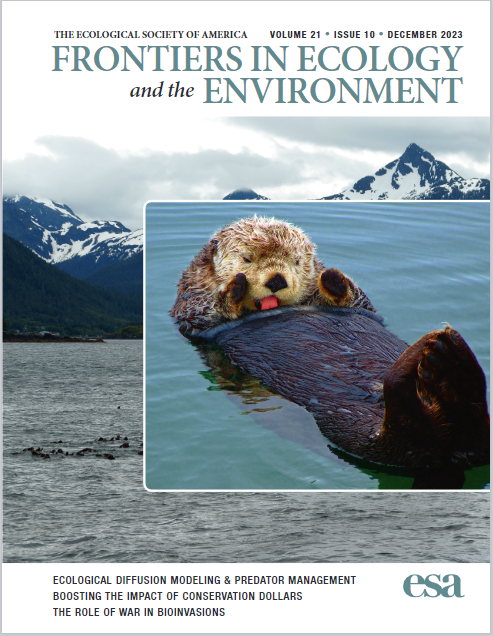
Frontiers in Ecology and the Environment is a publication by the Ecological Society of America that focuses on the significance of ecology and environmental science in various aspects of research and problem-solving. The journal covers topics such as biodiversity conservation, ecosystem preservation, natural resource management, public policy, and other related areas.
The publication features a range of content, including peer-reviewed articles, editorials, commentaries, letters, and occasional special issues and topical series. It releases ten issues per year, excluding January and July. ESA members receive both print and electronic copies of the journal, while institutional subscriptions are also available.
Frontiers in Ecology and the Environment is highly regarded in the field, as indicated by its ranking in the 2021 Journal Citation Reports by Clarivate Analytics. The journal is ranked 4th out of 174 in ecology journals and 11th out of 279 in environmental sciences journals. Its impact factor for 2021 is reported as 13.789, which further demonstrates its influence and importance in the scientific community.



 京公网安备 11010802042870号
京ICP备2023020795号-1
京公网安备 11010802042870号
京ICP备2023020795号-1

 分享
分享
 求助内容:
求助内容: 应助结果提醒方式:
 扫码关注我们
