{"title":"Optimization of Factors Affecting the Efficiency of Agrobacterium-Mediated Transformation of Wolffia arrhiza","authors":"A. N. Shvedova, P. A. Khvatkov, S. V. Dolgov","doi":"10.1134/S0003683823090089","DOIUrl":null,"url":null,"abstract":"<div><p>Plants of the duckweed family (<i>Lemna</i>, <i>Spirodela</i>) are actively used as expression platforms for the production of recombinant proteins due to a number of their advantages over other crops (small size, rapid vegetative reproduction, and high protein content in tissues). Rootless wolffia (<i>Wolffia arrhiza</i> (L.) Horkel ex Wimm) is a promising producer from the Lemnaceae family. Current <i>Wolffia</i> transformation protocols have an efficiency of approximately 0.36%. Based on transient expression, we have identified the most efficient <i>Agrobacterium</i> strain, EHA105, for the <i>W. arrhiza</i> transformation. An effective balance of growth regulators was selected for use at the first passage of cultivation and selection of transformed explants: 2,4-dichlorophenoxyacetic acid, 2.5 mg/L and 6-benzylaminopurine, 1.5 mg/L. The transformation efficiency of <i>W. arrhiza</i> was 0.54%, which is 1.5 times higher than in known protocols.</p></div>","PeriodicalId":466,"journal":{"name":"Applied Biochemistry and Microbiology","volume":"59 9","pages":"1177 - 1182"},"PeriodicalIF":1.1000,"publicationDate":"2024-01-12","publicationTypes":"Journal Article","fieldsOfStudy":null,"isOpenAccess":false,"openAccessPdf":"","citationCount":"0","resultStr":null,"platform":"Semanticscholar","paperid":null,"PeriodicalName":"Applied Biochemistry and Microbiology","FirstCategoryId":"99","ListUrlMain":"https://link.springer.com/article/10.1134/S0003683823090089","RegionNum":4,"RegionCategory":"生物学","ArticlePicture":[],"TitleCN":null,"AbstractTextCN":null,"PMCID":null,"EPubDate":"","PubModel":"","JCR":"Q4","JCRName":"BIOTECHNOLOGY & APPLIED MICROBIOLOGY","Score":null,"Total":0}
引用次数: 0
Abstract
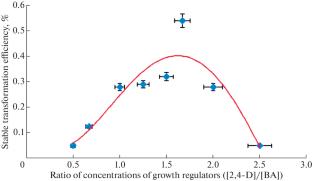
Plants of the duckweed family (Lemna, Spirodela) are actively used as expression platforms for the production of recombinant proteins due to a number of their advantages over other crops (small size, rapid vegetative reproduction, and high protein content in tissues). Rootless wolffia (Wolffia arrhiza (L.) Horkel ex Wimm) is a promising producer from the Lemnaceae family. Current Wolffia transformation protocols have an efficiency of approximately 0.36%. Based on transient expression, we have identified the most efficient Agrobacterium strain, EHA105, for the W. arrhiza transformation. An effective balance of growth regulators was selected for use at the first passage of cultivation and selection of transformed explants: 2,4-dichlorophenoxyacetic acid, 2.5 mg/L and 6-benzylaminopurine, 1.5 mg/L. The transformation efficiency of W. arrhiza was 0.54%, which is 1.5 times higher than in known protocols.
期刊介绍:
Applied Biochemistry and Microbiology is an international peer reviewed journal that publishes original articles on biochemistry and microbiology that have or may have practical applications. The studies include: enzymes and mechanisms of enzymatic reactions, biosynthesis of low and high molecular physiologically active compounds; the studies of their structure and properties; biogenesis and pathways of their regulation; metabolism of producers of biologically active compounds, biocatalysis in organic synthesis, applied genetics of microorganisms, applied enzymology; protein and metabolic engineering, biochemical bases of phytoimmunity, applied aspects of biochemical and immunochemical analysis; biodegradation of xenobiotics; biosensors; biomedical research (without clinical studies). Along with experimental works, the journal publishes descriptions of novel research techniques and reviews on selected topics.




 京公网安备 11010802042870号
京ICP备2023020795号-1
京公网安备 11010802042870号
京ICP备2023020795号-1

 分享
分享
 求助内容:
求助内容: 应助结果提醒方式:
 扫码关注我们
