Yafei Liu , Yusang Guo , Yaru Jiang, Lizhuang Feng, Yu Sun, Yijing Wang
{"title":"Recent progress in thermodynamic and kinetics modification of magnesium hydride hydrogen storage materials","authors":"Yafei Liu , Yusang Guo , Yaru Jiang, Lizhuang Feng, Yu Sun, Yijing Wang","doi":"10.1016/j.matre.2024.100252","DOIUrl":null,"url":null,"abstract":"<div><p>Hydrogen energy has emerged as a pivotal solution to address the global energy crisis and pave the way for a cleaner, low-carbon, secure, and efficient modern energy system. A key imperative in the utilization of hydrogen energy lies in the development of high-performance hydrogen storage materials. Magnesium-based hydrogen storage materials exhibit remarkable advantages, including high hydrogen storage density, cost-effectiveness, and abundant magnesium resources, making them highly promising for the hydrogen energy sector. Nonetheless, practical applications of magnesium hydride for hydrogen storage face significant challenges, primarily due to their slow kinetics and stable thermodynamic properties. Herein, we briefly summarize the thermodynamic and kinetic properties of MgH<sub>2</sub>, encompassing strategies such as alloying, nanoscaling, catalyst doping, and composite system construction to enhance its hydrogen storage performance. Notably, nanoscaling and catalyst doping have emerged as more effective modification strategies. The discussion focuses on the thermodynamic changes induced by nanoscaling and the kinetic enhancements resulting from catalyst doping. Particular emphasis lies in the synergistic improvement strategy of incorporating nanocatalysts with confinement materials, and we revisit typical works on the multi-strategy optimization of MgH<sub>2</sub>. In conclusion, we conduct an analysis of outstanding challenges and issues, followed by presenting future research and development prospects for MgH<sub>2</sub> as hydrogen storage materials.</p></div>","PeriodicalId":61638,"journal":{"name":"材料导报:能源(英文)","volume":"4 1","pages":"Article 100252"},"PeriodicalIF":13.8000,"publicationDate":"2024-02-01","publicationTypes":"Journal Article","fieldsOfStudy":null,"isOpenAccess":false,"openAccessPdf":"https://www.sciencedirect.com/science/article/pii/S2666935824000041/pdfft?md5=a578785ae0c9a8070ec6a422c086577e&pid=1-s2.0-S2666935824000041-main.pdf","citationCount":"0","resultStr":null,"platform":"Semanticscholar","paperid":null,"PeriodicalName":"材料导报:能源(英文)","FirstCategoryId":"1087","ListUrlMain":"https://www.sciencedirect.com/science/article/pii/S2666935824000041","RegionNum":0,"RegionCategory":null,"ArticlePicture":[],"TitleCN":null,"AbstractTextCN":null,"PMCID":null,"EPubDate":"2024/1/17 0:00:00","PubModel":"Epub","JCR":"","JCRName":"","Score":null,"Total":0}
引用次数: 0
Abstract
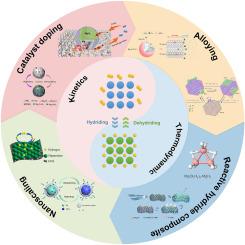
Hydrogen energy has emerged as a pivotal solution to address the global energy crisis and pave the way for a cleaner, low-carbon, secure, and efficient modern energy system. A key imperative in the utilization of hydrogen energy lies in the development of high-performance hydrogen storage materials. Magnesium-based hydrogen storage materials exhibit remarkable advantages, including high hydrogen storage density, cost-effectiveness, and abundant magnesium resources, making them highly promising for the hydrogen energy sector. Nonetheless, practical applications of magnesium hydride for hydrogen storage face significant challenges, primarily due to their slow kinetics and stable thermodynamic properties. Herein, we briefly summarize the thermodynamic and kinetic properties of MgH2, encompassing strategies such as alloying, nanoscaling, catalyst doping, and composite system construction to enhance its hydrogen storage performance. Notably, nanoscaling and catalyst doping have emerged as more effective modification strategies. The discussion focuses on the thermodynamic changes induced by nanoscaling and the kinetic enhancements resulting from catalyst doping. Particular emphasis lies in the synergistic improvement strategy of incorporating nanocatalysts with confinement materials, and we revisit typical works on the multi-strategy optimization of MgH2. In conclusion, we conduct an analysis of outstanding challenges and issues, followed by presenting future research and development prospects for MgH2 as hydrogen storage materials.



 京公网安备 11010802042870号
京ICP备2023020795号-1
京公网安备 11010802042870号
京ICP备2023020795号-1

 分享
分享
 求助内容:
求助内容: 应助结果提醒方式:
 扫码关注我们
