Susi Astolfo, Amanda Cristina de Souza Andrade, Ruth Terezinha Kehrig
{"title":"Temporal analysis and spatial distribution of acquired syphilis in the state of Mato Grosso, Brazil, 2010-2021: an ecological study.","authors":"Susi Astolfo, Amanda Cristina de Souza Andrade, Ruth Terezinha Kehrig","doi":"10.1590/S2237-96222024V33E2023398.EN","DOIUrl":null,"url":null,"abstract":"<p><strong>Objective: </strong>To analyze the temporal trend and the spatial distribution of acquired syphilis in Mato Grosso, Brazil, between 2010 and 2021.</p><p><strong>Methods: </strong>This was an ecological study using notifications of acquired syphilis held on the Notifiable Health Conditions Information System. Detection rates were calculated by health macro-region and three-year periods (2010-2012, 2013-2015, 2016-2018, 2019-2021). The jointpoint method was used to calculate annual percentage change (APC). Thematic maps of Bayesian rates were built and distribution was analyzed using Local Moran.</p><p><strong>Results: </strong>The detection rate increased from 16.2 per 100,000 inhabitants in the first three-year period (2010-2012) to 70.0 in the last three-year period (2019-2021). The Central-North macro-region had the highest rate in the last three years (94.3/100,000 inhab.), while the highest upward trend occurred in the Central-Northwest macro-region, from 2013 to 2018 (APC = 50.2; 95%CI 26.3;78.6). There was an increase in Bayesian rates in most municipalities.</p><p><strong>Conclusion: </strong>There was a trend towards an increase in acquired syphilis, especially in the last two three-year periods.</p>","PeriodicalId":51473,"journal":{"name":"Epidemiologia e Servicos de Saude","volume":"33 ","pages":"e2023398"},"PeriodicalIF":2.0000,"publicationDate":"2024-01-22","publicationTypes":"Journal Article","fieldsOfStudy":null,"isOpenAccess":false,"openAccessPdf":"https://www.ncbi.nlm.nih.gov/pmc/articles/PMC10804916/pdf/","citationCount":"0","resultStr":null,"platform":"Semanticscholar","paperid":null,"PeriodicalName":"Epidemiologia e Servicos de Saude","FirstCategoryId":"1085","ListUrlMain":"https://doi.org/10.1590/S2237-96222024V33E2023398.EN","RegionNum":0,"RegionCategory":null,"ArticlePicture":[],"TitleCN":null,"AbstractTextCN":null,"PMCID":null,"EPubDate":"2024/1/1 0:00:00","PubModel":"eCollection","JCR":"Q1","JCRName":"Multidisciplinary","Score":null,"Total":0}
引用次数: 0
Abstract
Objective: To analyze the temporal trend and the spatial distribution of acquired syphilis in Mato Grosso, Brazil, between 2010 and 2021.
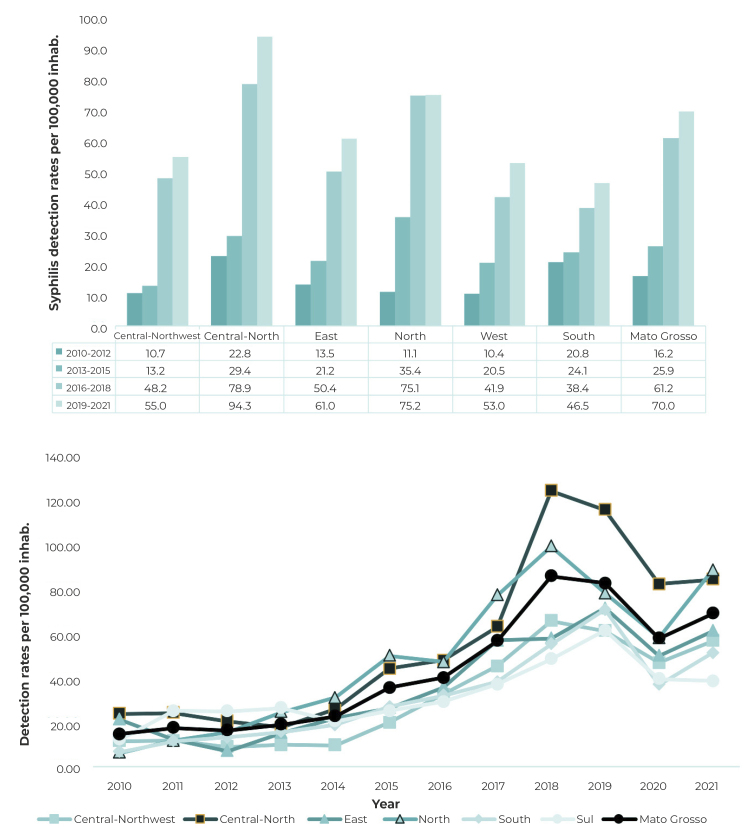
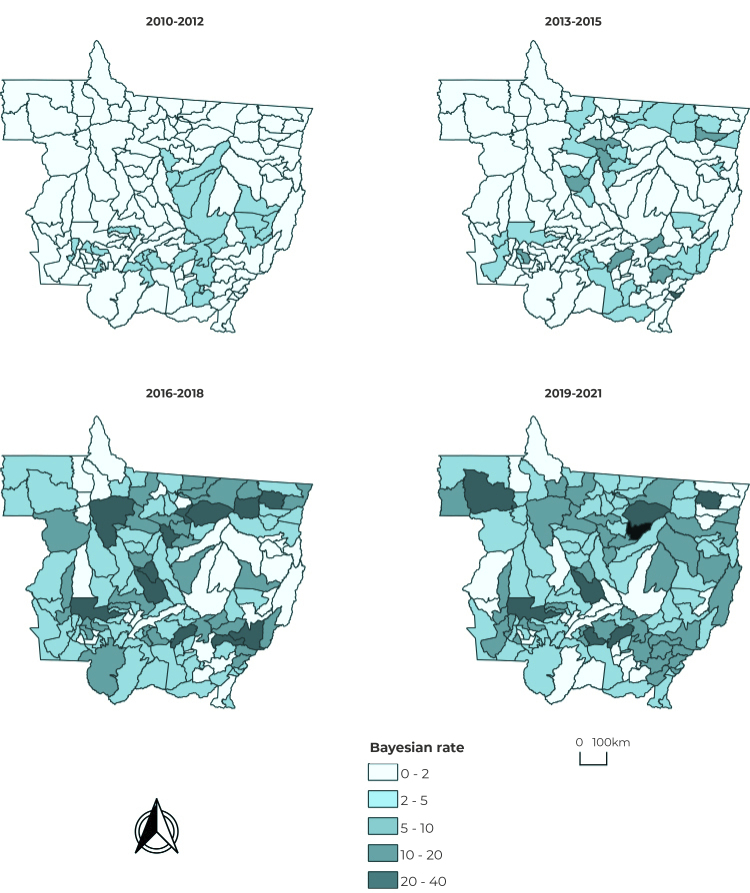
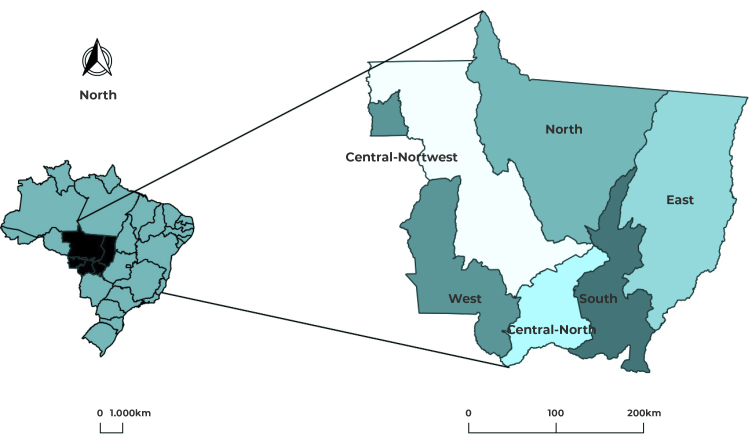
Methods: This was an ecological study using notifications of acquired syphilis held on the Notifiable Health Conditions Information System. Detection rates were calculated by health macro-region and three-year periods (2010-2012, 2013-2015, 2016-2018, 2019-2021). The jointpoint method was used to calculate annual percentage change (APC). Thematic maps of Bayesian rates were built and distribution was analyzed using Local Moran.
Results: The detection rate increased from 16.2 per 100,000 inhabitants in the first three-year period (2010-2012) to 70.0 in the last three-year period (2019-2021). The Central-North macro-region had the highest rate in the last three years (94.3/100,000 inhab.), while the highest upward trend occurred in the Central-Northwest macro-region, from 2013 to 2018 (APC = 50.2; 95%CI 26.3;78.6). There was an increase in Bayesian rates in most municipalities.
Conclusion: There was a trend towards an increase in acquired syphilis, especially in the last two three-year periods.




 京公网安备 11010802042870号
京ICP备2023020795号-1
京公网安备 11010802042870号
京ICP备2023020795号-1

 分享
分享
 求助内容:
求助内容: 应助结果提醒方式:
 扫码关注我们
