{"title":"Blood flow velocity in the anterior humeral circumflex artery and tear size can predict synovitis severity in patients with rotator cuff tears.","authors":"Takahiro Machida, Takahiko Hirooka, Akihisa Watanabe, Hinako Katayama, Yuki Matsukubo","doi":"10.5397/cise.2023.00752","DOIUrl":null,"url":null,"abstract":"<p><strong>Background: </strong>Rotator cuff tears are often associated with synovitis, but the ability of noninvasive ultrasonography to predict the severity of synovitis remains unclear. We investigated whether ultrasound parameters, namely peak systolic velocity in the anterior humeral circumflex artery and Doppler activity in the glenohumeral joint and subacromial space, reflect synovitis severity.</p><p><strong>Methods: </strong>A total of 54 patients undergoing arthroscopic rotator cuff repair were selected. Doppler ultrasound was used to measure peak systolic velocity in the anterior humeral circumflex artery and Doppler activity in the glenohumeral joint and subacromial space, and these values were compared with the intraoperative synovitis score in univariate and multivariate analyses.</p><p><strong>Results: </strong>Univariate analyses revealed that tear size, peak systolic velocity in the anterior humeral circumflex artery, and Doppler activity in the glenohumeral joint were associated with synovitis in the glenohumeral joint (P=0.02, P<0.001, P=0.02, respectively). In the subacromial space, tear size, peak systolic velocity in the anterior humeral circumflex artery, and Doppler activity in the subacromial space were associated with synovitis severity (P=0.02, P<0.001, P=0.02, respectively). Multivariate analyses indicated that tear size and peak systolic velocity in the anterior humeral circumflex artery were independently associated with synovitis scores in both the glenohumeral joint and the subacromial space (all P<0.05).</p><p><strong>Conclusions: </strong>These findings demonstrate that tear size and peak systolic velocity in the anterior humeral circumflex artery, which can both be measured noninvasively, are useful indicators of synovitis severity. Level of evidence: IV.</p>","PeriodicalId":33981,"journal":{"name":"Clinics in Shoulder and Elbow","volume":" ","pages":"11-17"},"PeriodicalIF":1.7000,"publicationDate":"2024-03-01","publicationTypes":"Journal Article","fieldsOfStudy":null,"isOpenAccess":false,"openAccessPdf":"https://www.ncbi.nlm.nih.gov/pmc/articles/PMC10938008/pdf/","citationCount":"0","resultStr":null,"platform":"Semanticscholar","paperid":null,"PeriodicalName":"Clinics in Shoulder and Elbow","FirstCategoryId":"1085","ListUrlMain":"https://doi.org/10.5397/cise.2023.00752","RegionNum":0,"RegionCategory":null,"ArticlePicture":[],"TitleCN":null,"AbstractTextCN":null,"PMCID":null,"EPubDate":"2024/1/24 0:00:00","PubModel":"Epub","JCR":"Q2","JCRName":"ORTHOPEDICS","Score":null,"Total":0}
引用次数: 0
Abstract
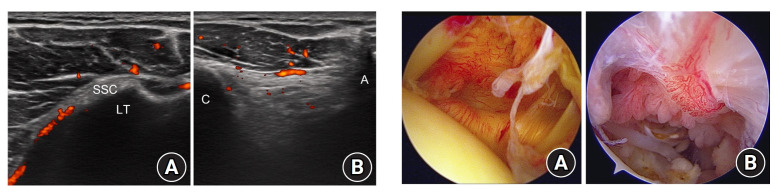
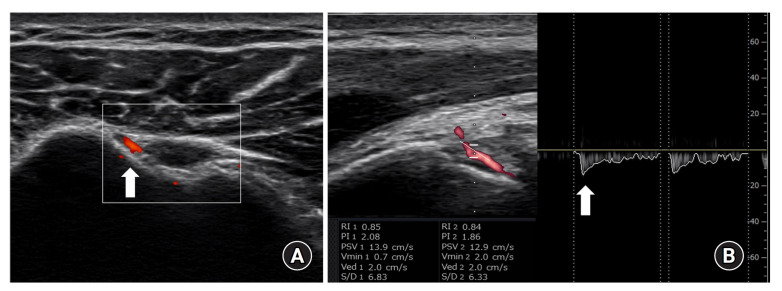
Background: Rotator cuff tears are often associated with synovitis, but the ability of noninvasive ultrasonography to predict the severity of synovitis remains unclear. We investigated whether ultrasound parameters, namely peak systolic velocity in the anterior humeral circumflex artery and Doppler activity in the glenohumeral joint and subacromial space, reflect synovitis severity.
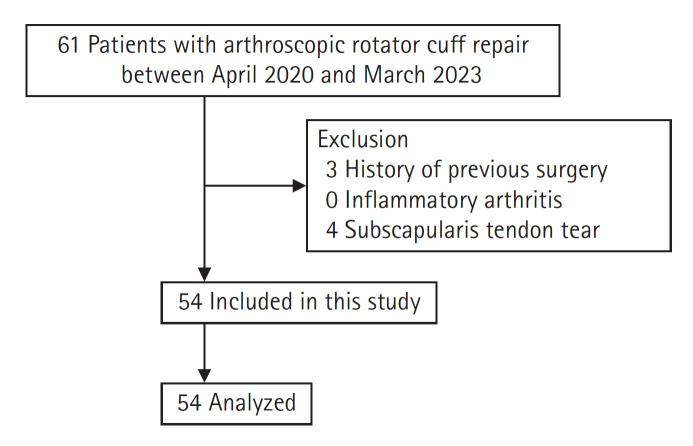
Methods: A total of 54 patients undergoing arthroscopic rotator cuff repair were selected. Doppler ultrasound was used to measure peak systolic velocity in the anterior humeral circumflex artery and Doppler activity in the glenohumeral joint and subacromial space, and these values were compared with the intraoperative synovitis score in univariate and multivariate analyses.
Results: Univariate analyses revealed that tear size, peak systolic velocity in the anterior humeral circumflex artery, and Doppler activity in the glenohumeral joint were associated with synovitis in the glenohumeral joint (P=0.02, P<0.001, P=0.02, respectively). In the subacromial space, tear size, peak systolic velocity in the anterior humeral circumflex artery, and Doppler activity in the subacromial space were associated with synovitis severity (P=0.02, P<0.001, P=0.02, respectively). Multivariate analyses indicated that tear size and peak systolic velocity in the anterior humeral circumflex artery were independently associated with synovitis scores in both the glenohumeral joint and the subacromial space (all P<0.05).
Conclusions: These findings demonstrate that tear size and peak systolic velocity in the anterior humeral circumflex artery, which can both be measured noninvasively, are useful indicators of synovitis severity. Level of evidence: IV.




 京公网安备 11010802042870号
京ICP备2023020795号-1
京公网安备 11010802042870号
京ICP备2023020795号-1

 分享
分享

 求助内容:
求助内容: 应助结果提醒方式:
 扫码关注我们
