Associations of the magnesium depletion score and magnesium intake with diabetes among US adults: an analysis of the National Health and Nutrition Examination Survey 2011-2018.
Zhong Tian, Shifang Qu, Yana Chen, Jiaxin Fang, Xingxu Song, Kai He, Kexin Jiang, Xiaoyue Sun, Jianyang Shi, Yuchun Tao, Lina Jin
{"title":"Associations of the magnesium depletion score and magnesium intake with diabetes among US adults: an analysis of the National Health and Nutrition Examination Survey 2011-2018.","authors":"Zhong Tian, Shifang Qu, Yana Chen, Jiaxin Fang, Xingxu Song, Kai He, Kexin Jiang, Xiaoyue Sun, Jianyang Shi, Yuchun Tao, Lina Jin","doi":"10.4178/epih.e2024020","DOIUrl":null,"url":null,"abstract":"<p><strong>Objectives: </strong>The magnesium depletion score (MDS) is considered more reliable than traditional approaches for predicting magnesium deficiency in humans. We explored the associations of MDS and dietary magnesium intake with diabetes.</p><p><strong>Methods: </strong>We obtained data from 18,853 participants in the National Health and Nutrition Examination Survey 2011-2018. Using multivariate regression and stratified analysis, we investigated the relationships of both MDS and magnesium intake with diabetes. To compute prevalence ratios (PRs), we employed modified Poisson or log-binomial regression. We characterized the non-linear association between magnesium intake and diabetes using restricted cubic spline analysis.</p><p><strong>Results: </strong>Participants with MDS ≥2 exhibited a PR of 1.26 (95% confidence interval [CI], 1.19 to 1.34) for diabetes. Per-standard deviation (SD) increase in dietary magnesium intake was associated with a lower prevalence of diabetes (PR, 0.91; 95% CI, 0.87 to 0.96). Subgroup analyses revealed a positive association between MDS ≥2 and diabetes across all levels of dietary magnesium intake, including the lowest (PR, 1.35; 95% CI, 1.18 to 1.55), middle (PR, 1.23; 95% CI, 1.12 to 1.35), and highest tertiles (PR, 1.25; 95% CI, 1.13 to 1.37; pinteraction<0.001). Per-SD increase in magnesium intake was associated with lower diabetes prevalence in participants with MDS <2 (PR, 0.92; 95% CI, 0.87 to 0.98) and those with MDS ≥2 (PR, 0.91; 95% CI, 0.84 to 0.98; pinteraction=0.030).</p><p><strong>Conclusions: </strong>MDS is associated with diabetes, particularly among individuals with low magnesium intake. Adequate dietary magnesium intake may reduce diabetes risk, especially in those with high MDS.</p>","PeriodicalId":48543,"journal":{"name":"Epidemiology and Health","volume":" ","pages":"e2024020"},"PeriodicalIF":2.2000,"publicationDate":"2024-01-01","publicationTypes":"Journal Article","fieldsOfStudy":null,"isOpenAccess":false,"openAccessPdf":"https://www.ncbi.nlm.nih.gov/pmc/articles/PMC11099598/pdf/","citationCount":"0","resultStr":null,"platform":"Semanticscholar","paperid":null,"PeriodicalName":"Epidemiology and Health","FirstCategoryId":"3","ListUrlMain":"https://doi.org/10.4178/epih.e2024020","RegionNum":4,"RegionCategory":"医学","ArticlePicture":[],"TitleCN":null,"AbstractTextCN":null,"PMCID":null,"EPubDate":"2024/1/10 0:00:00","PubModel":"Epub","JCR":"Q2","JCRName":"PUBLIC, ENVIRONMENTAL & OCCUPATIONAL HEALTH","Score":null,"Total":0}
引用次数: 0
Abstract
Objectives: The magnesium depletion score (MDS) is considered more reliable than traditional approaches for predicting magnesium deficiency in humans. We explored the associations of MDS and dietary magnesium intake with diabetes.
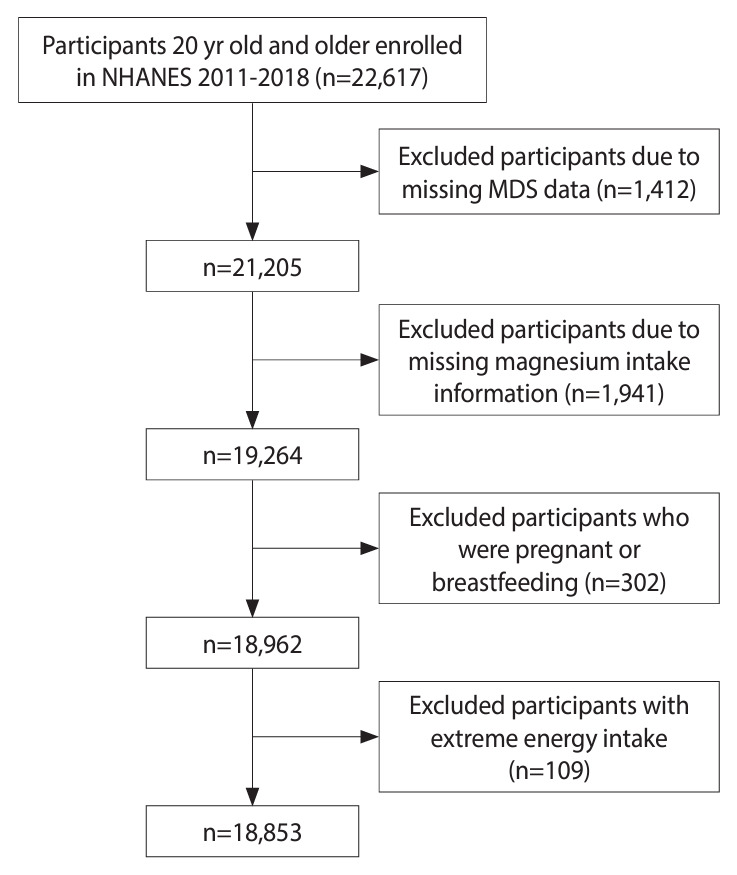
Methods: We obtained data from 18,853 participants in the National Health and Nutrition Examination Survey 2011-2018. Using multivariate regression and stratified analysis, we investigated the relationships of both MDS and magnesium intake with diabetes. To compute prevalence ratios (PRs), we employed modified Poisson or log-binomial regression. We characterized the non-linear association between magnesium intake and diabetes using restricted cubic spline analysis.
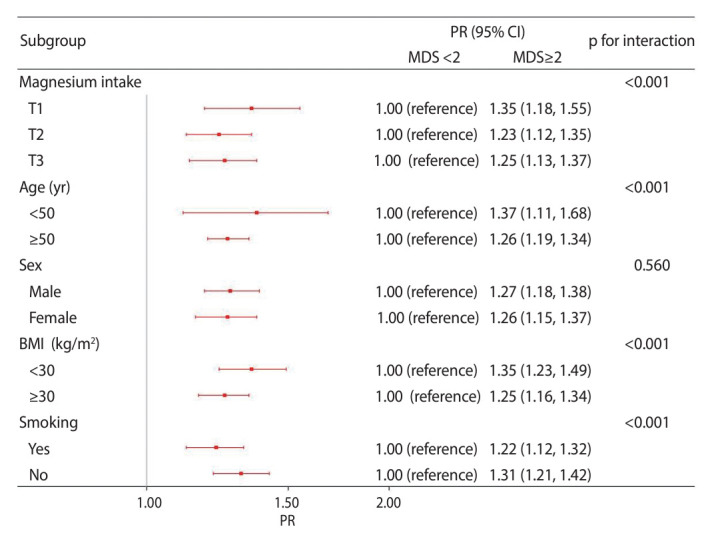
Results: Participants with MDS ≥2 exhibited a PR of 1.26 (95% confidence interval [CI], 1.19 to 1.34) for diabetes. Per-standard deviation (SD) increase in dietary magnesium intake was associated with a lower prevalence of diabetes (PR, 0.91; 95% CI, 0.87 to 0.96). Subgroup analyses revealed a positive association between MDS ≥2 and diabetes across all levels of dietary magnesium intake, including the lowest (PR, 1.35; 95% CI, 1.18 to 1.55), middle (PR, 1.23; 95% CI, 1.12 to 1.35), and highest tertiles (PR, 1.25; 95% CI, 1.13 to 1.37; pinteraction<0.001). Per-SD increase in magnesium intake was associated with lower diabetes prevalence in participants with MDS <2 (PR, 0.92; 95% CI, 0.87 to 0.98) and those with MDS ≥2 (PR, 0.91; 95% CI, 0.84 to 0.98; pinteraction=0.030).
Conclusions: MDS is associated with diabetes, particularly among individuals with low magnesium intake. Adequate dietary magnesium intake may reduce diabetes risk, especially in those with high MDS.
期刊介绍:
Epidemiology and Health (epiH) is an electronic journal publishing papers in all areas of epidemiology and public health. It is indexed on PubMed Central and the scope is wide-ranging: including descriptive, analytical and molecular epidemiology; primary preventive measures; screening approaches and secondary prevention; clinical epidemiology; and all aspects of communicable and non-communicable diseases prevention. The epiH publishes original research, and also welcomes review articles and meta-analyses, cohort profiles and data profiles, epidemic and case investigations, descriptions and applications of new methods, and discussions of research theory or public health policy. We give special consideration to papers from developing countries.




 京公网安备 11010802042870号
京ICP备2023020795号-1
京公网安备 11010802042870号
京ICP备2023020795号-1

 分享
分享
 求助内容:
求助内容: 应助结果提醒方式:
 扫码关注我们
