{"title":"Association of plain water intake with self-reported depression and suicidality among Korean adolescents.","authors":"Jung Woo Lee, Yookyung Kim","doi":"10.4178/epih.e2024019","DOIUrl":null,"url":null,"abstract":"<p><strong>Objectives: </strong>Adolescent depression and suicidality are serious health problems worldwide. Lower plain water intake has been proposed as a risk factor for depression in adults. This study investigated the association of daily plain water intake with self-reported depression and suicidality among Korean adolescents.</p><p><strong>Methods: </strong>We used nationwide data from 112,250 students aged 12-18 years who participated in the Korean Youth Risk Behavior Web-based Surveys in 2019 and 2020. Daily plain water intake was categorized as <1 glass, 1-2 glasses, and ≥3 glasses. The adjusted odds ratios (aORs) with 95% confidence intervals (CIs) for self-reported depression and suicidality were calculated using multiple regression analyses.</p><p><strong>Results: </strong>The weighted prevalence rates of self-reported depression, suicidal ideation, suicide planning, and suicide attempts were 26.7%, 12.0%, 3.8%, and 2.5%, respectively. Of the participants, 3.9%, 18.5%, and 77.7% were categorized into the <1 glass/day, 1-2 glass/day, and ≥3 glass/day groups, respectively. Compared to the reference group (≥3 glass/day), the lowest level of water intake (<1 glass/day) was associated with higher odds of self-reported depression (aOR, 1.30; 95% CI, 1.20 to 1.39), suicidal ideation (aOR, 1.39; 95% CI, 1.27 to 1.55), suicide planning (aOR, 1.46; 95% CI, 1.25 to 1.69), and suicide attempts (aOR, 1.38; 95% CI, 1.15 to 1.67). Moderately lower water intake (1-2 glass/day) showed slightly increased odds of self-reported depression (aOR, 1.05; 95% CI, 1.01 to 1.10) and suicidal ideation (aOR, 1.08; 95% CI, 1.03 to 1.14).</p><p><strong>Conclusions: </strong>Lower plain water intake was significantly associated with a higher risk of self-reported depression and suicidality among Korean adolescents. Since this cross-sectional study is unable to establish a causal relationship, it underscores the need for additional longitudinal research.</p>","PeriodicalId":48543,"journal":{"name":"Epidemiology and Health","volume":" ","pages":"e2024019"},"PeriodicalIF":2.2000,"publicationDate":"2024-01-01","publicationTypes":"Journal Article","fieldsOfStudy":null,"isOpenAccess":false,"openAccessPdf":"https://www.ncbi.nlm.nih.gov/pmc/articles/PMC11099597/pdf/","citationCount":"0","resultStr":null,"platform":"Semanticscholar","paperid":null,"PeriodicalName":"Epidemiology and Health","FirstCategoryId":"3","ListUrlMain":"https://doi.org/10.4178/epih.e2024019","RegionNum":4,"RegionCategory":"医学","ArticlePicture":[],"TitleCN":null,"AbstractTextCN":null,"PMCID":null,"EPubDate":"2024/1/9 0:00:00","PubModel":"Epub","JCR":"Q2","JCRName":"PUBLIC, ENVIRONMENTAL & OCCUPATIONAL HEALTH","Score":null,"Total":0}
引用次数: 0
Abstract
Objectives: Adolescent depression and suicidality are serious health problems worldwide. Lower plain water intake has been proposed as a risk factor for depression in adults. This study investigated the association of daily plain water intake with self-reported depression and suicidality among Korean adolescents.
Methods: We used nationwide data from 112,250 students aged 12-18 years who participated in the Korean Youth Risk Behavior Web-based Surveys in 2019 and 2020. Daily plain water intake was categorized as <1 glass, 1-2 glasses, and ≥3 glasses. The adjusted odds ratios (aORs) with 95% confidence intervals (CIs) for self-reported depression and suicidality were calculated using multiple regression analyses.
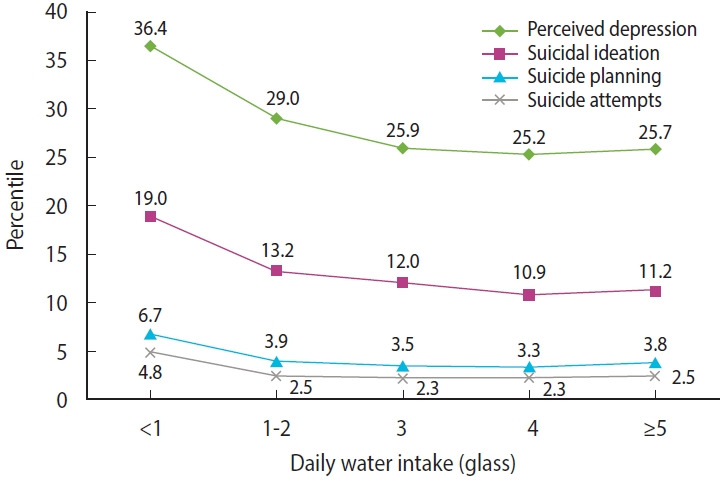
Results: The weighted prevalence rates of self-reported depression, suicidal ideation, suicide planning, and suicide attempts were 26.7%, 12.0%, 3.8%, and 2.5%, respectively. Of the participants, 3.9%, 18.5%, and 77.7% were categorized into the <1 glass/day, 1-2 glass/day, and ≥3 glass/day groups, respectively. Compared to the reference group (≥3 glass/day), the lowest level of water intake (<1 glass/day) was associated with higher odds of self-reported depression (aOR, 1.30; 95% CI, 1.20 to 1.39), suicidal ideation (aOR, 1.39; 95% CI, 1.27 to 1.55), suicide planning (aOR, 1.46; 95% CI, 1.25 to 1.69), and suicide attempts (aOR, 1.38; 95% CI, 1.15 to 1.67). Moderately lower water intake (1-2 glass/day) showed slightly increased odds of self-reported depression (aOR, 1.05; 95% CI, 1.01 to 1.10) and suicidal ideation (aOR, 1.08; 95% CI, 1.03 to 1.14).
Conclusions: Lower plain water intake was significantly associated with a higher risk of self-reported depression and suicidality among Korean adolescents. Since this cross-sectional study is unable to establish a causal relationship, it underscores the need for additional longitudinal research.
期刊介绍:
Epidemiology and Health (epiH) is an electronic journal publishing papers in all areas of epidemiology and public health. It is indexed on PubMed Central and the scope is wide-ranging: including descriptive, analytical and molecular epidemiology; primary preventive measures; screening approaches and secondary prevention; clinical epidemiology; and all aspects of communicable and non-communicable diseases prevention. The epiH publishes original research, and also welcomes review articles and meta-analyses, cohort profiles and data profiles, epidemic and case investigations, descriptions and applications of new methods, and discussions of research theory or public health policy. We give special consideration to papers from developing countries.



 京公网安备 11010802042870号
京ICP备2023020795号-1
京公网安备 11010802042870号
京ICP备2023020795号-1

 分享
分享
 求助内容:
求助内容: 应助结果提醒方式:
 扫码关注我们
