A Real-World Study of Steroid-Free Monotherapy with Tofacitinib in Severe and Therapy-Recalcitrant Alopecia Areata, Alopecia Totalis, and Alopecia Universalis Cases: A Retrospective Analysis.
{"title":"A Real-World Study of Steroid-Free Monotherapy with Tofacitinib in Severe and Therapy-Recalcitrant Alopecia Areata, Alopecia Totalis, and Alopecia Universalis Cases: A Retrospective Analysis.","authors":"Savitha Sharath, Kabir Sardana, Ananta Khurana","doi":"10.4103/idoj.idoj_131_23","DOIUrl":null,"url":null,"abstract":"<p><strong>Background: </strong>Alopecia areata (AA) presents with noncicatricial alopecia and has multifactorial etiology. Janus Kinase inhibitors (JAKibs) with potential efficacy and favorable side-effect profile are the first class of drugs to receive FDA approval in AA.</p><p><strong>Objectives: </strong>Our primary objective was to assess the complete response rates to tofacitinib monotherapy in severe and recalcitrant AA, alopecia totalis (AT), and alopecia universalis (AU) patients using the latest percentage change in Severity of alopecia tool (SALT) score. We also aimed to analyze the various systemic agents used by these patients prior to the use of tofacitinib.</p><p><strong>Materials and methods: </strong>Institutional records of 17 patients with severe or refractory AA, AT, and AU treated with tofacitinib monotherapy were analyzed, retrospectively. The response to tofacitinib therapy was determined after calculating percentage change in SALT score. End of treatment was defined as the dose which resulted in a significant response (complete/near complete response was ≥75% hair regrowth from baseline as determined by SALT score).</p><p><strong>Results: </strong>Majority of patients had severe AA (SALT ≥ 50) (<i>n</i> = 9/17, 52.94%), while five patients had AT and three had AU. All patients had received either systemic glucocorticoids (GCS), which included oral mini pulse (OMP) (<i>n</i> = 8), intravenous pulse steroids (<i>n</i> = 4), and daily oral GCS (<i>n</i> = 6) or immunosuppressive agents (ISAs) which included cyclosporine (<i>n</i> = 14) followed by methotrexate (<i>n</i> = 6) and azathioprine (<i>n</i> = 6). Mean SALT score prior to starting tofacitinib was 74.23. Mean dose of tofacitinib used was 13.23 mg (10-15 mg) and mean duration of treatment was 9.23 months. Latest percentage change of SALT score ranged from 70.58% to 100%, with an average of 91.47%. Most patients showed complete/near complete response (13/17, 76.47%).</p><p><strong>Conclusion: </strong>Tofacitinib was found to be safe and effective in severe/refractory AA, AU, and AT patients recalcitrant to other treatment modalities in our study. Further studies are needed to assess the effect of these targeted drugs on JAK-STAT expression or tissue cytokines involved in the pathogenesis of AA using immunohistochemistry.</p>","PeriodicalId":13335,"journal":{"name":"Indian Dermatology Online Journal","volume":"15 1","pages":"49-54"},"PeriodicalIF":2.0000,"publicationDate":"2023-11-07","publicationTypes":"Journal Article","fieldsOfStudy":null,"isOpenAccess":false,"openAccessPdf":"https://www.ncbi.nlm.nih.gov/pmc/articles/PMC10810385/pdf/","citationCount":"0","resultStr":null,"platform":"Semanticscholar","paperid":null,"PeriodicalName":"Indian Dermatology Online Journal","FirstCategoryId":"1085","ListUrlMain":"https://doi.org/10.4103/idoj.idoj_131_23","RegionNum":0,"RegionCategory":null,"ArticlePicture":[],"TitleCN":null,"AbstractTextCN":null,"PMCID":null,"EPubDate":"2024/1/1 0:00:00","PubModel":"eCollection","JCR":"Q3","JCRName":"DERMATOLOGY","Score":null,"Total":0}
引用次数: 0
Abstract
Background: Alopecia areata (AA) presents with noncicatricial alopecia and has multifactorial etiology. Janus Kinase inhibitors (JAKibs) with potential efficacy and favorable side-effect profile are the first class of drugs to receive FDA approval in AA.
Objectives: Our primary objective was to assess the complete response rates to tofacitinib monotherapy in severe and recalcitrant AA, alopecia totalis (AT), and alopecia universalis (AU) patients using the latest percentage change in Severity of alopecia tool (SALT) score. We also aimed to analyze the various systemic agents used by these patients prior to the use of tofacitinib.
Materials and methods: Institutional records of 17 patients with severe or refractory AA, AT, and AU treated with tofacitinib monotherapy were analyzed, retrospectively. The response to tofacitinib therapy was determined after calculating percentage change in SALT score. End of treatment was defined as the dose which resulted in a significant response (complete/near complete response was ≥75% hair regrowth from baseline as determined by SALT score).
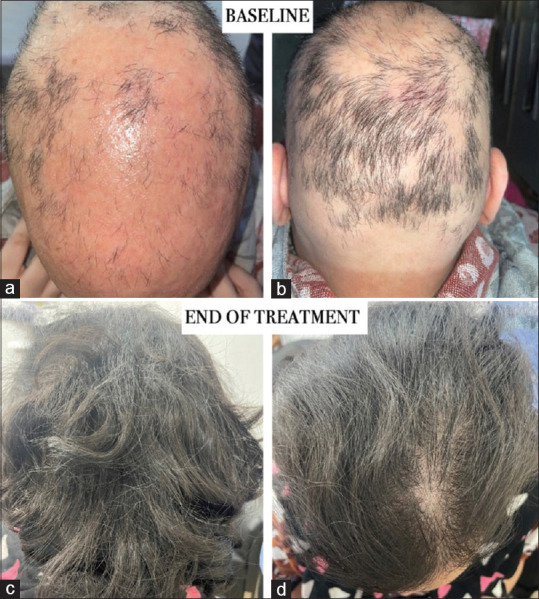
Results: Majority of patients had severe AA (SALT ≥ 50) (n = 9/17, 52.94%), while five patients had AT and three had AU. All patients had received either systemic glucocorticoids (GCS), which included oral mini pulse (OMP) (n = 8), intravenous pulse steroids (n = 4), and daily oral GCS (n = 6) or immunosuppressive agents (ISAs) which included cyclosporine (n = 14) followed by methotrexate (n = 6) and azathioprine (n = 6). Mean SALT score prior to starting tofacitinib was 74.23. Mean dose of tofacitinib used was 13.23 mg (10-15 mg) and mean duration of treatment was 9.23 months. Latest percentage change of SALT score ranged from 70.58% to 100%, with an average of 91.47%. Most patients showed complete/near complete response (13/17, 76.47%).
Conclusion: Tofacitinib was found to be safe and effective in severe/refractory AA, AU, and AT patients recalcitrant to other treatment modalities in our study. Further studies are needed to assess the effect of these targeted drugs on JAK-STAT expression or tissue cytokines involved in the pathogenesis of AA using immunohistochemistry.





 京公网安备 11010802042870号
京ICP备2023020795号-1
京公网安备 11010802042870号
京ICP备2023020795号-1

 分享
分享
 求助内容:
求助内容: 应助结果提醒方式:
 扫码关注我们
