{"title":"High-performance photocatalytic reduction of Cr(VI) using a retrievable Fe-doped WO<sub>3</sub>/SiO<sub>2</sub> heterostructure.","authors":"Natkritta Boonprakob, Duangdao Channei, Chen Zhao","doi":"10.1186/s11671-023-03919-0","DOIUrl":null,"url":null,"abstract":"<p><p>The enhancement of the photocatalytic performance of pristine WO<sub>3</sub> was systematically adjusted due to its fast recombination rate and low reduction potential. A designed heterostructure photocatalyst was necessarily synthesised by Fe<sup>3+</sup> metal ions doping into WO<sub>3</sub> structure with and composition modification. In this study, we synthesised a retrievable Fe-doped WO<sub>3</sub>/SiO<sub>2</sub> heterostructure using a surfactant-assisted hydrothermal method. This heterostructure was then employed as an effective photocatalyst for the removal of Cr(VI) under visible light irradiation. Enlarged photocatalytic reduction was observed over a synergetic 7.5 mol% Fe-doped WO<sub>3</sub>/SiO<sub>2</sub>-20 nanocomposite, resulting in dramatically increased activity compared with undoped WO<sub>3</sub> and SiO<sub>2</sub> nanomaterials under visible light illumination within 90 min. The presence of 7.5 mol% Fe<sup>3+</sup> ion dopant in WO<sub>3</sub> optimised electron-hole recombination, consequently reducing WO<sub>3</sub> photocorrosion. After adding SiO<sub>2</sub> nanoparticles, the binary WO<sub>3</sub>-SiO<sub>2</sub> nanocomposite played roles as both adsorbent and photocatalyst to increase specific surface area. Thus, the 7.5 mol% Fe-doped WO<sub>3</sub>/SiO<sub>2</sub>-20 nanocomposite catalyst had more active sites on the surface of catalyst, and enhanced photocatalytic reduction was significantly achieved. The results showed 91.1% photocatalytic reduction over the optimum photocatalyst, with a photoreduction kinetic rate of 21.1 × 10<sup>-3</sup> min<sup>-1</sup>, which was approximately four times faster than pristine WO<sub>3</sub>. Therefore, the superior optimal photocatalyst demonstrated reusability, with activities decreasing by only 9.8% after five cycles. The high photocatalytic performance and excellent stability of our photocatalyst indicate great potential for water pollution treatments.</p>","PeriodicalId":72828,"journal":{"name":"Discover nano","volume":"19 1","pages":"22"},"PeriodicalIF":6.7000,"publicationDate":"2024-01-31","publicationTypes":"Journal Article","fieldsOfStudy":null,"isOpenAccess":false,"openAccessPdf":"https://www.ncbi.nlm.nih.gov/pmc/articles/PMC10831000/pdf/","citationCount":"0","resultStr":null,"platform":"Semanticscholar","paperid":null,"PeriodicalName":"Discover nano","FirstCategoryId":"1085","ListUrlMain":"https://doi.org/10.1186/s11671-023-03919-0","RegionNum":0,"RegionCategory":null,"ArticlePicture":[],"TitleCN":null,"AbstractTextCN":null,"PMCID":null,"EPubDate":"","PubModel":"","JCR":"0","JCRName":"MATERIALS SCIENCE, MULTIDISCIPLINARY","Score":null,"Total":0}
引用次数: 0
Abstract
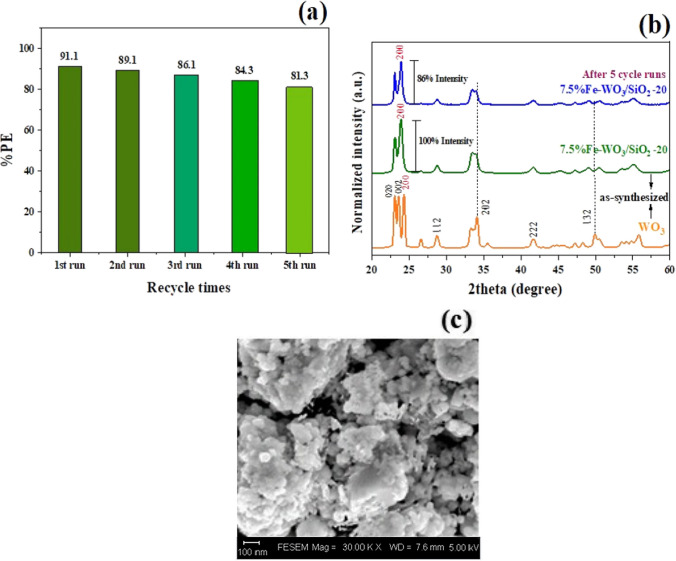
The enhancement of the photocatalytic performance of pristine WO3 was systematically adjusted due to its fast recombination rate and low reduction potential. A designed heterostructure photocatalyst was necessarily synthesised by Fe3+ metal ions doping into WO3 structure with and composition modification. In this study, we synthesised a retrievable Fe-doped WO3/SiO2 heterostructure using a surfactant-assisted hydrothermal method. This heterostructure was then employed as an effective photocatalyst for the removal of Cr(VI) under visible light irradiation. Enlarged photocatalytic reduction was observed over a synergetic 7.5 mol% Fe-doped WO3/SiO2-20 nanocomposite, resulting in dramatically increased activity compared with undoped WO3 and SiO2 nanomaterials under visible light illumination within 90 min. The presence of 7.5 mol% Fe3+ ion dopant in WO3 optimised electron-hole recombination, consequently reducing WO3 photocorrosion. After adding SiO2 nanoparticles, the binary WO3-SiO2 nanocomposite played roles as both adsorbent and photocatalyst to increase specific surface area. Thus, the 7.5 mol% Fe-doped WO3/SiO2-20 nanocomposite catalyst had more active sites on the surface of catalyst, and enhanced photocatalytic reduction was significantly achieved. The results showed 91.1% photocatalytic reduction over the optimum photocatalyst, with a photoreduction kinetic rate of 21.1 × 10⁻³ min-1, which was approximately four times faster than pristine WO3. Therefore, the superior optimal photocatalyst demonstrated reusability, with activities decreasing by only 9.8% after five cycles. The high photocatalytic performance and excellent stability of our photocatalyst indicate great potential for water pollution treatments.






 京公网安备 11010802042870号
京ICP备2023020795号-1
京公网安备 11010802042870号
京ICP备2023020795号-1

 分享
分享

 求助内容:
求助内容: 应助结果提醒方式:
 扫码关注我们
