{"title":"Endotypes of occupational asthma.","authors":"Paola Mason, Marco Biasioli, Filippo Liviero","doi":"10.1097/ACI.0000000000000969","DOIUrl":null,"url":null,"abstract":"<p><strong>Purpose of review: </strong>To describe recent findings in endotyping occupational asthma by addressing the role of specific biomarkers.</p><p><strong>Recent findings: </strong>Studies on occupational asthma endotypes have focused on immune and inflammatory patterns associated with different occupational exposures to sensitizers or irritants.Sputum neutrophilia has been found in 58.5% patients with occupational asthma caused by high molecular weight (HMW) agents, and work-related dysphonia in patients with occupational asthma was described as associated with sputum neutrophilia too. Neutrophils have been associated also with irritant-induced asthma. The measurement of specific IgE has been confirmed as a valuable diagnostic tool in occupational asthma caused by HMW agents, on the contrary, for most low-molecular-weight agents, the presence of specific IgE has been proven in a small subset of affected workers. Fractional exhaled nitric oxide has been confirmed as a marker of type 2 (T2) inflammation in occupational asthma, mostly when induced by HMW agents (e.g. flour), and it has proved to be more sensitive than spirometry in measuring the efficacy of an intervention.MicroRNA-155 has been shown to contribute to airway inflammation in occupational asthma induced by toluene diisocyanate.</p><p><strong>Summary: </strong>Occupational asthma is heterogeneous, thus monitoring multiple biomarkers is crucial to understand, which inflammatory responses are prevalent.</p>","PeriodicalId":10956,"journal":{"name":"Current Opinion in Allergy and Clinical Immunology","volume":" ","pages":"58-63"},"PeriodicalIF":2.6000,"publicationDate":"2024-04-01","publicationTypes":"Journal Article","fieldsOfStudy":null,"isOpenAccess":false,"openAccessPdf":"https://www.ncbi.nlm.nih.gov/pmc/articles/PMC10916750/pdf/","citationCount":"0","resultStr":null,"platform":"Semanticscholar","paperid":null,"PeriodicalName":"Current Opinion in Allergy and Clinical Immunology","FirstCategoryId":"3","ListUrlMain":"https://doi.org/10.1097/ACI.0000000000000969","RegionNum":4,"RegionCategory":"医学","ArticlePicture":[],"TitleCN":null,"AbstractTextCN":null,"PMCID":null,"EPubDate":"2024/1/30 0:00:00","PubModel":"Epub","JCR":"Q2","JCRName":"ALLERGY","Score":null,"Total":0}
引用次数: 0
Abstract
Purpose of review: To describe recent findings in endotyping occupational asthma by addressing the role of specific biomarkers.
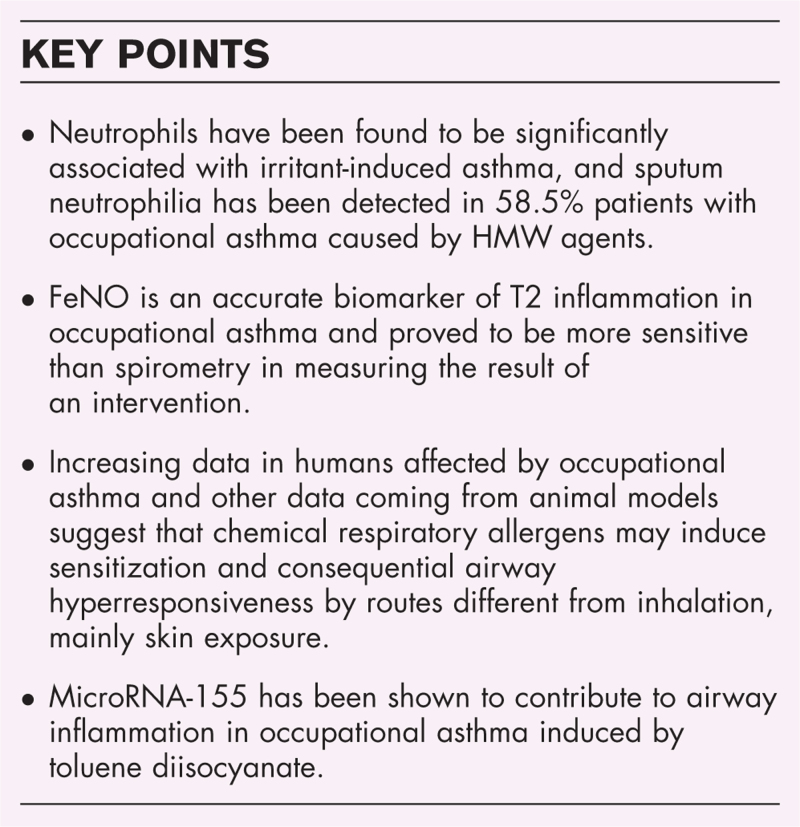
Recent findings: Studies on occupational asthma endotypes have focused on immune and inflammatory patterns associated with different occupational exposures to sensitizers or irritants.Sputum neutrophilia has been found in 58.5% patients with occupational asthma caused by high molecular weight (HMW) agents, and work-related dysphonia in patients with occupational asthma was described as associated with sputum neutrophilia too. Neutrophils have been associated also with irritant-induced asthma. The measurement of specific IgE has been confirmed as a valuable diagnostic tool in occupational asthma caused by HMW agents, on the contrary, for most low-molecular-weight agents, the presence of specific IgE has been proven in a small subset of affected workers. Fractional exhaled nitric oxide has been confirmed as a marker of type 2 (T2) inflammation in occupational asthma, mostly when induced by HMW agents (e.g. flour), and it has proved to be more sensitive than spirometry in measuring the efficacy of an intervention.MicroRNA-155 has been shown to contribute to airway inflammation in occupational asthma induced by toluene diisocyanate.
Summary: Occupational asthma is heterogeneous, thus monitoring multiple biomarkers is crucial to understand, which inflammatory responses are prevalent.
期刊介绍:
This reader-friendly, bimonthly resource provides a powerful, broad-based perspective on the most important advances from throughout the world literature. Featuring renowned guest editors and focusing exclusively on one to three topics, every issue of Current Opinion in Allergy and Clinical Immunology delivers unvarnished, expert assessments of developments from the previous year. Insightful editorials and on-the-mark invited reviews cover key subjects such as upper airway disease; mechanisms of allergy and adult asthma; paediatric asthma and development of atopy; food and drug allergies; and immunotherapy.



 京公网安备 11010802042870号
京ICP备2023020795号-1
京公网安备 11010802042870号
京ICP备2023020795号-1

 分享
分享
 求助内容:
求助内容: 应助结果提醒方式:
 扫码关注我们
