{"title":"A Green Method of Synthesizing Battery-Grade Lithium Sulfide: Hydrogen Reduction of Lithium Sulfate","authors":"Yujiang Sun, Xin Zhang, Shijie Xu, Shunjin Yang, Xinyu Wang, Xiaorou Cao, Xiao Sun, Yuzhe Zhang, Dehang Ren, Xiaohu Hu, Haoyu Yang, Qiaran Zhang, Zongjing Lu, Xuejing Zhang and Yongan Yang*, ","doi":"10.1021/acssuschemeng.3c07872","DOIUrl":null,"url":null,"abstract":"<p >Lithium sulfide (Li<sub>2</sub>S) is a critical material for two systems of next-generation advanced lithium batteries. However, its practical applications are seriously impeded by its expensive price due to its troublesome storage and problematic production. Herein we report the synthesis of Li<sub>2</sub>S by thermally reducing lithium sulfate with hydrogen. Compared with the industrial approach of carbothermal reduction, this new method using a gaseous reductant is advantageous because of emitting zero amount of carbon oxides, having no solid byproducts or precursor residuals, generating only one environmentally benign and recyclable byproduct of water, and not requiring postsynthesis purification. Those features make this method cost-effective and easy for material storage. Moreover, the actual synthesis involves many parasitic reactions, which surprisingly do not cause real troubles for producing high-purity Li<sub>2</sub>S. Furthermore, compared with the commercial Li<sub>2</sub>S, the as-synthesized Li<sub>2</sub>S demonstrates superior performance when used as the cathode material in lithium–sulfur batteries and as the precursor to make sulfide solid electrolyte Li<sub>6</sub>PS<sub>5</sub>Cl for all-solid-state lithium batteries. Therefore, this green method enables paving the way for practical sustainable applications of Li<sub>2</sub>S.</p>","PeriodicalId":25,"journal":{"name":"ACS Sustainable Chemistry & Engineering","volume":"12 7","pages":"2813–2824"},"PeriodicalIF":7.3000,"publicationDate":"2024-02-02","publicationTypes":"Journal Article","fieldsOfStudy":null,"isOpenAccess":false,"openAccessPdf":"","citationCount":"0","resultStr":null,"platform":"Semanticscholar","paperid":null,"PeriodicalName":"ACS Sustainable Chemistry & Engineering","FirstCategoryId":"92","ListUrlMain":"https://pubs.acs.org/doi/10.1021/acssuschemeng.3c07872","RegionNum":1,"RegionCategory":"化学","ArticlePicture":[],"TitleCN":null,"AbstractTextCN":null,"PMCID":null,"EPubDate":"","PubModel":"","JCR":"Q1","JCRName":"CHEMISTRY, MULTIDISCIPLINARY","Score":null,"Total":0}
引用次数: 0
Abstract
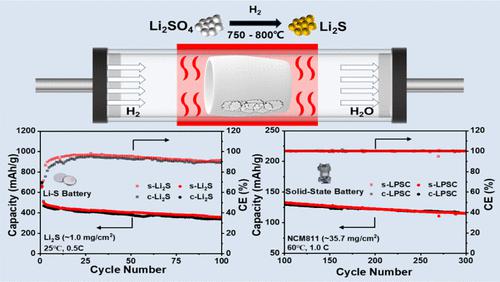
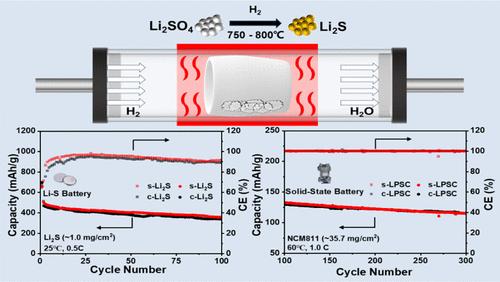
Lithium sulfide (Li2S) is a critical material for two systems of next-generation advanced lithium batteries. However, its practical applications are seriously impeded by its expensive price due to its troublesome storage and problematic production. Herein we report the synthesis of Li2S by thermally reducing lithium sulfate with hydrogen. Compared with the industrial approach of carbothermal reduction, this new method using a gaseous reductant is advantageous because of emitting zero amount of carbon oxides, having no solid byproducts or precursor residuals, generating only one environmentally benign and recyclable byproduct of water, and not requiring postsynthesis purification. Those features make this method cost-effective and easy for material storage. Moreover, the actual synthesis involves many parasitic reactions, which surprisingly do not cause real troubles for producing high-purity Li2S. Furthermore, compared with the commercial Li2S, the as-synthesized Li2S demonstrates superior performance when used as the cathode material in lithium–sulfur batteries and as the precursor to make sulfide solid electrolyte Li6PS5Cl for all-solid-state lithium batteries. Therefore, this green method enables paving the way for practical sustainable applications of Li2S.
期刊介绍:
ACS Sustainable Chemistry & Engineering is a prestigious weekly peer-reviewed scientific journal published by the American Chemical Society. Dedicated to advancing the principles of green chemistry and green engineering, it covers a wide array of research topics including green chemistry, green engineering, biomass, alternative energy, and life cycle assessment.
The journal welcomes submissions in various formats, including Letters, Articles, Features, and Perspectives (Reviews), that address the challenges of sustainability in the chemical enterprise and contribute to the advancement of sustainable practices. Join us in shaping the future of sustainable chemistry and engineering.




 京公网安备 11010802042870号
京ICP备2023020795号-1
京公网安备 11010802042870号
京ICP备2023020795号-1

 分享
分享
 求助内容:
求助内容: 应助结果提醒方式:
 扫码关注我们
