The EGR1–Artemin Axis in Keratinocytes Enhances the Innervation of Epidermal Sensory Neurons during Skin Inflammation Induced by House Dust Mite Extract from Dermatophagoides farinae
{"title":"The EGR1–Artemin Axis in Keratinocytes Enhances the Innervation of Epidermal Sensory Neurons during Skin Inflammation Induced by House Dust Mite Extract from Dermatophagoides farinae","authors":"","doi":"10.1016/j.jid.2024.01.017","DOIUrl":null,"url":null,"abstract":"<div><p>Epidermal hyperinnervation is a critical feature of pruritus during skin inflammation. However, the mechanisms underlying epidermal hyperinnervation are unclear. This study investigates the role of the transcription factor EGR1 in epidermal innervation by utilizing wild-type (<em>Egr1</em><sup><em>+/+</em></sup>) and <em>Egr1</em>-null (<em>Egr1</em><sup><em>‒/‒</em></sup>) mice topically applied <em>Dermatophagoides farinae</em> extract from dust mite. Our findings revealed that <em>Egr1</em><sup><em>‒/‒</em></sup> mice exhibited reduced scratching behaviors and decreased density of epidermal innervation compared with <em>Egr1</em><sup><em>+/+</em></sup> mice. Furthermore, we identified artemin, a neurotrophic factor, as an EGR1 target responsible for <em>Dermatophagoides farinae</em> extract–induced hyperinnervation. It has been demonstrated that <em>Dermatophagoides farinae</em> extract stimulates toll-like receptors in keratinocytes. To elucidate the cellular mechanism, we stimulated keratinocytes with Pam3CSK4, a toll-like receptor 1/2 ligand. Pam3CSK4 triggered a toll-like receptor 1/2–mediated signaling cascade involving IRAK4, IκB kinase, MAPKs, ELK1, EGR1, and artemin, leading to increased neurite outgrowth and neuronal migration. In addition, increased expression of EGR1 and artemin was observed in the skin tissues of patients with atopic dermatitis. These findings highlight the significance of the EGR1–artemin axis in keratinocytes, promoting the process of epidermal innervation and suggesting it as a potential therapeutic target for alleviating itch and pain associated with house dust mite–induced skin inflammation.</p></div>","PeriodicalId":16311,"journal":{"name":"Journal of Investigative Dermatology","volume":"144 8","pages":"Pages 1817-1828.e17"},"PeriodicalIF":5.7000,"publicationDate":"2024-08-01","publicationTypes":"Journal Article","fieldsOfStudy":null,"isOpenAccess":false,"openAccessPdf":"","citationCount":"0","resultStr":null,"platform":"Semanticscholar","paperid":null,"PeriodicalName":"Journal of Investigative Dermatology","FirstCategoryId":"3","ListUrlMain":"https://www.sciencedirect.com/science/article/pii/S0022202X24000903","RegionNum":2,"RegionCategory":"医学","ArticlePicture":[],"TitleCN":null,"AbstractTextCN":null,"PMCID":null,"EPubDate":"","PubModel":"","JCR":"Q1","JCRName":"DERMATOLOGY","Score":null,"Total":0}
引用次数: 0
Abstract
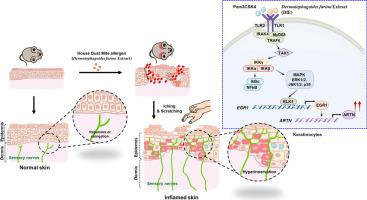
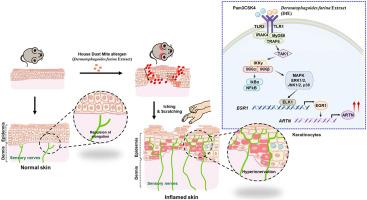
Epidermal hyperinnervation is a critical feature of pruritus during skin inflammation. However, the mechanisms underlying epidermal hyperinnervation are unclear. This study investigates the role of the transcription factor EGR1 in epidermal innervation by utilizing wild-type (Egr1+/+) and Egr1-null (Egr1‒/‒) mice topically applied Dermatophagoides farinae extract from dust mite. Our findings revealed that Egr1‒/‒ mice exhibited reduced scratching behaviors and decreased density of epidermal innervation compared with Egr1+/+ mice. Furthermore, we identified artemin, a neurotrophic factor, as an EGR1 target responsible for Dermatophagoides farinae extract–induced hyperinnervation. It has been demonstrated that Dermatophagoides farinae extract stimulates toll-like receptors in keratinocytes. To elucidate the cellular mechanism, we stimulated keratinocytes with Pam3CSK4, a toll-like receptor 1/2 ligand. Pam3CSK4 triggered a toll-like receptor 1/2–mediated signaling cascade involving IRAK4, IκB kinase, MAPKs, ELK1, EGR1, and artemin, leading to increased neurite outgrowth and neuronal migration. In addition, increased expression of EGR1 and artemin was observed in the skin tissues of patients with atopic dermatitis. These findings highlight the significance of the EGR1–artemin axis in keratinocytes, promoting the process of epidermal innervation and suggesting it as a potential therapeutic target for alleviating itch and pain associated with house dust mite–induced skin inflammation.
期刊介绍:
Journal of Investigative Dermatology (JID) publishes reports describing original research on all aspects of cutaneous biology and skin disease. Topics include biochemistry, biophysics, carcinogenesis, cell regulation, clinical research, development, embryology, epidemiology and other population-based research, extracellular matrix, genetics, immunology, melanocyte biology, microbiology, molecular and cell biology, pathology, percutaneous absorption, pharmacology, photobiology, physiology, skin structure, and wound healing



 京公网安备 11010802042870号
京ICP备2023020795号-1
京公网安备 11010802042870号
京ICP备2023020795号-1

 分享
分享
 求助内容:
求助内容: 应助结果提醒方式:
 扫码关注我们
